Zak Bagans’ The Haunted Museum Houdini Seance Room Exhibit

This past Thursday, I booked the upgraded  RIP tour package at Zak Bagans Haunted Museum in Las Vegas.

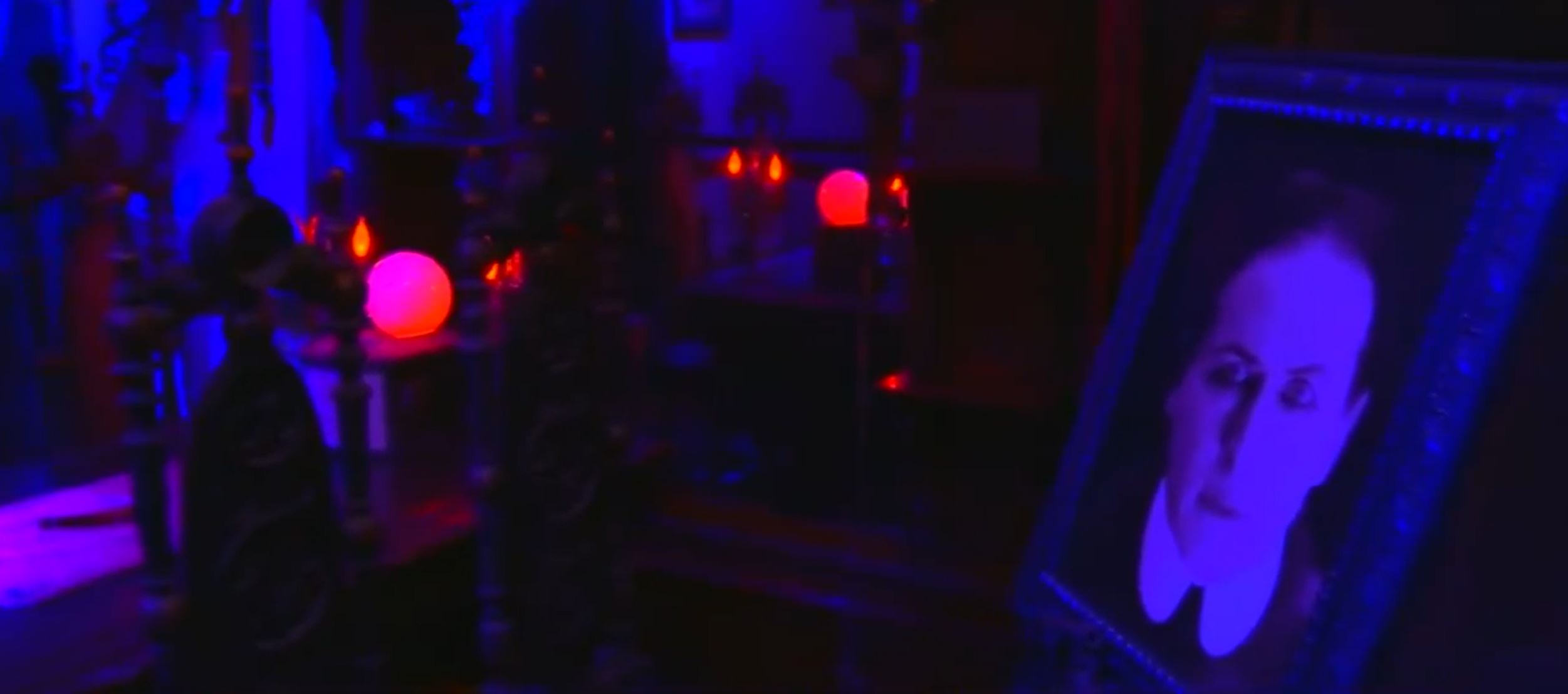
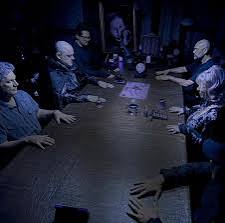
And to my surprise, the RIP All Access pass included a Houdini Seance Room Exhibit:

Who knew? Apparently back in 2022, the room included a Ouija board and was set up for seances, reflecting Houdini’s pact with his wife Bess to try and communicate from beyond.

a

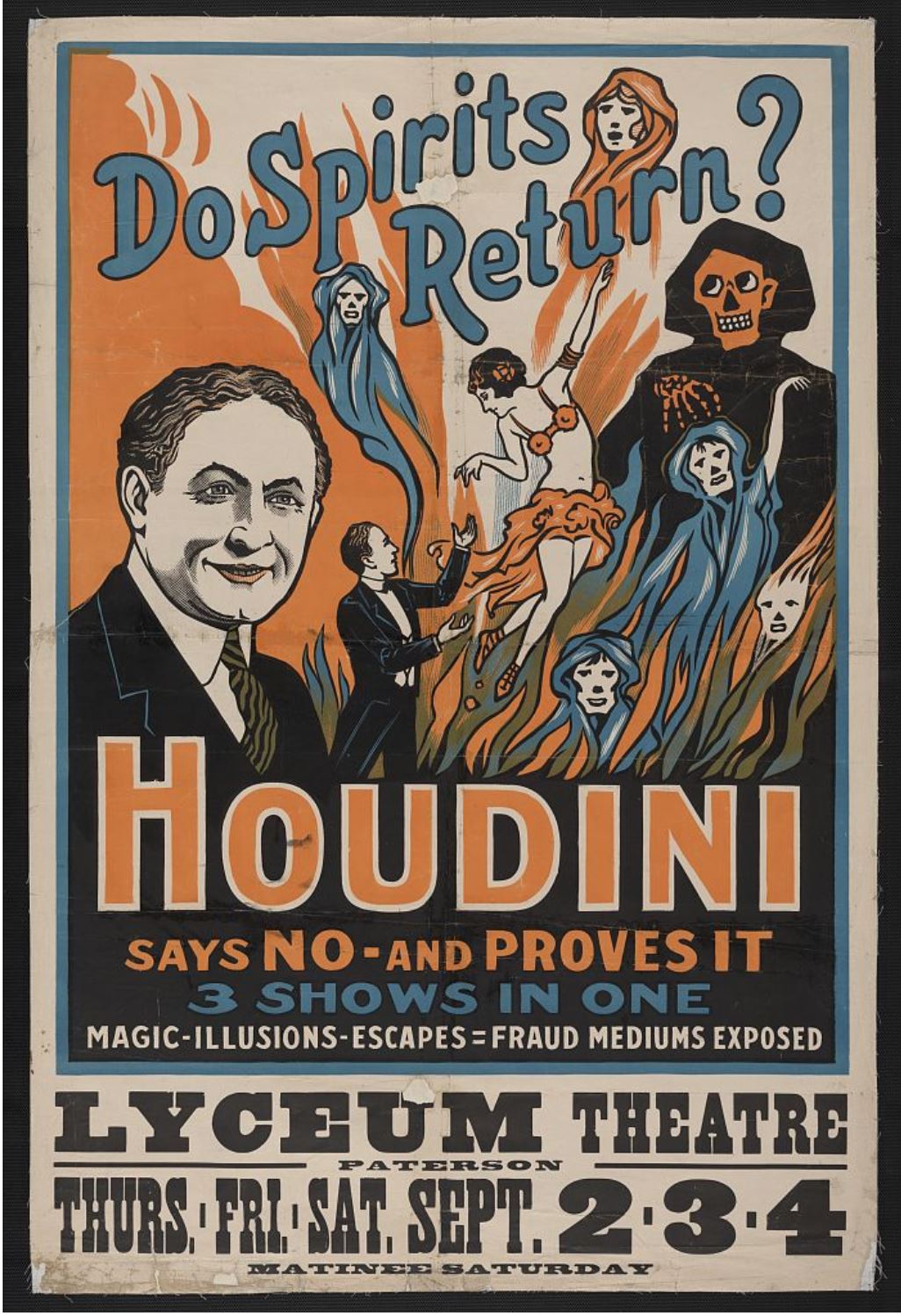
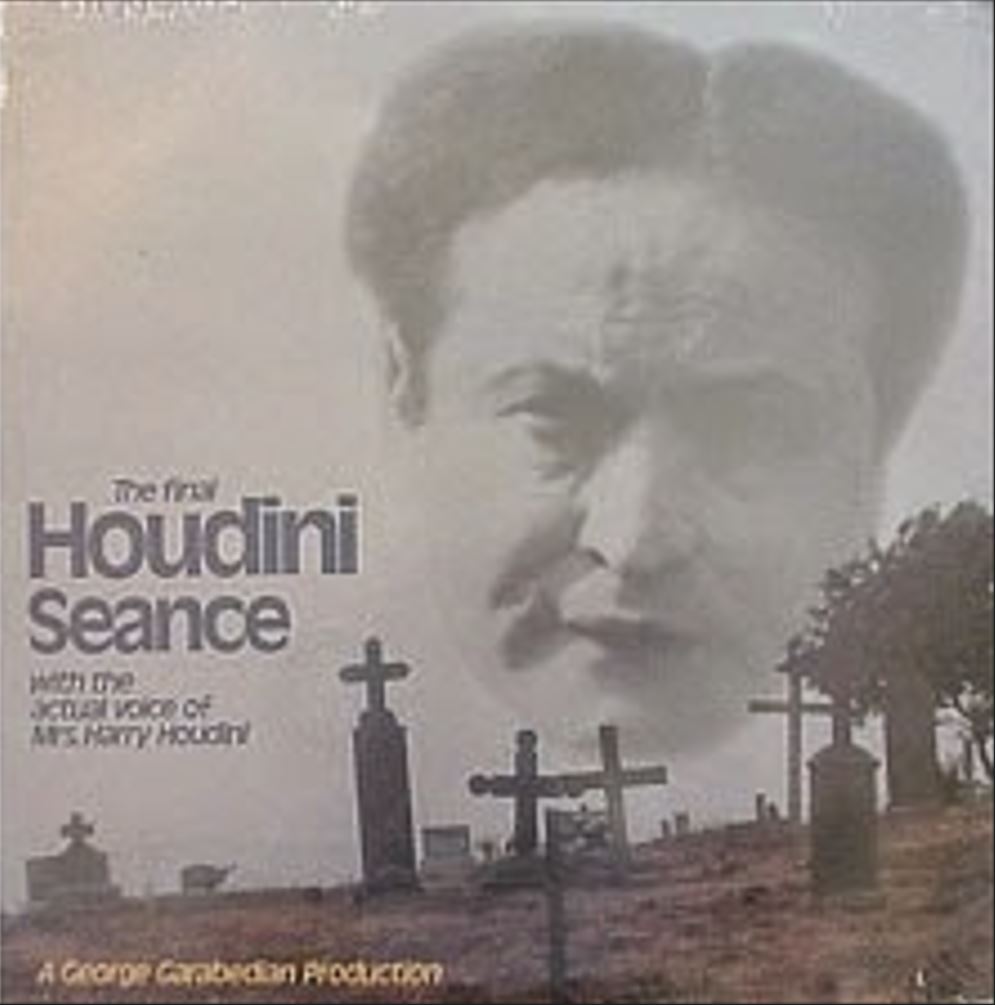
The room also included a spirit bell that guests could ring, a Do Spirits Return Poster, and an LP record of The Final Houdini Seance. Playing in the background, you heard Ed Saint’s voice from the recording of the famous Final Houdini Seance held atop the roof of the Hollywood Knickerbocker Hotel on October 31, 1936.

You might remember, Zak Bagans and the Ghost Adventures conducting a historic seance on the 100th anniversary of Houdini’s 1924 midnight visit to Winchester Mystery House:

1951 Houdini Stamp

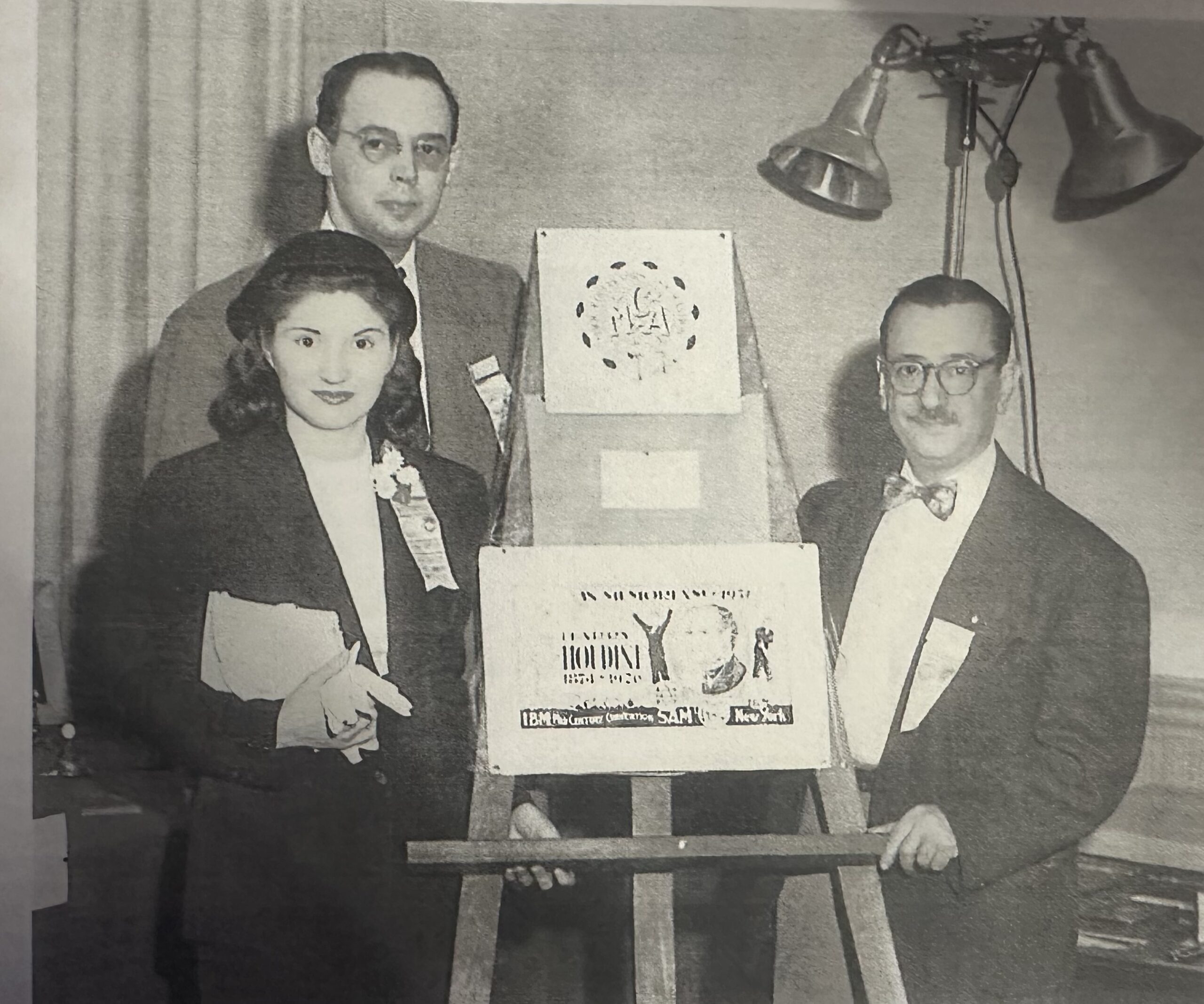
Photo credit: Irving Desfor May 27, 1951

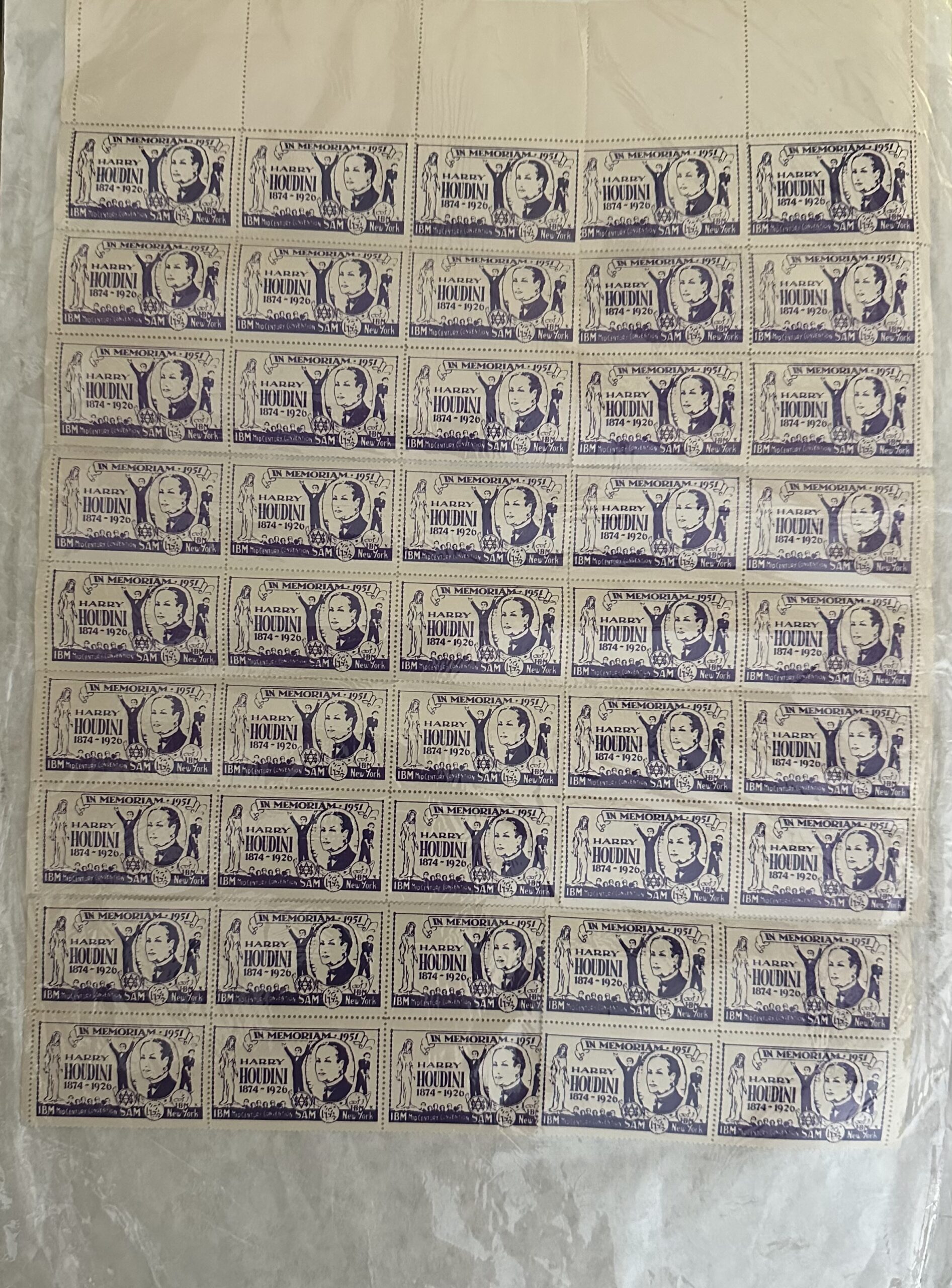
In 1951, the year of the 25th anniversary of Harry Houdini’s death, artwork for a postage stamp honoring the master showman was unveiled by the Magic Collector’s Association, at the combined IBM/SAM Convention in New York. Pictured above are Dr. Morris N. Young and wife Chesley [left] with convention committee chairman, Dr. Ben Braude [right]. Designed by magician/artist Sir Felix Korem, the stamp which incorporated portrayals of Houdini with emblems of the three organizations [I.B.M., S.A.M., M.C.A.], was never approved by U.S. Postal authorities.

[MAGIC JULY 2002]

It is printed in deep purple on gray stock, gummed, and perforated, in sheets of 50.

Below is an example from my collection:

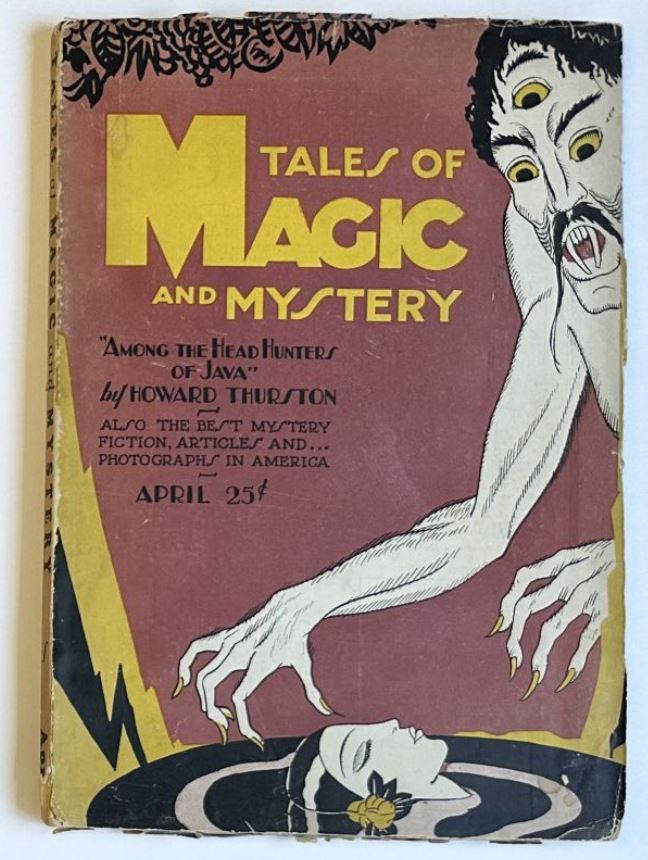
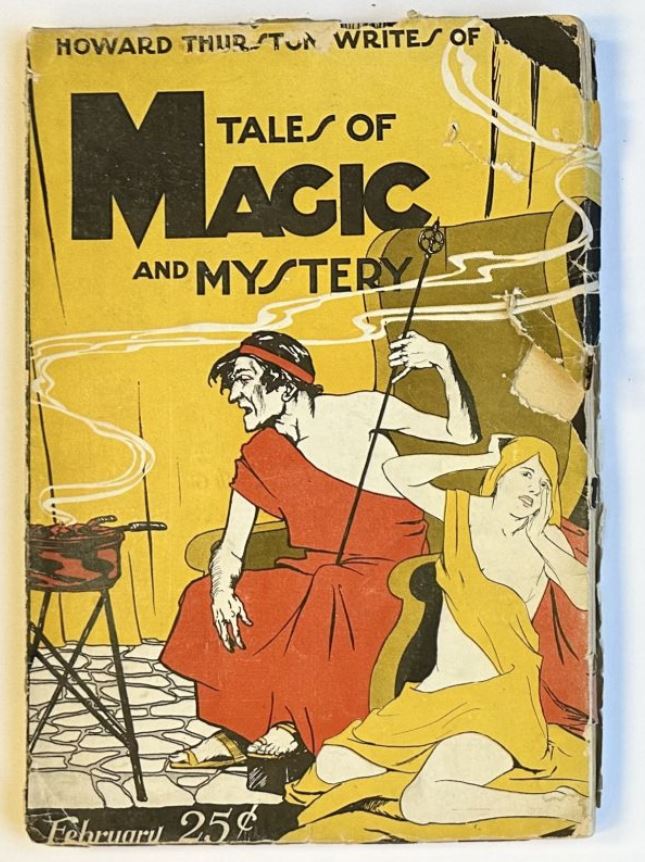
Tales of Magic and Mystery – Houdini Series (Apr 1928 issue)

Tales of Magic and Mystery was a short-lived but highly regarded pulp magazine that released five issues between December 1927 and April 1928. Each issue had an article on Houdini by Walter B. Gibson.

Today I share Apr 1928 from my collection:

Houdini’s Rendition of Mazeppa’s Ride

DURING the early years of his adventurous career, Houdini attempted many daring and unusual escapes that were prepared upon the spur of the moment. To the average person they would not seem as remarkable as some of his later feats, but it must be remembered that the unexpected is an important element in every exhibition of danger.

Houdini’s career may be roughly divided into three parts. First, his early career, in which he developed the escape act and encountered many difficulties; second, the period in which he became famous throughout the world; third, his later career in which his escapes did not play so prominent a part.

It was during the early period that he experienced many hazardous undertakings, and attempted escapes which involved unusual dangers. When he became established, he accepted difficult challenges, which were submitted to him in advance. These included some of his most sensational escapes—performances which astounded the public. In these he relied upon his vast experience, and it was only on rare occasions that he was endangered by the unforeseen.

The third period of Houdini’s life included his motion picture activities, and finally his complete show. In the movies he performed many stunts that were extremely hazardous, but which were planned out beforehand, and were not the results of challenges.

It was Houdini’s willingness to attempt any form of escape that impressed the public. The challenges were advertised and given the publicity which they deserved; but the real secret of Houdini’s extraordinary ability and versatility lay in his early experiences, dating from the days when he would enthusiastically undertake anything that was suggested to him.

There is probably no complete catalog of all of Houdini’s achievements. Some of them were recorded in newspaper clippings; of others we find notes that merely mention them. He escaped on several occasions from deep-sea diving-suits; at other times he was secured in coffins. He was sewn in leather hides, and tied up in wet packs. He was done up in bandages, laced to a cot and deluged with water, to make his escape more difficult.

In his original escape act, Houdini had made no provision for challenges; but they were suggested to him by members of the audience, most of whom imagined that everything he did on the stage was faked. This proved to be the making of Houdini. It is almost impossible to convince the hard-boiled spectator that the handcuff expert does not have his crowd of confederates or “plants” distributed through the audience. But Houdini convinced them, and he became famous.

Less than a dozen years ago, a famous boxer attended one of Houdini’s performances at a vaudeville theater. Knowing that the man was there, Houdini invited him to come on the stage and assist the committee. This brought applause from the audience.

The fighter, however, refused to accept the invitation. He branded Houdini as a faker and suggested that the members of the committee were all in his employ. Houdini replied so effectively to these statements that the entire audience joined sides with him, and he broke loose in violent protest against the boxer, who left the theater while Houdini remained triumphant and continued with his performance.

This was characteristic of Houdini—he was always ready to assert his rights, and he invariably was the winner of a verbal combat before the public.

REVERTING to Houdini’s early career, which formed the basis of his late success, we have a story which he told of a thrilling and remarkable escape under the most difficult circumstances. It illustrates his great presence of mind in an emergency, and stands but as one of his greatest adventures.

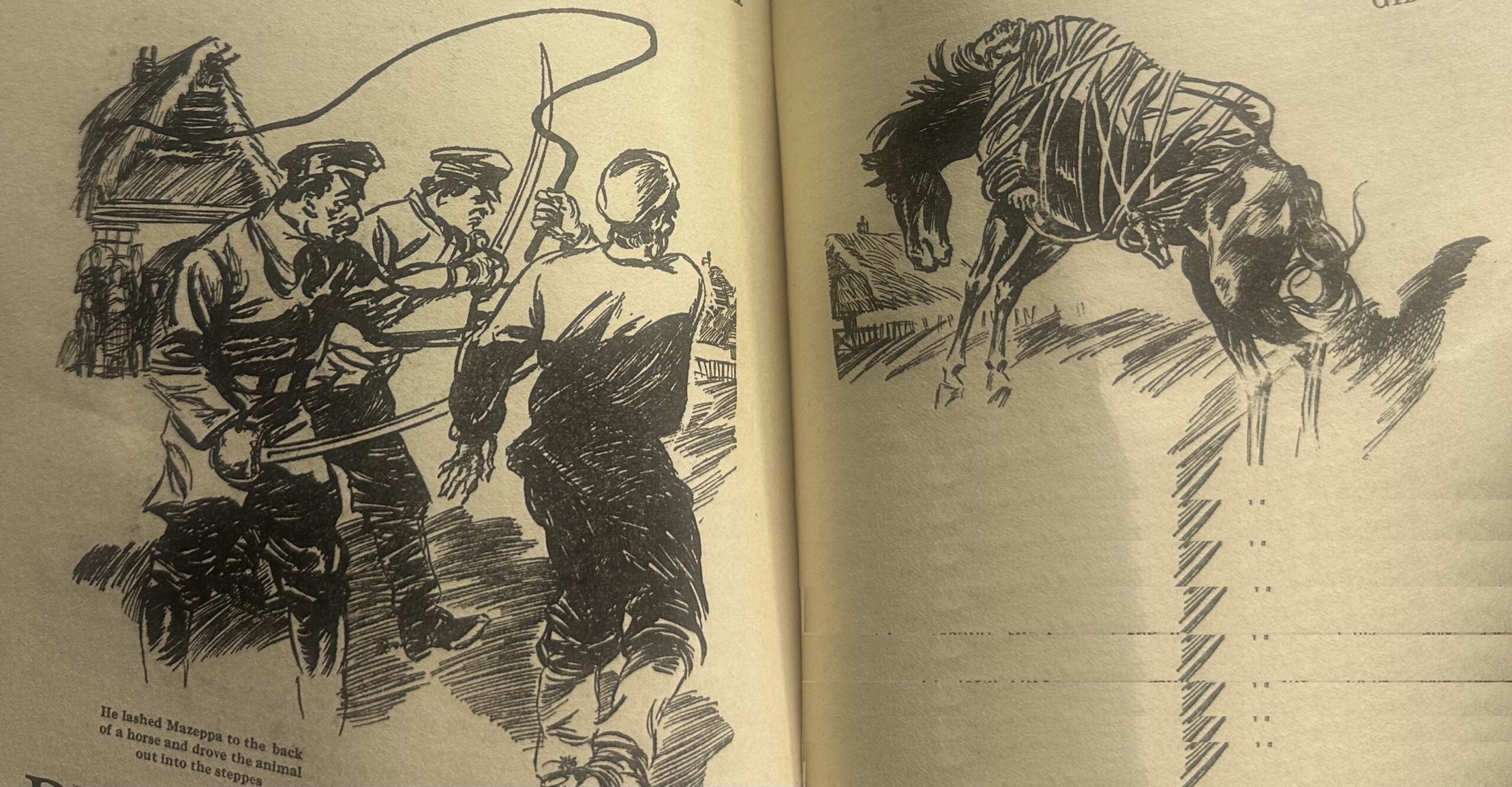
There is an old tale of a famous cossack named Ivan Mazeppa, who lived in the seventeenth century. This warrior fell into the hands of an enemy who chose a unique method of sending him to his doom. He lashed Mazeppa to the back of a horse and drove the animal out into the steppes, where it ran away, and carried its helpless rider many miles. By good fortune, Mazeppa was rescued; otherwise he would have died from exposure and starvation.

Houdini had heard of this story and he believed that it would be possible for a man to release himself under such trying conditions. It is difficult enough to obtain freedom from a tangle of ropes. On the back of a horse, however, the conditions are far worse; yet Houdini was willing to undertake the task.

The opportunity finally came, and here is his story of the event that occurred more than thirty years ago:

“I was in Novia Scotia,” he related, “in the year 1896. I was traveling with a man named Marco, of Hartford, Connecticut. The old subject of Mazeppa’s ride on the horse was brought up, and I offered to try it, stating that I could release myself while bound to the back of a horse. I stipulated that the horse could be released and run free while I was lashed to it.

“A horse was to be provided and naturally we supposed that it would be a tame one—a broken horse that could be controlled by the rider.

“The stableman made an error—so he asserted afterward—although there is the possibility that he wished to make my task far more difficult than anticipated. Whatever the case may have been, I only know that he gave me a young, fiery steed, instead of the tame horse. It was fairly quiet while I was being tied, but as soon as it was released, with me on its back, it started to run away.

“I was in a terrible predicament. There was no telling where the horse would take me. If I succeeded in partly releasing myself, I would probably have been thrown to the ground and dragged to my death.

“Fortunately I was securely bound, and in that position, I was temporarily safe, but I knew that a prolonged ride upon the back of the wild horse would be a most dangerous experience. There was no one to rescue me, and I was anxious to extricate myself from my unfortunate position.

“While the horse dashed madly along a road, I carefully worked to free one hand. I was successful, and still retained my secure position, with my body held firmly by the ropes. Then, with my free hand, I managed to obtain one of the loose ends of the rope.

“The horse began to slow down, and I beat him furiously with end of the rope, so that he started on again. Mile after mile I played the same game, driving the horse to his limit, and never letting him pause for breath. This continued until the horse had run nearly fifteen miles, when he seemed to be completely exhausted, and could scarcely respond to my lashings. Then I began to work on the ropes, and gradually I released myself, while the horse offered no further trouble.

“It took me some time to accomplish this, but when I was free, the horse was as pleased as I was. It was a wild and dangerous ride, but it ended safely, and when I returned with the horse—now completely subdued—the people were amazed to see that I had succeeded. They had virtually given me up for lost.”

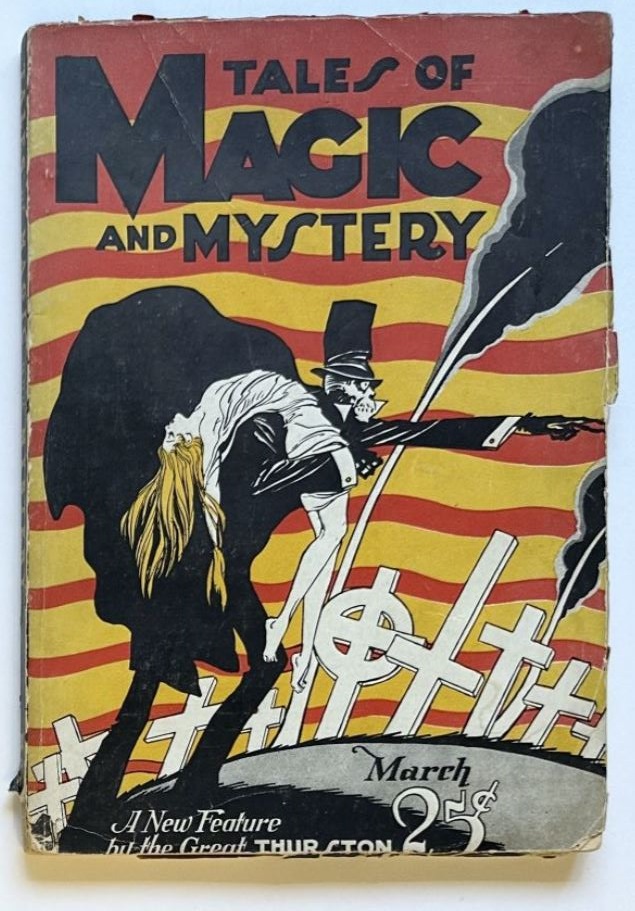
Tales of Magic and Mystery – Houdini Series (Mar 1928 issue)

Tales of Magic and Mystery was a short-lived but highly regarded pulp magazine that released five issues between December 1927 and April 1928. Each issue had an article on Houdini by Walter B. Gibson.

Today I share Mar 1928 from my collection:

Further Famous Escapes of Harry Houdini

IN his travels and adventures in many countries, Houdini always studied the methods of imprisonment, restraint and torture practiced in those lands. He frequently exhibited his skill in escaping from local prisons, under tests imposed by the authorities.

When in Russia in 1903, which then was under the Czarist regime, Houdini met with some of his most difficult experiences. The prison masters of that country were pitiless in their methods, and when Houdini offered to escape from their restraints, they accepted the challenge and did all in their power to prevent his success.

In Moscow, he was imprisoned in the carette, or transportation cell, a traveling prison that was considered impregnable. No windows were in the van. The only mode of entrance was through a solid door, which was heavily padlocked.

The secret police of Russia had charge of this contrivance. They searched Houdini thoroughly, and made him undergo a rigorous examination. Then they imprisoned him in the transportation cell; but in twenty minutes he had effected his escape.

This severe test took place before the chief of the secret police, a man named Lebadeff, and it was stated to be the only occasion on which any prisoner had won his freedom from the traveling cell. This achievement made Houdini immensely popular in Russia and he remained there for four months.

Twenty years ago Houdini devised an escape from the Spanish Maiden, a fearsome relic of the Inquisition. This torture device was made of iron and had sharp spikes on the inside of the front cover, which closed like a mummy case. Persons sentenced to death were executed by being placed in the Iron Maiden; then the door was closed upon them and the spikes pierced the body of the unfortunate victim.

The Spanish Maiden devised by Houdini was arranged so that the spikes, while not injuring the performer, surrounded him from all angles, and were a source of danger that seemingly made escape impossible. Yet his ingenuity solved a way of eluding the embrace of the medieval monster.

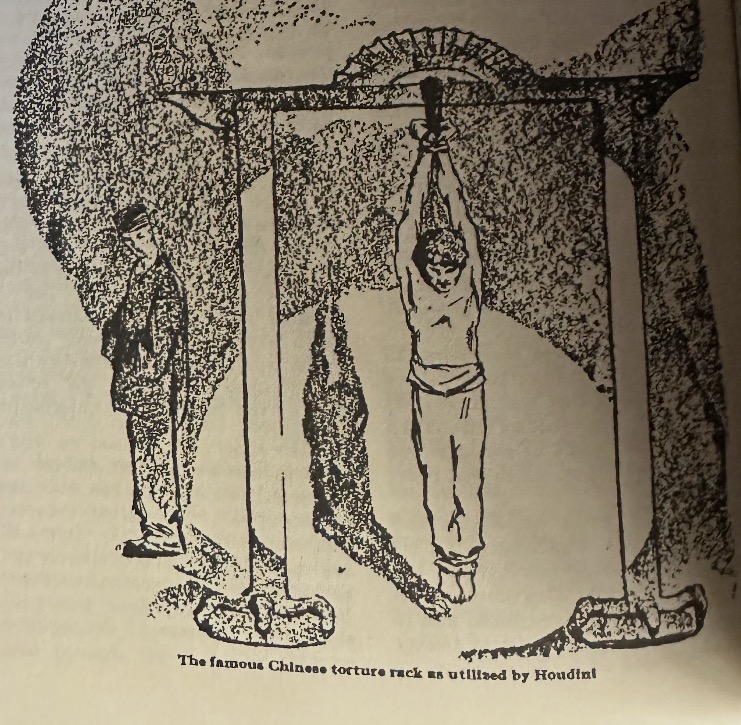
A few years before his death Houdini produced a new and sensational escape which was based upon a Chinese torture rack. Two upright posts with a cross-bar constituted the apparatus. The prisoner was bound by his hands and suspended from the cross-bar, to hang there helpless, in agony.

When he presented this upon the stage. Houdini first showed motion pictures portraying him in the toils of the Chinese, who bound him to the torture rack. Then the screen was raised, the spot-light was thrown on the stage, and there was Houdini, bound to the rack itself, ready for the escape.

He did this in full view of the audience—as was the case with his strait-jacket escape—and the spectators were able to see for themselves how the wizard of escape could use his powerful strength and agility to good advantage.

Swinging his body back, forth, and sideways, Houdini managed to escape one of the upright posts with his feet, and thus he climbed the post and drew his legs to the upright bar. Working with his teeth upon the knots, he gradually released his bonds, and finally broke through to freedom.

It was a sensational and spectacular escape, and clearly revealed the strenuous efforts that were necessary to Houdini’s work. More than once this man was injured during his performances, for he was heavily built, and was often in danger of breaking a wrist or an ankle.

ONE of Houdini’s trying experiences occurred, not in a foreign country, but in the United States, when he was accepting a customary challenge.

“It was in Philadelphia,” said Houdini, “that my powers were taxed to the utmost. The Wolfe Lock Company had made a special lock consisting of two padlocks fastening a shackle to either hand. These were firmly fastened to a cross-bar to keep my hands apart. The key-holes were on top, and the complete shackles weighed more than twenty pounds.

“I went into the cabinet and started to work on the difficult contrivance. I knew that the escape would not be easy, and I was studying the key-holes when an unforeseen accident occurred.

“A stage-hand, up above, kicked down a shower of dirt which fell over the shackles and filled the key-holes, clogging them completely. When I tried to work on the locks, I found it impossible. Finally I was forced to lie down on my back and put my hands up over my head to bring the key-holes downward.

“It was an awkward position. I was supporting the weight of the heavy shackles during the entire operation, but I finally managed to get the dirt from the key-holes and open the locks.”

It was typical of Houdini to go through with a challenge once he had accepted it. This was proven when he was in England, and was firmly shackled on a London stage. He struggled time and again with the device that was clamped to him, and refused to give up the attempt. He was forced to extract a knife from his vest pocket, and with it cut his coat which he had turned inside out above his head, because the coat interfered with the escape and the challenger refused to unlock him long enough to remove the garment. He did this in view of the audience, then he returned to his cabinet and kept on working. He finally succeeded after a seventy minute struggle.

IN preceding articles of this series, mention has been made of Houdini’s European tour, during which he accomplished some of his most sensational escapes. His dives from high bridges, his controversy with the German police, and his miraculous escape from death before an onrushing train were all episodes in that adventurous tour. But there was one more event of that period which stands out as a thrilling escape from death. It afforded the escape wizard a few seconds of great danger from which he escaped through a freak of chance.

While in Europe, he traveled through many districts with the Circus-Althouse, and lost no opportunity to attempt difficult releases. Much of his time was spent in Germany, but the tour also called for a visit to Holland. There he was called upon to amaze the stolid natives, and in looking for a good place from which to effect an escape, he decided upon employing a typical wind-mill.

Tall wind-mills are plentiful in Holland , and they tower high in the air, with their broad fans whirling in the breeze. Here indeed was a spectacular form of escape. The mythical Don Quixote had attacked a wind-mill; the actual Houdini set out to baffle one.

A suitable tower was chosen for the escape, and it afforded a good position from which the crowd could see everything that transpired. Not only did Houdini face the task of getting free, but he must scramble down to safety after the release was affected. The wind also figured in the problem, and altogether it was a most fascinating situation.

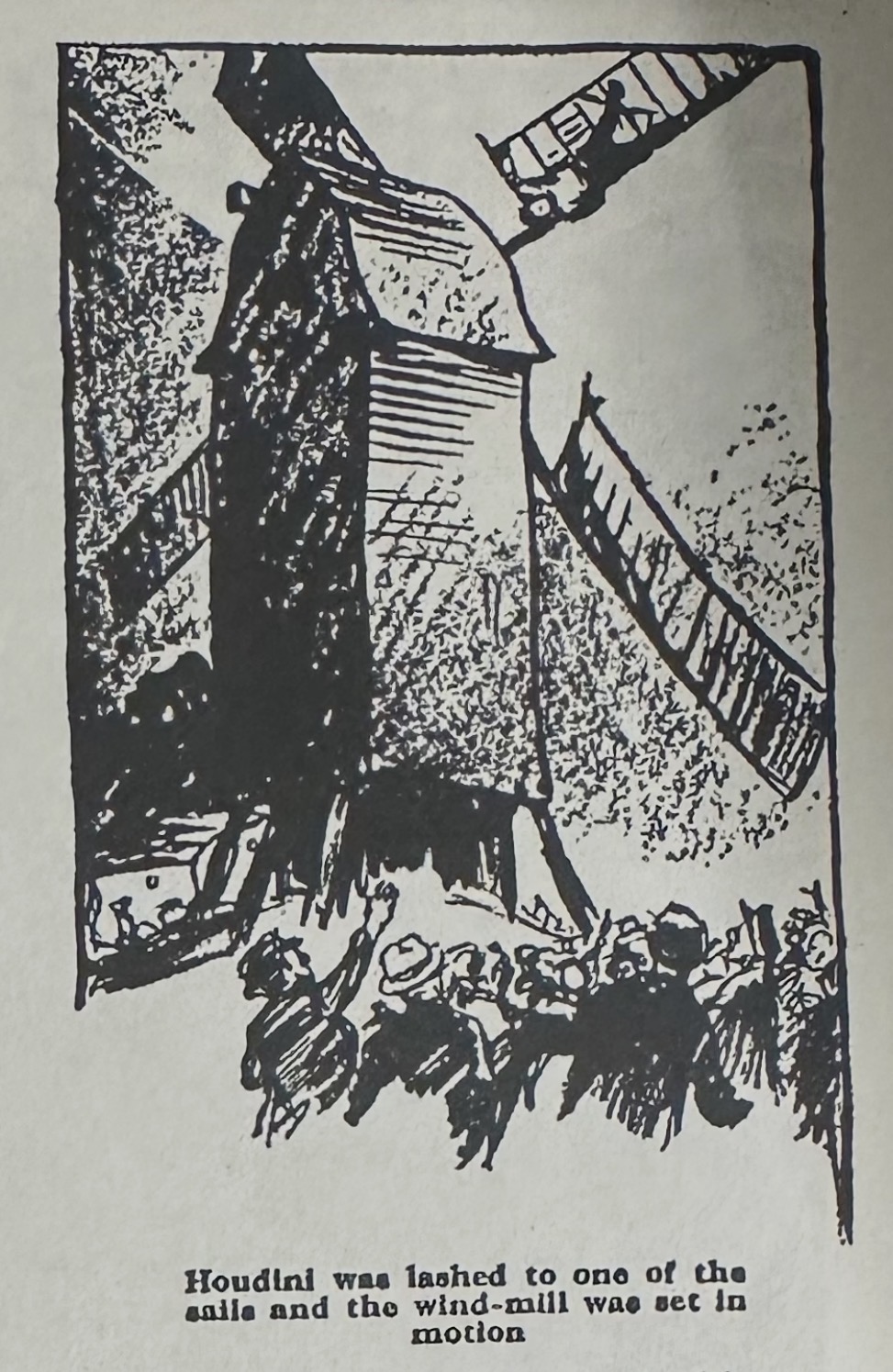
“The escape was arranged,” said Houdini. “I allowed myself to be firmly lashed to the sails of the wind-mill, and I fully planned to make my escape from it while it was in motion. I was bound there, and began the struggle.

“It was not until I was on the revolving wind-mill that a certain difficulty was realized. We had not given the matter of my weight any important consideration. Being of heavy-build, my added weight brought about unexpected consequences. The sails leaned to one side, and the exertion which I made was too much for it. The wind-mill was unable to stand the strain. Before I had really begun to release myself, it broke and toppled to the ground.”

A fall of fifty or sixty feet is no small matter under ordinary circumstances. Free, a person has some small chance of escaping without serious injuries. But bound to an object that threatens to crush one beneath it makes the situation desperate. The witnesses of the catastrophe looked on in horror, for Houdini’s death seemed a certainty. Yet in his difficult circumstances lay his salvation, which occurred in a most unexpected manner.

“I realized my predicament,” related Houdini, “while I was falling with the wind-mill, but I was powerless and in no position to help myself. It was a most dangerous situation, but I was saved by a fortunate occurrence—something quite as unexpected as the breaking of the wind-mill.

“During its fall, the wind-mill turned over! It fell in such a way that I was on top when the crash came. Instead of being underneath the wreckage, I was in the best possible position, and my fall was broken!”

All that remained was to remove Houdini, unhurt, from the shattered wind-mill. The one possible chance that could have saved him had taken place, and he escaped without serious injury.

This adventure was unique in Houdini’s career in that he had no possible chance to save himself. In the milk-churn, on the railroad track, and in his other predicaments he had at least some chance for quick action. But falling through the air, to what seemed certain doom, gave him no opportunity to use his own effects in the hope of safety.


Tied firmly to a wild horse, immediate danger of being dragged to his death, Houdini won his way to safety by an ingenious plan. Read this unusual story of his early career in next month’s issues of TALES OF MAGIC AND MYSTERY.

Tales of Magic and Mystery – Houdini Series (Feb 1928 issue)

Tales of Magic and Mystery was a short-lived but highly regarded pulp magazine that released five issues between December 1927 and April 1928. Each issue had an article on Houdini by Walter B. Gibson.

Today I share  Feb 1928 from my collection:
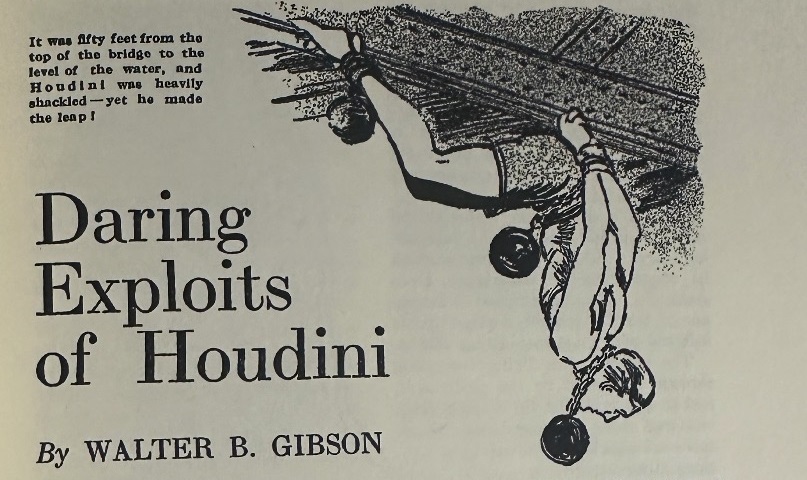
Daring Exploits of Houdini

Under water and in the air, Houdini performed feats of daring that were quite as spectacular as his exhibitions on the stage. His versatility amazed the public; yet his ability to perform these exploits can be traced directly to his early training.

At the age of twelve, he swam across the East River, and his interest in outdoor exercises produced in him a powerful physical development. In the year 1910, he achieved the distinction of being the first man in Australia to fly in an airplane.

This flight stands as evidence of Houdini’s early interest in aviation. When he appeared in motion pictures a few years later he performed some remarkable stunts while in the air, and stated emphatically that all his feats were genuine. The doubles and fake photography used in so many pictures were tabooed by Houdini, but unfortunately the average persons who witness motion pictures are unable to distinguish between the real and the imitation.

In “The Grim Game”, Houdini had a narrow escape from death while doing a stunt in the air that had an unexpected conclusion. He related the story as follows:

“During the screening of this picture, I thought at one time that my end had come. I was three thousand feet up in the airplane, circling over another machine.  The plan was for me to drop from my plane into the cockpit of the other by means of a rope. I was dangling from the rope-end, ready for the leap.

“Suddenly a strong wind turned the lower plan upwards. The two machines crashed together, nearly amputating my limbs, the propellers locked in a deadly embrace, and we were spun around and around.

“But by a miracle the planes were righted into a half-glide, and though they were considerably smashed by their impact. I managed to escape unhurt.”

When the picture appeared, the story had been rearranged so as to include the action of the crashing and falling plans, which reached the ground in a shattered condition. This stands on record as one of the most spectacular scenes of motion picture photography ever produced.

Houdini’s ease in the water served him well in his escapes. An interesting story is told of an experience which he encountered on his return from Australia. The ship stopped at Suava, one of the Fiji Islands, a place that is infested with huge man-eating sharks.

The natives were diving for coins, thrown overboard by the passengers, and it was said that their black skins rendered them immune from the attacks of sharks. One of these divers won the applause of the ship’s passengers by coming up with coin in his mouth, apparently having caught the money in that manner.

In the discussion that followed, Houdini stated that the man caught the coins in his hand and placed them in his mouth. Other persons doubted this statement, so someone suggested that the diver make the attempt with his hands tied behind his back.

At the same time, Houdini agreed to try the feat himself, and it was stipulated that he should be handcuffed.

Everything was set for the test, but before the dive was made the captain of the steamer stepped forward and cautioned Houdini not to attempt it, due to the presence of the sharks, which were a great danger. Nevertheless, Houdini persisted, and his hands were locked behind him. The native diver preferred a rope to the cuffs, because of their additional weight.

The coins were tossed into the sea, and quick as a flash both divers were after them. Down into the depths they went, while the passengers waited breathlessly. A minute passed before the native dive made his reappearance,. He came up, gasping for air—without his coin.

Perhaps twenty seconds later Houdini reappeared on the surface, just as the spectators were beginning to express doubts about his safety. His hands were firmly locked; but in his mouth were both of the coins!

He was drawn on board the ship a few seconds before the fins of the ever watchful sharks were sighted, making their rapid approach. Houdini presented the money he won by wager to the native diver he had defeated.

In an interview Houdini later explained his feat.

“In a tank,” he said, “you can pick up a coin with your hands tied behind your back, because you can use your mouth, teeth, and tongue to manipulate the coin. But when you are in the ocean, it is next to impossible to catch a coin and bring it up in your mouth.

“You ask me how I did it? I will let you in the secret—I didn’t do it at all! When I was under water, I released one of my hands, which gave me the use of both of them; I caught my coin and observed meanwhile that the black was unable to get his. I swam after him until he had given up trying for it, and we had gone down to such a depth that my ears rang, and my head was splitting, and all I could see was the white, shining piece of money.

“Eventually I grabbed the coin, put in my mouth, and propelled myself violently upward. As I rose toward the surface my hands were still free, so I turned around and came up feet first. This allowed me to get my hands behind and into the cuffs, which naturally gave the impression of having been locked during the entire feat. Which is why I gave the Fiji Islander the entire amount at stake.

“I would not care to do it again; it was not for the money. I merely wanted to show that I was as good a swimmer as some of those Fiji Islanders.”

UNQUESTIONABLY the underwater feats were thrilling in all who witnessed them. That was probably why he devised his famous water torture cell, in which he was imprisoned upside down in a tank of water with a glass front. The audience could see him there before the cabinet was lowered over him and the escape which he made in a few minutes was most spectacular.

But before he produced this master escape, Houdini customarily gave outdoor exhibitions. Sometimes he was lowered into deep water while handcuffed and imprisoned in a box from which he made his escape; on other occasions he leaped from a bridge, while heavily manacled.

He did this in Berlin, Germany, from the Fredrichstrasse Bridge, on the fifth of September, 1908. At Breman, he plunged into the Weser, which was covered with a thin layer of ice, through which he broke, and then released himself. On the seventh of December, 1908, he dived, manacled , into the Mersey River at Liverpool, and eight days later he took a similar plunge into the Egbaston River at Birmingham. On the nineteenth of April, the year following, he dived from the roof of the Morgue in Paris, into the Seine, and again effected his release. On the eighteenth of February, 1910, he performed a similar test in Melbourne, Australia, when he dived headfirst from Queen’s Bridge into the Yarra River.

Each of these exhibitions was filled with danger; but the greatest test of Houdini’s iron nerve was in Portland, Maine, where he encountered unexpected difficulties. In one of his last interviews Houdini recounted the circumstances surrounding that eventful achievement.

“While in Portland,” said he, ‘I advertised that I would dive, handcuffed, from a bridge. I went out to look the situation over, and found that the water was deep enough; and as the bridge was not very high, I decided that I could attempt the plunge from the superstructure, which was much higher, making the distance to the water as great as on some of my other famous plunges. So I advertised the feat that way, and stated the time at which it would take place.”

The water in which Houdini intended to make his escape was an inlet of the ocean. Possibly he had forgotten this; at any rate, he was due for a great surprise.

“When I went out to make the jump,” he continued, “a large crowd was there; but the tide was low. I had made my calculations while the water was at high tide, and I was in a predicament. I had a much longer jump to make, and much less water to do it in.”

Houdini did not state the actual measurements; but the tides in Portland Harbor are by no means meagre. From the description, the leap at high tide from the superstructure was at least twenty-five feet. The tide on the coast of Maine is very great, exceeding thirty feet in some localities, and the leap which then confronted Houdini must have been very nearly fifty feet—to which was added the grave danger of shallow water. A leap while manacled carries the diver deep beneath the surface, and the bottom of the channel loomed as a further hazard.

A man of less daring would either have abandoned the attempt or would have jumped from the lower level of the bridge; but not Houdini! He had advertised that the plunge would be taken from the superstructure, and the crowd was there to see it. So up he went, on the superstructure, and gazed down at the water far beneath him, ready to take what might prove to be a fatal plunge.

“The time had come,” he said, ‘And so I risked everything and made the leap. It was a most dangerous thing to do, but I was successful, and the crowd was more than satisfied .

‘Nevertheless,” he added quietly, “I was glad when it was over!”

Just how dangerous the under water escape was is proven by the disasters which befell those imitators who sought to emulate Houdini. Two daring performers were rescued when their plans went wrong—one by life guards at Atlantic City; another from a river in which he lay unconscious. A third performer,, Ricardo by name, jumped handcuffed from the Luippold Bridge, in Landshut, Bavaria, on the fourteenth of April, 1909, and was drowned. It is probable that many others have lost their lives in similar attempts. Obviously the exploits of escape artists are only for men of stout heart and supple strength.

Further adventures of Houdini will be related in the March issue. His amazing escape from death while lashed to a falling wind-mill bordered upon the miraculous. Do not miss this thrilling event in the life of the great escape wizard.