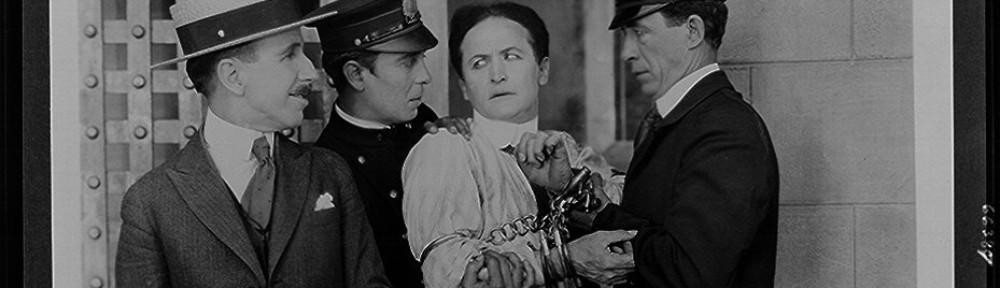
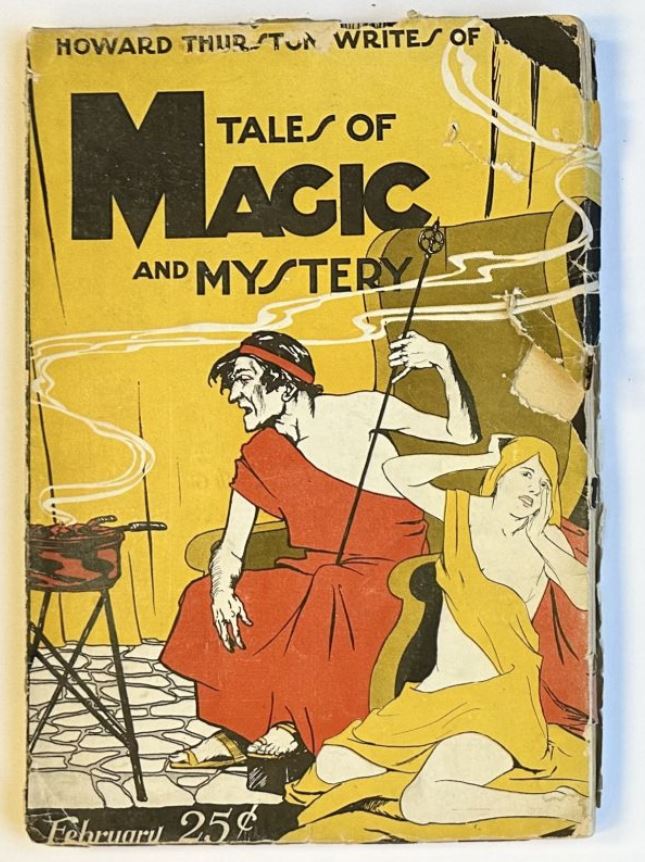
Tales of Magic and Mystery was a short-lived but highly regarded pulp magazine that released five issues between December 1927 and April 1928. Each issue had an article on Houdini by Walter B. Gibson.
- Dec 1927 – Houdini
- Jan 1928 – Houdini in Europe
- Feb 1928 – Daring Exploits of Houdini
- Mar 1928 – Further Famous Escapes of Harry Houdini
- Apr 1928 – Houdini’s Rendition of Mazeppa’s Ride
Today I share Feb 1928 from my collection:
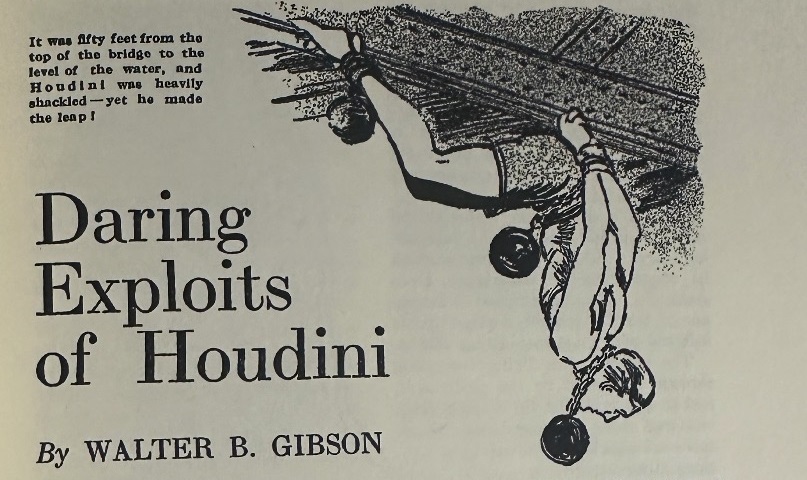
Daring Exploits of Houdini
Under water and in the air, Houdini performed feats of daring that were quite as spectacular as his exhibitions on the stage. His versatility amazed the public; yet his ability to perform these exploits can be traced directly to his early training.
At the age of twelve, he swam across the East River, and his interest in outdoor exercises produced in him a powerful physical development. In the year 1910, he achieved the distinction of being the first man in Australia to fly in an airplane.
This flight stands as evidence of Houdini’s early interest in aviation. When he appeared in motion pictures a few years later he performed some remarkable stunts while in the air, and stated emphatically that all his feats were genuine. The doubles and fake photography used in so many pictures were tabooed by Houdini, but unfortunately the average persons who witness motion pictures are unable to distinguish between the real and the imitation.
In “The Grim Game”, Houdini had a narrow escape from death while doing a stunt in the air that had an unexpected conclusion. He related the story as follows:
“During the screening of this picture, I thought at one time that my end had come. I was three thousand feet up in the airplane, circling over another machine. The plan was for me to drop from my plane into the cockpit of the other by means of a rope. I was dangling from the rope-end, ready for the leap.
“Suddenly a strong wind turned the lower plan upwards. The two machines crashed together, nearly amputating my limbs, the propellers locked in a deadly embrace, and we were spun around and around.
“But by a miracle the planes were righted into a half-glide, and though they were considerably smashed by their impact. I managed to escape unhurt.”
When the picture appeared, the story had been rearranged so as to include the action of the crashing and falling plans, which reached the ground in a shattered condition. This stands on record as one of the most spectacular scenes of motion picture photography ever produced.
Houdini’s ease in the water served him well in his escapes. An interesting story is told of an experience which he encountered on his return from Australia. The ship stopped at Suava, one of the Fiji Islands, a place that is infested with huge man-eating sharks.
The natives were diving for coins, thrown overboard by the passengers, and it was said that their black skins rendered them immune from the attacks of sharks. One of these divers won the applause of the ship’s passengers by coming up with coin in his mouth, apparently having caught the money in that manner.
In the discussion that followed, Houdini stated that the man caught the coins in his hand and placed them in his mouth. Other persons doubted this statement, so someone suggested that the diver make the attempt with his hands tied behind his back.
At the same time, Houdini agreed to try the feat himself, and it was stipulated that he should be handcuffed.
Everything was set for the test, but before the dive was made the captain of the steamer stepped forward and cautioned Houdini not to attempt it, due to the presence of the sharks, which were a great danger. Nevertheless, Houdini persisted, and his hands were locked behind him. The native diver preferred a rope to the cuffs, because of their additional weight.
The coins were tossed into the sea, and quick as a flash both divers were after them. Down into the depths they went, while the passengers waited breathlessly. A minute passed before the native dive made his reappearance,. He came up, gasping for air—without his coin.
Perhaps twenty seconds later Houdini reappeared on the surface, just as the spectators were beginning to express doubts about his safety. His hands were firmly locked; but in his mouth were both of the coins!
He was drawn on board the ship a few seconds before the fins of the ever watchful sharks were sighted, making their rapid approach. Houdini presented the money he won by wager to the native diver he had defeated.
In an interview Houdini later explained his feat.
“In a tank,” he said, “you can pick up a coin with your hands tied behind your back, because you can use your mouth, teeth, and tongue to manipulate the coin. But when you are in the ocean, it is next to impossible to catch a coin and bring it up in your mouth.
“You ask me how I did it? I will let you in the secret—I didn’t do it at all! When I was under water, I released one of my hands, which gave me the use of both of them; I caught my coin and observed meanwhile that the black was unable to get his. I swam after him until he had given up trying for it, and we had gone down to such a depth that my ears rang, and my head was splitting, and all I could see was the white, shining piece of money.
“Eventually I grabbed the coin, put in my mouth, and propelled myself violently upward. As I rose toward the surface my hands were still free, so I turned around and came up feet first. This allowed me to get my hands behind and into the cuffs, which naturally gave the impression of having been locked during the entire feat. Which is why I gave the Fiji Islander the entire amount at stake.
“I would not care to do it again; it was not for the money. I merely wanted to show that I was as good a swimmer as some of those Fiji Islanders.”
UNQUESTIONABLY the underwater feats were thrilling in all who witnessed them. That was probably why he devised his famous water torture cell, in which he was imprisoned upside down in a tank of water with a glass front. The audience could see him there before the cabinet was lowered over him and the escape which he made in a few minutes was most spectacular.
But before he produced this master escape, Houdini customarily gave outdoor exhibitions. Sometimes he was lowered into deep water while handcuffed and imprisoned in a box from which he made his escape; on other occasions he leaped from a bridge, while heavily manacled.
He did this in Berlin, Germany, from the Fredrichstrasse Bridge, on the fifth of September, 1908. At Breman, he plunged into the Weser, which was covered with a thin layer of ice, through which he broke, and then released himself. On the seventh of December, 1908, he dived, manacled , into the Mersey River at Liverpool, and eight days later he took a similar plunge into the Egbaston River at Birmingham. On the nineteenth of April, the year following, he dived from the roof of the Morgue in Paris, into the Seine, and again effected his release. On the eighteenth of February, 1910, he performed a similar test in Melbourne, Australia, when he dived headfirst from Queen’s Bridge into the Yarra River.
Each of these exhibitions was filled with danger; but the greatest test of Houdini’s iron nerve was in Portland, Maine, where he encountered unexpected difficulties. In one of his last interviews Houdini recounted the circumstances surrounding that eventful achievement.
“While in Portland,” said he, ‘I advertised that I would dive, handcuffed, from a bridge. I went out to look the situation over, and found that the water was deep enough; and as the bridge was not very high, I decided that I could attempt the plunge from the superstructure, which was much higher, making the distance to the water as great as on some of my other famous plunges. So I advertised the feat that way, and stated the time at which it would take place.”
The water in which Houdini intended to make his escape was an inlet of the ocean. Possibly he had forgotten this; at any rate, he was due for a great surprise.
“When I went out to make the jump,” he continued, “a large crowd was there; but the tide was low. I had made my calculations while the water was at high tide, and I was in a predicament. I had a much longer jump to make, and much less water to do it in.”
Houdini did not state the actual measurements; but the tides in Portland Harbor are by no means meagre. From the description, the leap at high tide from the superstructure was at least twenty-five feet. The tide on the coast of Maine is very great, exceeding thirty feet in some localities, and the leap which then confronted Houdini must have been very nearly fifty feet—to which was added the grave danger of shallow water. A leap while manacled carries the diver deep beneath the surface, and the bottom of the channel loomed as a further hazard.
A man of less daring would either have abandoned the attempt or would have jumped from the lower level of the bridge; but not Houdini! He had advertised that the plunge would be taken from the superstructure, and the crowd was there to see it. So up he went, on the superstructure, and gazed down at the water far beneath him, ready to take what might prove to be a fatal plunge.
“The time had come,” he said, ‘And so I risked everything and made the leap. It was a most dangerous thing to do, but I was successful, and the crowd was more than satisfied .
‘Nevertheless,” he added quietly, “I was glad when it was over!”
Just how dangerous the under water escape was is proven by the disasters which befell those imitators who sought to emulate Houdini. Two daring performers were rescued when their plans went wrong—one by life guards at Atlantic City; another from a river in which he lay unconscious. A third performer,, Ricardo by name, jumped handcuffed from the Luippold Bridge, in Landshut, Bavaria, on the fourteenth of April, 1909, and was drowned. It is probable that many others have lost their lives in similar attempts. Obviously the exploits of escape artists are only for men of stout heart and supple strength.
Further adventures of Houdini will be related in the March issue. His amazing escape from death while lashed to a falling wind-mill bordered upon the miraculous. Do not miss this thrilling event in the life of the great escape wizard.
I had forgotten about the Fiji Islands coin catching story. I believe it was in the Gresham book. We can see that the Grim Game plane transfer had not been exposed yet in 1928.
Yes, Fiji Island story was in the Gresham book; it was also in Kellock. And it was not widely reported that Kennedy did the transfer, but it did make some papers like the New York Tribune, July 06, 1919, Page 6: https://harryhoudinicircumstantialevidence.com/?p=473
That said, the story quickly became Houdini doing the transfer for many years, until Milbourne Christopher revealed otherwise in the Untold Story.
Wow! The truth was already reported in 1919! Unbelievable! HH took a chance getting caught out on his Baron Von Munchausen lie. And poor Ricardo. That sucks drowning to death underwater in manacles.
The Fiji coin catching story was in A LOT of newspapers at the time. It was a go-to bit of Houdini publicity. But there are new details here that I like.