Tales of Magic and Mystery was a short-lived but highly regarded pulp magazine that released five issues between December 1927 and April 1928. Each issue had an article on Houdini by Walter B. Gibson.
- Dec 1927 – Houdini
- Jan 1928 – Houdini in Europe
- Feb 1928 – Daring Exploits of Houdini
- Mar 1928 – Further Famous Escapes of Harry Houdini
- Apr 1928 – Houdini’s Rendition of Mazeppa’s Ride
Today I share Mar 1928 from my collection:
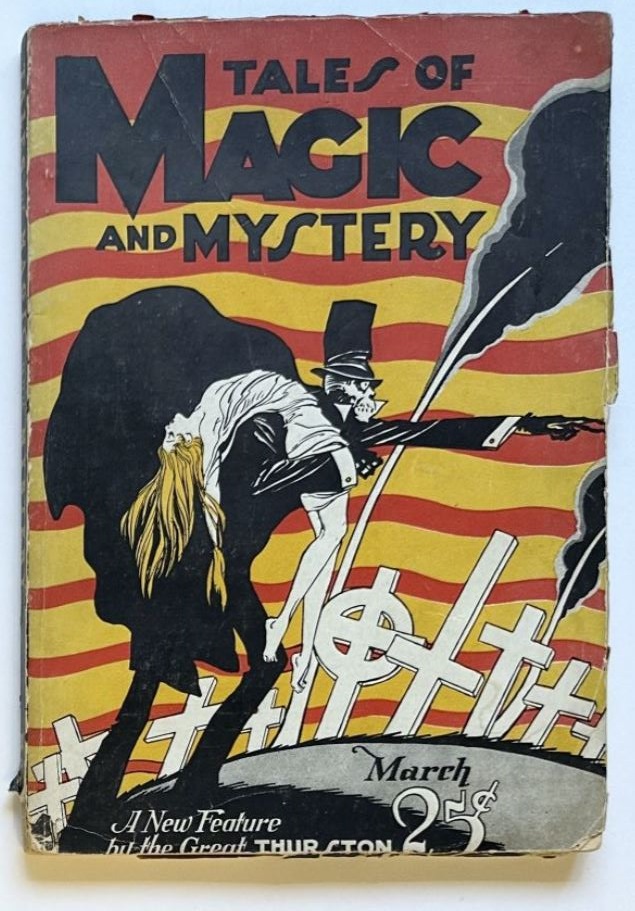
Further Famous Escapes of Harry Houdini
IN his travels and adventures in many countries, Houdini always studied the methods of imprisonment, restraint and torture practiced in those lands. He frequently exhibited his skill in escaping from local prisons, under tests imposed by the authorities.
When in Russia in 1903, which then was under the Czarist regime, Houdini met with some of his most difficult experiences. The prison masters of that country were pitiless in their methods, and when Houdini offered to escape from their restraints, they accepted the challenge and did all in their power to prevent his success.
In Moscow, he was imprisoned in the carette, or transportation cell, a traveling prison that was considered impregnable. No windows were in the van. The only mode of entrance was through a solid door, which was heavily padlocked.
The secret police of Russia had charge of this contrivance. They searched Houdini thoroughly, and made him undergo a rigorous examination. Then they imprisoned him in the transportation cell; but in twenty minutes he had effected his escape.
This severe test took place before the chief of the secret police, a man named Lebadeff, and it was stated to be the only occasion on which any prisoner had won his freedom from the traveling cell. This achievement made Houdini immensely popular in Russia and he remained there for four months.
Twenty years ago Houdini devised an escape from the Spanish Maiden, a fearsome relic of the Inquisition. This torture device was made of iron and had sharp spikes on the inside of the front cover, which closed like a mummy case. Persons sentenced to death were executed by being placed in the Iron Maiden; then the door was closed upon them and the spikes pierced the body of the unfortunate victim.
The Spanish Maiden devised by Houdini was arranged so that the spikes, while not injuring the performer, surrounded him from all angles, and were a source of danger that seemingly made escape impossible. Yet his ingenuity solved a way of eluding the embrace of the medieval monster.
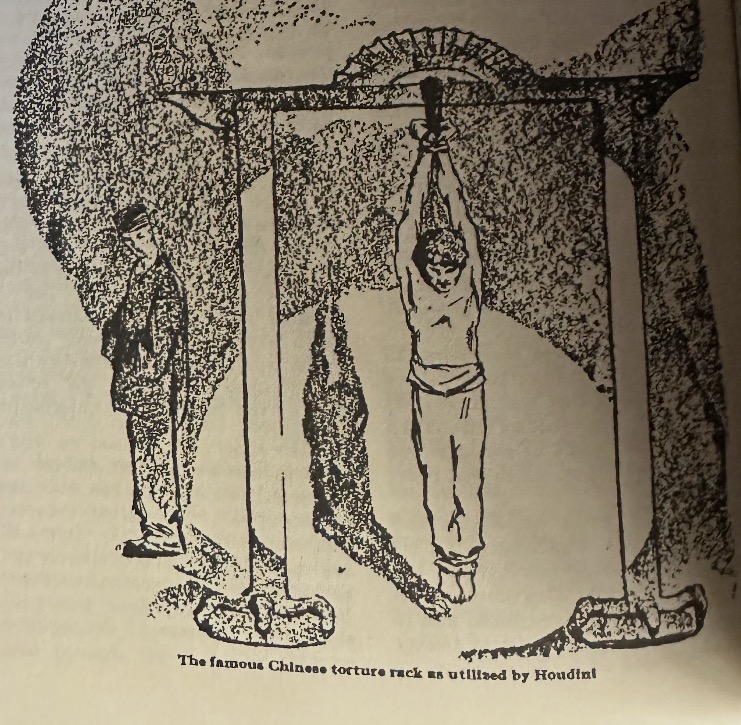
A few years before his death Houdini produced a new and sensational escape which was based upon a Chinese torture rack. Two upright posts with a cross-bar constituted the apparatus. The prisoner was bound by his hands and suspended from the cross-bar, to hang there helpless, in agony.
When he presented this upon the stage. Houdini first showed motion pictures portraying him in the toils of the Chinese, who bound him to the torture rack. Then the screen was raised, the spot-light was thrown on the stage, and there was Houdini, bound to the rack itself, ready for the escape.
He did this in full view of the audience—as was the case with his strait-jacket escape—and the spectators were able to see for themselves how the wizard of escape could use his powerful strength and agility to good advantage.
Swinging his body back, forth, and sideways, Houdini managed to escape one of the upright posts with his feet, and thus he climbed the post and drew his legs to the upright bar. Working with his teeth upon the knots, he gradually released his bonds, and finally broke through to freedom.
It was a sensational and spectacular escape, and clearly revealed the strenuous efforts that were necessary to Houdini’s work. More than once this man was injured during his performances, for he was heavily built, and was often in danger of breaking a wrist or an ankle.
ONE of Houdini’s trying experiences occurred, not in a foreign country, but in the United States, when he was accepting a customary challenge.
“It was in Philadelphia,” said Houdini, “that my powers were taxed to the utmost. The Wolfe Lock Company had made a special lock consisting of two padlocks fastening a shackle to either hand. These were firmly fastened to a cross-bar to keep my hands apart. The key-holes were on top, and the complete shackles weighed more than twenty pounds.
“I went into the cabinet and started to work on the difficult contrivance. I knew that the escape would not be easy, and I was studying the key-holes when an unforeseen accident occurred.
“A stage-hand, up above, kicked down a shower of dirt which fell over the shackles and filled the key-holes, clogging them completely. When I tried to work on the locks, I found it impossible. Finally I was forced to lie down on my back and put my hands up over my head to bring the key-holes downward.
“It was an awkward position. I was supporting the weight of the heavy shackles during the entire operation, but I finally managed to get the dirt from the key-holes and open the locks.”
It was typical of Houdini to go through with a challenge once he had accepted it. This was proven when he was in England, and was firmly shackled on a London stage. He struggled time and again with the device that was clamped to him, and refused to give up the attempt. He was forced to extract a knife from his vest pocket, and with it cut his coat which he had turned inside out above his head, because the coat interfered with the escape and the challenger refused to unlock him long enough to remove the garment. He did this in view of the audience, then he returned to his cabinet and kept on working. He finally succeeded after a seventy minute struggle.
IN preceding articles of this series, mention has been made of Houdini’s European tour, during which he accomplished some of his most sensational escapes. His dives from high bridges, his controversy with the German police, and his miraculous escape from death before an onrushing train were all episodes in that adventurous tour. But there was one more event of that period which stands out as a thrilling escape from death. It afforded the escape wizard a few seconds of great danger from which he escaped through a freak of chance.
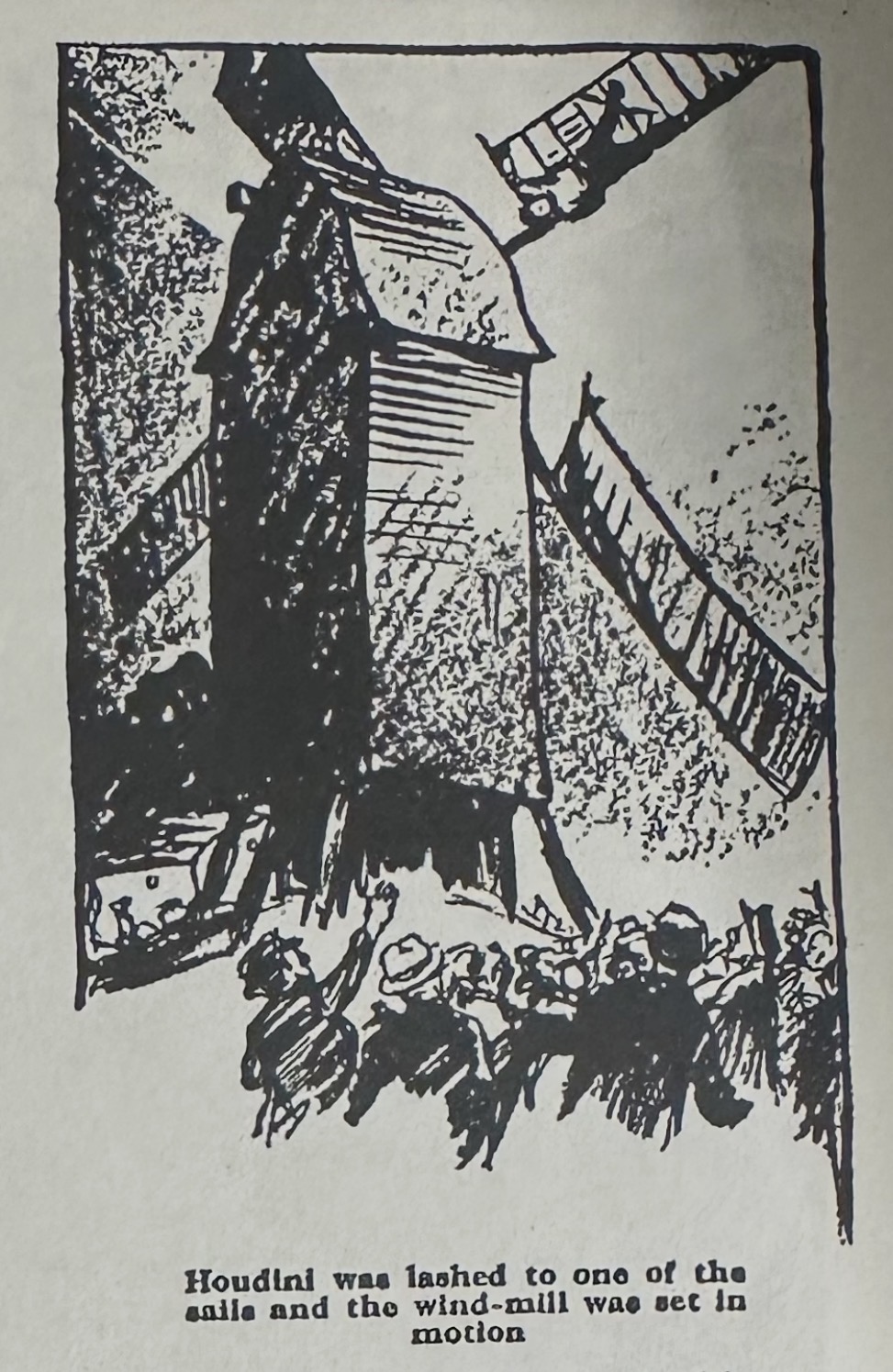
While in Europe, he traveled through many districts with the Circus-Althouse, and lost no opportunity to attempt difficult releases. Much of his time was spent in Germany, but the tour also called for a visit to Holland. There he was called upon to amaze the stolid natives, and in looking for a good place from which to effect an escape, he decided upon employing a typical wind-mill.
Tall wind-mills are plentiful in Holland , and they tower high in the air, with their broad fans whirling in the breeze. Here indeed was a spectacular form of escape. The mythical Don Quixote had attacked a wind-mill; the actual Houdini set out to baffle one.
A suitable tower was chosen for the escape, and it afforded a good position from which the crowd could see everything that transpired. Not only did Houdini face the task of getting free, but he must scramble down to safety after the release was affected. The wind also figured in the problem, and altogether it was a most fascinating situation.
“The escape was arranged,” said Houdini. “I allowed myself to be firmly lashed to the sails of the wind-mill, and I fully planned to make my escape from it while it was in motion. I was bound there, and began the struggle.
“It was not until I was on the revolving wind-mill that a certain difficulty was realized. We had not given the matter of my weight any important consideration. Being of heavy-build, my added weight brought about unexpected consequences. The sails leaned to one side, and the exertion which I made was too much for it. The wind-mill was unable to stand the strain. Before I had really begun to release myself, it broke and toppled to the ground.”
A fall of fifty or sixty feet is no small matter under ordinary circumstances. Free, a person has some small chance of escaping without serious injuries. But bound to an object that threatens to crush one beneath it makes the situation desperate. The witnesses of the catastrophe looked on in horror, for Houdini’s death seemed a certainty. Yet in his difficult circumstances lay his salvation, which occurred in a most unexpected manner.
“I realized my predicament,” related Houdini, “while I was falling with the wind-mill, but I was powerless and in no position to help myself. It was a most dangerous situation, but I was saved by a fortunate occurrence—something quite as unexpected as the breaking of the wind-mill.
“During its fall, the wind-mill turned over! It fell in such a way that I was on top when the crash came. Instead of being underneath the wreckage, I was in the best possible position, and my fall was broken!”
All that remained was to remove Houdini, unhurt, from the shattered wind-mill. The one possible chance that could have saved him had taken place, and he escaped without serious injury.
This adventure was unique in Houdini’s career in that he had no possible chance to save himself. In the milk-churn, on the railroad track, and in his other predicaments he had at least some chance for quick action. But falling through the air, to what seemed certain doom, gave him no opportunity to use his own effects in the hope of safety.
Tied firmly to a wild horse, immediate danger of being dragged to his death, Houdini won his way to safety by an ingenious plan. Read this unusual story of his early career in next month’s issues of TALES OF MAGIC AND MYSTERY.
I was hoping this “Chinese Torture Rack” was the Sangaw, but it appears to be something different. https://www.wildabouthoudini.com/2023/08/sangaw-surprise.html
Another thought. The torture rack as described here appears to be what we see in The Master Mystery.
The Sangaw [SAM Houdini Night] and “Chinese Torture Rack” [Gibson] descriptions each describe a horizontal bar [or cross bar] on uprights [or two upright posts] and each describe showing a motion picture before performing the escape before an audience.
But the descriptions of how he was bound differ.
Gibson’s description and photo look similar to how he was bound in Mastery Mystery Episode 12 “The Death Noose”. That is, bound by his hands and feet while suspended.
The SAM Houdini Night description secures each wrist to the central portions of the uprights, then securely binds the feet to a floor-piece, and lastly runs a loop under the front part of the neck, thence around the head in such a manner that the head may not the lowered; then remainder of the rope is then securely fastened to the central part of the upper most cross-piece.
In Episode 9 of the Master Mystery, he is bound hand and foot to a partition, while the noose of the garroting machine was placed around his neck.