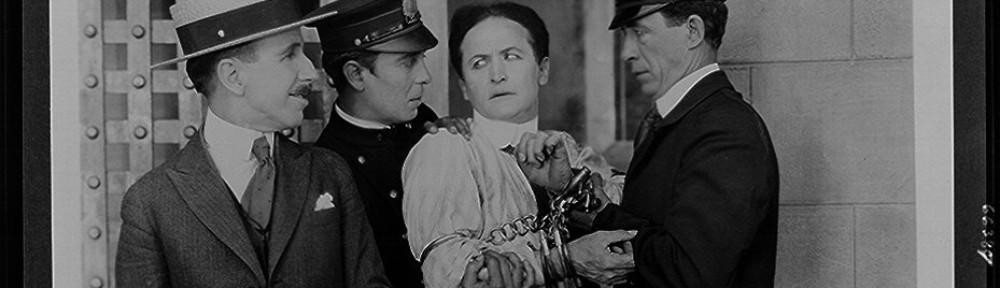
Movie Related Correspondence with Quincy Kilby – July 12 1919

I recently went through a Houdini scrapbook compiled by Houdini’s personal friend, Quincy Kilby, and thought I would share items related to his movies in chronological order.

Previously we looked at letters from 1918 and the Master Mystery:

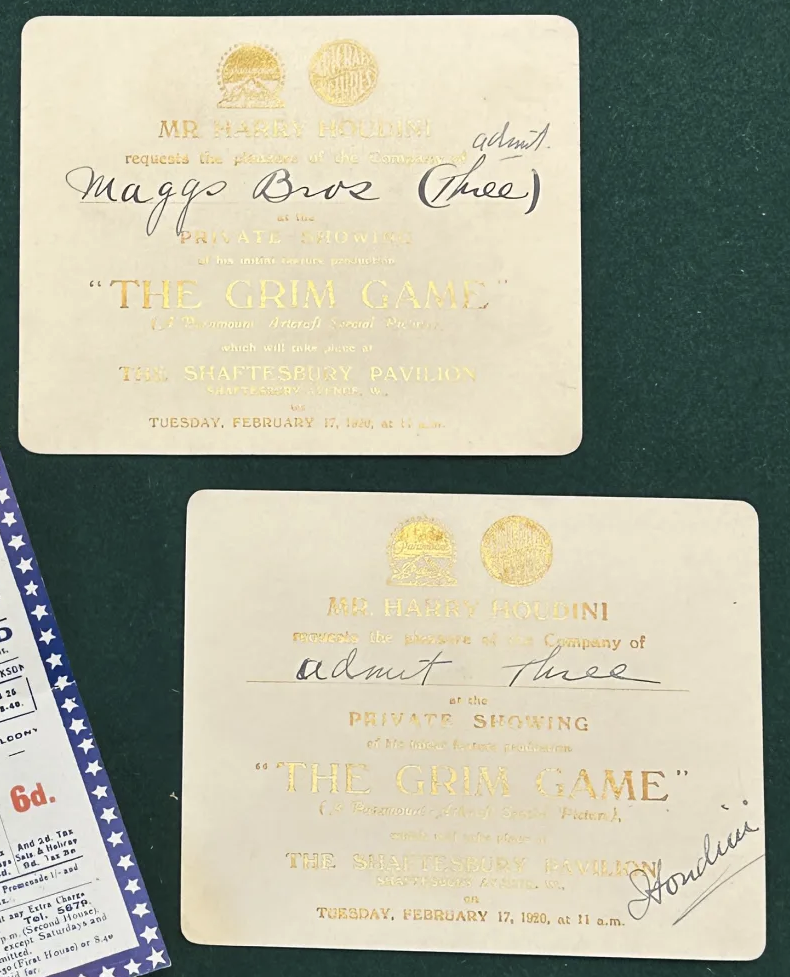
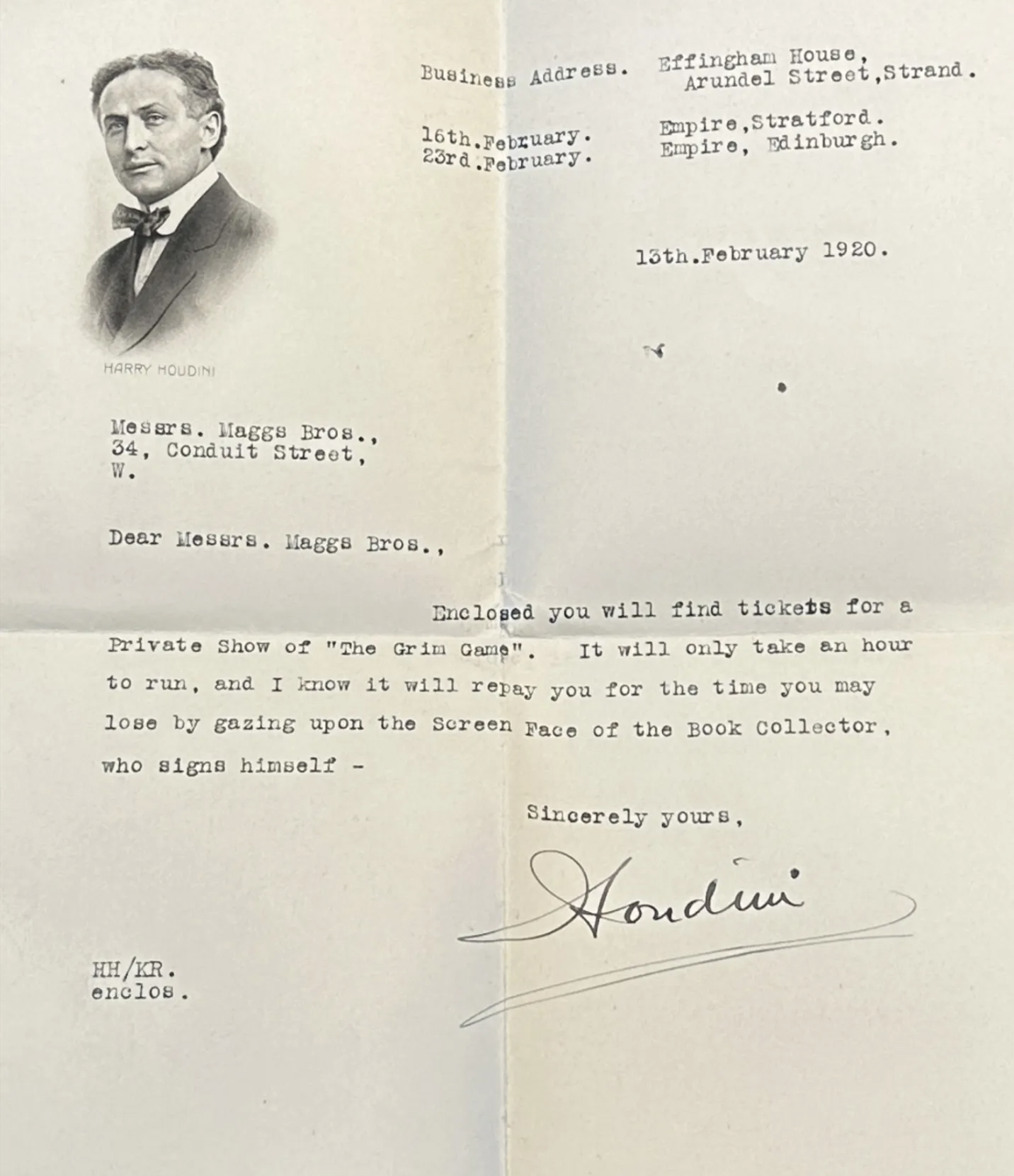
And now we look at letters from 1919 and The Grim Game:

Today, I share July 12 Letter:

Dear Q.K.,

My wrist getting along okay, July 20th, will try and finish the last few scenes, and return to New York leaving on or about July 25th.

The Grim Game will be finished next Sunday, my wrist will be strong enough to do the finishing stunts.

Tom Jefferson is at work in another studio.

Will try and see him before we leave.

Must close bes of all good wishes, from Mrs. Houdini and your pal to you all

Houdini

P.S, …

We will remain here until on or about July 26th.

After that New York Address.

Movie Related Correspondence with Quincy Kilby – June 28 1919

I recently went through a Houdini scrapbook compiled by Houdini’s personal friend, Quincy Kilby, and thought I would share items related to his movies in chronological order.

Previously we looked at letters from 1918 and the Master Mystery:

And now we look at letters from 1919 and The Grim Game:

Today, I share June 28 Letter:

And Poem by Q.K. for The Silver Wedding of Harry and Beatrice Houdini:

The letter mentions breaking his wrist again; he first broke it when filming The Master Mystery and now during the filming of The Grim Game which was 90% finished.

Movie Related Correspondence with Quincy Kilby – June 9 1919

I recently went through a Houdini scrapbook compiled by Houdini’s personal friend, Quincy Kilby, and thought I would share items related to his movies in chronological order.

Previously we looked at letters from 1918 and the Master Mystery:

And now we look at letters from 1919 and The Grim Game:

Today, I share June 9 Letter:

Hollywood, California June 9, 1919

Dear Q.K.

Thomas Jefferson and myself frequently converse about you, and it was through an accident that I found out young Joe Jefferson was a friend of mine.

I thought that young Joe was an old man, but it appears that he was younger than I.

Worked with him in vaudeville, that is he was on the same bill, and very pleasant, and very pleasant weeks we had…

So Mr. Thomas J. and I have lots to talk about…

He does not know yet that he is to be “murdered” by an arch fiend in the first act, and though he always asks me what will be become of him, I do not give him a sensible answer.

So we have a fine time, as no one really knows the full story…

Houdini


So, who was young Joe Jefferson?  Let’s look at who his father was first. Joseph Jefferson III (1829-1905) was the 4th generation of a theatrical family that was established by Thomas Jefferson (1728 -1807), an English actor who managed several theatres.  Thomas’s son Joseph Jefferson I (1774-1832) came to America in 1795 on tour and remained to manage the John Street and Park Theatres in New York and the Chestnut Street Theatre in Philadelphia.  He played a comic actor.  Joseph Jefferson II (1804-1842) was an actor as well.  All three Jefferson’s were noted for playing old men.  Joseph Jefferson III was born 20 February, 1829 at Philadelphia United States of America, son of Joseph Jefferson, actor, and his wife Cornelia Frances Thomas Burke.  He began is stage career at 4, and, after his father died in 1842, relied on acting for a living. At 21 he married Margaret Clements Lockyer. On February 18, 1861 his wife died, leaving four children.  On December 20, 1867, he married Sarah Warren the niece of the actor William Warren. Fame came with his creation of the role of Rip Van Winkle. He died in 1905.

Young Joe

Joseph Warren Jefferson IV was a child of the second wife.  He was born July 6, 1869.  He was a member of his father’s company.  So at the time of the Grim Game, Joe Jefferson IV would have been 50 years old and Houdini 45 years old, making young Joe Jefferson five years older not younger than Houdini. Joseph Jefferson IV (1869 – 1919) performed at Macauley’s Theatre three times in Rip Van Winkle.

What was the connection with Thomas J and young Joe? Thomas Jefferson played Old Man Cameron in the Grim Game.  Like young Joe Jefferson, Thomas Jefferson was one of Joseph Jefferson III sons. He acted in his dads company in several roles opposite his father.  He became an actor in D.W. Griffith’s stock company appearing with Houdini in The Grim Game.`

9.8 CGC Graded Houdini (1953) Beta Paramount Pictures USA 1991

CGC Home Video, a division of the Certified Guaranty Company, announced in 2023 that it would begin grading Betamax and VHS tapes.

Early last year, John Cox, had his factory sealed VHS copy graded by CGC:

Which led me to bring my ungraded factory sealed Beta copy over to John’s place to see if it was worth getting graded. Suffice it to say, this Houdini nut rolled the dice and sent it in to be graded.

After waiting 5 months, a box arrived at the house, and to my surprise, it received a 9.8 grade, which far exceeded my expectations.

CGC uses a 10 point-scale for home video, with 9.8 signifying “Near Mint/Mint” a virtually perfect copy.

Betamax tapes were produced in smaller quantities than VHS. And the 1991 home video release of Houdini came near the very end of the Betamax formats life, making factory-sealed Betamax copies, an extremely rare item, let alone one graded at 9.8.


Houdini Was Born Not In America, But in Hungary

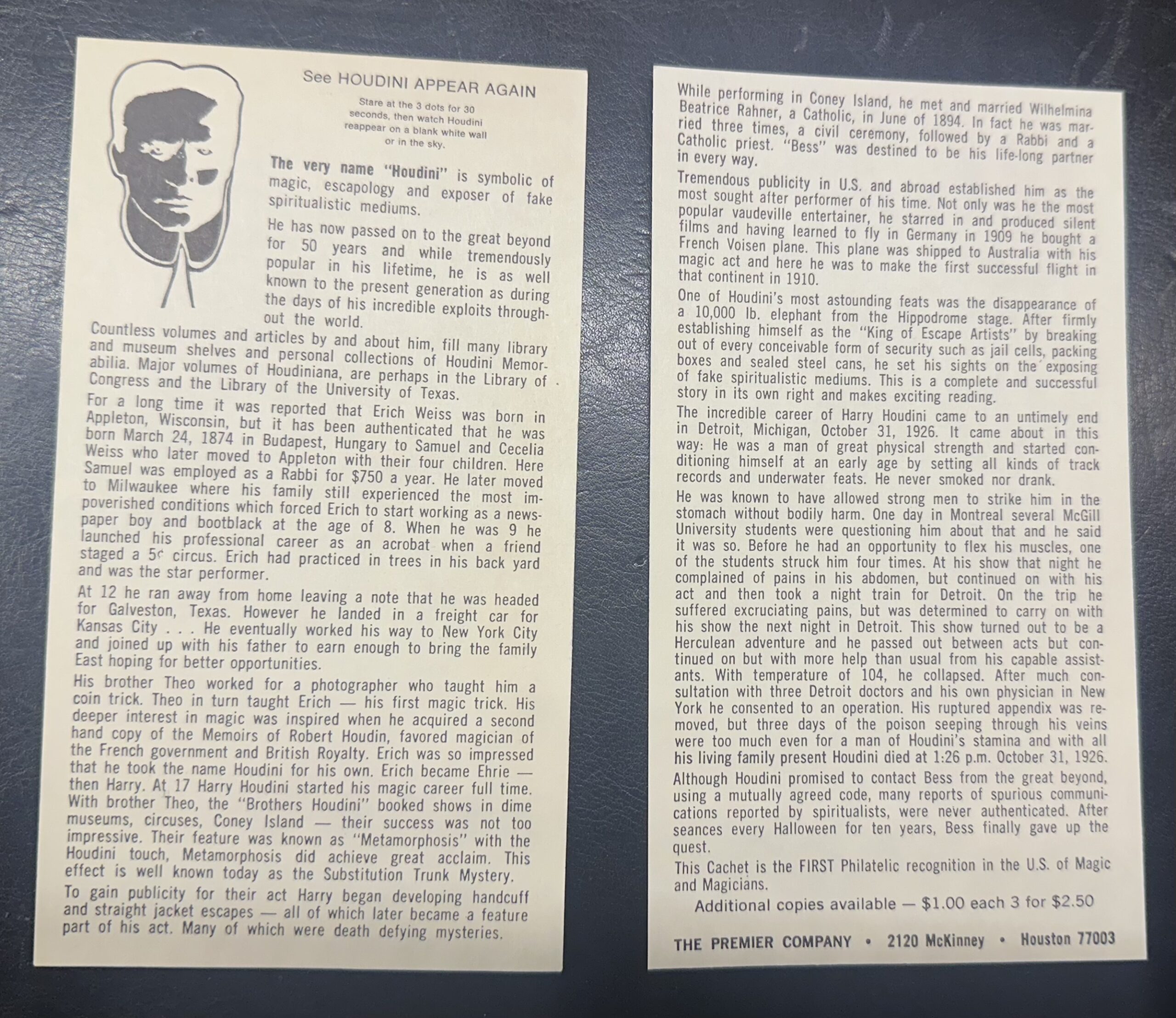
With Houdini’s 152nd Birthday coming up on March 24th, thought I would share my issue of Magie, no. 12, December 1932 that provides early published evidence that Houdini was not born in American on April 6th, 1874, but in Hungary on March 24th, 1874.

Page 165:

Page 165 Translation (courtesy of Patrick Culliton):

Page 166:

Also of interest is page 167, where Ottokar Fisher writes:

Page 167 Translation (courtesy of google translate):

On the question: “Houdini’s Birthplace”

When I began reading Harold Kellock’s book Life-Story, published in 1928, I was extremely surprised to find that the city of Appleton, Wisconsin, was listed as Houdini’s birthplace. On the occasion of his guest performance at the Ronacher Theater in Vienna in March 1902, Houdini himself told me that he was born in Hungary and came to the United States with his father at  the age of two. I also know that he traveled to Budapest during Easter week, on Good Friday, a day which there were no performances, to visit his relatives. For me therefore, there has always been no doubt that Houdini was a native, Hungarian, which I also expressed in my obituary, which appeared after his death in the artist magazine “Das Programm.” I personally find it incomprehensible what purpose Houdini’s successors are pursuing by claiming he was born in Appleton! Such a claim is, in my opinion, absolutely incorrect and hardly verifiable. This is all the more so since the president of the Association of Hungarian Amateur Magicians (M.A.M.E.), Dr. Vilmos Lenard, through his thorough research in the birth registers of the Budapest Jewish Community and through contact with Houdini’s relatives who still live in Budapest today has clearly and irrefutably established Budapest as Houdini’s true birthplace and is able to substantiate the accuracy of his research officially certified documents.

Movie Related Correspondence with Quincy Kilby – May 1919

I recently went through a Houdini scrapbook compiled by Houdini’s personal friend, Quincy Kilby, and thought I would share items related to his movies in chronological order.

Previously we looked at letters from 1918 and the Master Mystery:

And now we look at letters from 1919 and The Grim Game:

Today, I share May 11 Telegram:

Dear Q.K.,

We start in to work tomorrow. Been delayed. Thomas Jefferson is in my cast, strange you write to me regarding him.

Shall convey your regards, He plays my rich crabbed uncle.

Houdini

And a undated [May ?] Telegram:

Dear Q.K.?

Thought the enclosed [Still 298-22] might interest you. Have started in to work. Thomas Jefferson is my cast. Will write you more in detail as soon as I get opportunity, Regards H.H

Will have to postpone our Silver wedding mayhap a month or so.


Find it interesting that Houdini was thinking he may have to postpone his 25th Wedding Anniversary due to working on The Grim Game.

Related:

Movie Related Correspondence with Quincy Kilby – April 12 1919 and April 24 1919

I recently went through a Houdini scrapbook compiled by Houdini’s personal friend, Quincy Kilby, and thought I would share items related to his movies in chronological order.

Previously we looked at letters from 1918 and the Master Mystery:

And now we look at letters from 1919 and The Grim Game:

  • Movie Related Correspondence with Quincy Kilby March 7 1919
  • Movie Related Correspondence with Quincy Kilby April 12 1919 and April 24 1919
  • TBS

Today, I share a April 12th Letter:

 Dear Q.K.,.

. . .

We leave for Los Angeles Calif Wednesday [4/16] and my address will be for the next 5 weeks or say 6 weeks Lasky Studios Hollywood Calif.

. . .

Houdini

And a handwritten April 24 letter:

Dear Q.K.

Arrived Okay.

My address for (?) next 2 months – Lasky Studios Hollywood California

nothing new. Expect to start in about first week in May.

Hopes all well

Yours as always

Houdini

Related:

Movie Related Correspondence with Quincy Kilby – March 7 1919

I recently went through a Houdini scrapbook compiled by Houdini’s personal friend, Quincy Kilby, and thought I would share items related to his movies in chronological order.

Previously we looked at letters from 1918 and the Master Mystery:

And now we look at letters from 1919 and The Grim Game:

  • Movie Related Correspondence with Quincy Kilby March 7 1919
  • TBS

Today, I share a March 7th Letter:

My Dear Q.K.,

We expect to leave for Los Angeles in 6 weeks as I have signed with Jesse Lasky for a feature picture.

So you see I am drifting away from vaudeville, and with the exception of my European dates have no plans re a return.

If I do not give my own show, will very-likely return to Hippodrome, unless I remain in pictures, and now you know all my plans.

Houdini

Related:

Dunninger tells dramatic stories about Houdini’s Death

The Parade Magazine issue from October 26, 1952 is a vintage newspaper Sunday supplement featuring prominent 1950s celebrities. The popular syndicated magazine supplement was included in Sunday newspapers across the U.S.

This specific issue [recently added to my collection] includes a very interesting Houdini/Dunninger article by Hy Gardner [an American entertainment reporter who interviewed celebrities on his radio show in the early 1950’s], which I am sharing with my annotations in brackets [ ]:

$10,000 REWARD…for anyone who can talk with this lonely ghost

NEXT THURSDAY night [10/30/52], Halloween Eve, at the bewitching hour of midnight [12a Friday 10/31/52], dozens of mediums from Coast to Coast will try to establish spiritual contact with the late Houdini.

Ever since the death on Halloween Eve [10/30], 1926, of the great escape artist, there’s been a standing offer of at least $10,000 to be paid to anyone who delivers a message from Houdini.

[This is the first mention (albeit subtle) of “Death on Halloween Eve” from Dunninger that I am aware of. Dunninger also annotates “the date should have read Oct 30, 1926” on a 1968 letter received from Dr. Kennedy (chief of surgery at Grace Hospital in Detroit that took care of Harry Houdini during his final days in October 1926). All bios have the death as Halloween Oct 31, 1926.]

At this writing, some 800 mediums have applied to Houdini’s friend and contemporary, Dunninger, for the prize, but in each instance Dunninger [like Houdini] has explained away—or duplicated by natural or scientific means—what they claimed was contact by supernatural means.

  • Now Paramount Pictures is preparing a film on Houdini’s life, in which Dunninger will be technical advisor [true] and probably play himself [false]. As Paramount no doubt will show, these annual seances, actually trace back to a meeting in Atlantic City, N.J., four or five years before Houdini’s death. Houdini and Dunninger had been invited by Sir Arthur Conan Doyle and Lady Doyle to attend a séance. [This is the first and only mention of Dunninger being invited, that I am aware of. It does not appear in the movie, nor are the Doyle’s featured in the movie.]

At the session [June 18, 1922] Lady Doyle went into a trance, placed a pencil on some paper and gave Houdini an 8 page message [17 page message in Copperfield Collection] from his departed mother. “This is extraordinary, Lady Doyle,” he admitted, “but one thing puzzles me. This message is in English, and while my mother spoke six languages, English was not one of them!”

Lady Doyle was so insulted she packed and left town immediately. Sir Arthur, protecting his wife, suggested that there might have been some form of intellectual development in the spirit plane to enable the mother to learn English.

“After this,” Dunninger says, “Sir Arthur, Houdini and I made a 3-way pact: whoever passed away first would try to contact the others. [First I heard of a 3-way pact. AFAIK, Dunninger had a code with Houdini and may have had a code with Sir Arthur; according to The New Yorker (November 22, 1941), “Dunninger is fond of that particular sum of money {$10,000} and from time to time has offered it to anyone who with astral aid, can disclose the translation of secret code messages entrusted to him by the late Harry Houdini, the late Sir Arthur Conan Doyle, and the late Thomas A. Edison, all of whom wanted to investigate the possibilities of communication with spirits.]

  • “Now, as sole survivor, I’m left with a 10-word message given me before his death by Houdini. It’s in code and I am the only one who knows what it would mean if decoded. This is the message the mediums will try to get from Houdini himself on Halloween Eve.” [In 1947, Dunninger chaired a “Waiting for Houdini” committee and held this 10-word code; Dunninger would continue these seances for the rest of his life, though the 10-word code was never successfully used to prove communication from Houdini; supposedly, the original envelope with Dunninger’s signature and seal, which held the original message between Houdini and Dunninger was stolen from Houdini Museum in Niagara Falls]

Dunninger tells a dramatic story about Houdini’s death. Houdini, who had a premonition of his own death, had gone to Detroit. [This dramatic story can be summarized as follows:

“In New York, on a rainy night in October, 1926 he phoned Joseph Dunninger, the famous magician and mentalist, and asked him to come to his house. When Dunninger arrived, Houdini explained that he wanted Dunninger to help him take some boxes to a storage place the other side of the city. As they were driving away, Houdini suddenly told Dunninger to turn back. They arrived before the house, and Houdini got out of the car. He stood silently in the rain and then got back in. ‘I just wanted  one last look’, Houdini said, ‘I’ll never see it again alive.’” {Berkley/Reader’s Digest The Great Entertainers (1983) The Man No Lock Could Hold article by James Stewart-Gordon (February 1976)}

The full story appears in Gresham’s, Houdini The Man Who Walked Through Walls (1959):

About two o’clock one morning in October, 1926, I got a phone call from Houdini. He said, ‘JoeI just got in town today and have to hurry right out again. I want to move some stuff from the house. Can you come up with the car?’ I told him I was on my way. When I got to 113th Street Houdini was waiting for me in the doorway. It was raining cats and dogs.

A Holmes partrolman was with him to let him in the house so as not to set off the burglar alarms. Houdini had some bales of paper and magazines to take out and the Holmes man helped us stack them in the car. Houdini was wearing old clothes, and a straw hatlet’s get something to eat.’ We went around the corner to a delicatessen and had pastrami sandwiches. We came back, got in the car and Houdini said, ‘Driver through the park, Joe.’ When we got to the exit on Central Park West around 72nd Street he grabbed my arm; in a hollow, tragic voice he said, ‘Go back, Joe!’

“ ‘Go back where’

“ ‘Go back to the house, Joe’

“ ‘Why—did you forget something?’

“ ‘Don’t ask questions, Joe. Just turn around and go back.’

“I drove back to the house. By the this time it was raining even harder, if that was possible, but Houdini ignored it; he got out of the car, took off the straw hat and stood looking up at the dark house with rain streaming down his face. Then he got back in the car, saying nothing. When we again approached the western exit of the park his shoulders began to shake. He was crying. Finally he said, ‘I’ve seen my house for the last time, Joe. I’ll never see my house again.’ As far as I know, he never did. We drove a way in silence and then he said suddenly, ‘Joeyou know that bronze coffin I made to expose that faker, Rahman Bey? Not only for that, Joe I made it to be buried in.’

‘Like so many of these incidents, we have no way of knowing how many other ‘presentiments of death’ Houdini had before, which did not come true. But this one I know about for I was there.” So Dunninger contributes to the Houdini legend.

And Kalush’s, The Secret Life of Houdini (2006) chose to repeat Dunninger’s story as told to Gresham, with the exception he gives us a date in October when it possibly occurred; he has it occurring after Providence tour (which ended 10/9) and before Albany tour (which started 10/11). Maxine Dunninger’s, Daddy was a Mind Reader (2012), also shares her dad’s story. FWIW, the story does not appear in Silverman’s Houdini (1996) which means he could not corroborate it. I couldn’t find it recounted anywhere else before the story surfaced in the 1950s; My search included AskAlexander, Newspapers.com, Houdini’s Spirit Exposes and Dunninger’s Psychical Investigations (1928), Science and Invention (October 1929) When Fate Fooled Houdini article by Dunninger, Inside the Mediums Cabinet (1935) and others. Also doesn’t appear in Kellock’s Houdini A Life Story (1928) or Christopher’s The Untold Story (1969).]

A Horrible Feeling

A WEEK OR TWO later, Dunninger, enjoying a bite with Keith Theater manager A. Frank Jones in Washington, felt faint. “I have a horrible feeling,” he told Jones, “that Houdini has just passed!” Back at the theater, reporters told them Houdini had just died of peritonitis, the result of a blow struck by a man anxious to win a cash award offered “anyone who could hit Houdini hard enough to hurt him!” [On October 30th, Dunninger performed an afternoon and evening show at the Maryland Theater in Baltimore; And on October 31st, Dunninger made his vaudeville premier at Keith’s Theater in Washington D.C.; A. Frank Jones from the New York offices of Keith-Albee acted as Dunninger’s personal manager; Rolan Roberts was the manager of Keith’s who is said to have discovered Dunninger; November 1st, is when papers reported Houdini’s death on Halloween from peritonitis, with some saying caused by a blow, but there is no evidence of a cash award offered for hitting Houdini hard enough to hurt him, so…]

  • Dunninger expects to coach Tony Curtis, who’ll play Houdini in the picture. But he’ll leave the dangerous stunts to doubles. “After all,” he says, “the public won’t expect this youngster to dive off bridges, handcuffed like Houdini, or be lowered in an iron box into a river!” [Dunninger aquired an iron box from Bess Houdini, and it was used in the movie, but there is no evidence of Houdini using it in performance.]


In summary, Dunninger definitely added to Houdini’s legend with these stories, but there’s not a lot of supporting evidence and really no way to substantiate Houdini’s premonition of seeing his house for the last time, or Dunninger’s premonition of when Houdini passed.

For those of you who believe…no explanation is necessary, and for those of you, who do not believe …no explanation is possible.”…DUNNINGER

Movie Related Correspondence with Quincy Kilby – December 15 1918

I recently went through a Houdini scrapbook compiled by Houdini’s personal friend, Quincy Kilby, and thought I would share items related to his movies in chronological order.

Today, I share a December 15th Letter:

My Dear Quincy Kilby,

Re my Buried Alive Illusion of Mystery, it is not certain, for the Movie Fans are “clambering” for another Houdini serial, and as that is much easier than my Self created hazardous work, I may step that way.

Houdini

In 1914, Houdini copyrighted “Buried Alive” with a play and had a poster made for the effect, but the stage version would have to wait for Houdini to perfect and perform.

Per John Cox:

The Buried Alive is one of Houdini’s most elusive escapes. Houdini himself claimed to have performed it as early as 1908 in Germany. In 1914 he had a lithograph made for the effect, but there’s no record of him performing it at this time. In 1918 he announced Buried Alive for his return to the Hippodrome in Everything, but when he broke his wrist making The Master Mystery he had to substitute it with a suspended straitjacket escape. There’s also his famous 1919 accident while rehearsing a Buried Alive stunt in California, but that was an outdoor stunt, not the stage version.

Now here we have evidence of the apparatus being built in 1922.

Buried Alive wouldn’t surface until 1926, and then only for a couple performances.


Related: