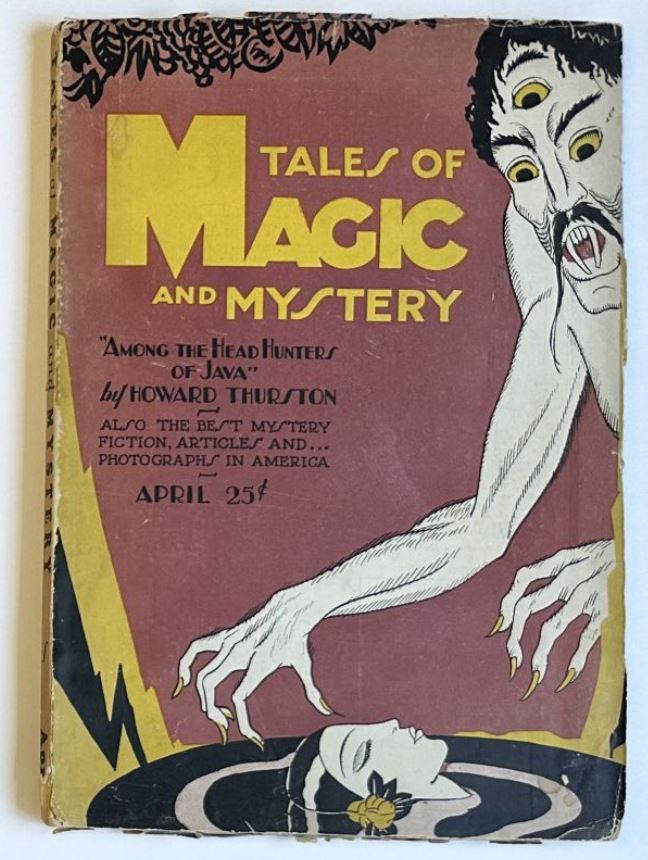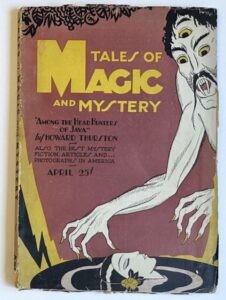
Tales of Magic and Mystery was a short-lived but highly regarded pulp magazine that released five issues between December 1927 and April 1928. Each issue had an article on Houdini by Walter B. Gibson.
Today I share Apr 1928 from my collection:
Houdini’s Rendition of Mazeppa’s Ride
DURING the early years of his adventurous career, Houdini attempted many daring and unusual escapes that were prepared upon the spur of the moment. To the average person they would not seem as remarkable as some of his later feats, but it must be remembered that the unexpected is an important element in every exhibition of danger.
Houdini’s career may be roughly divided into three parts. First, his early career, in which he developed the escape act and encountered many difficulties; second, the period in which he became famous throughout the world; third, his later career in which his escapes did not play so prominent a part.
It was during the early period that he experienced many hazardous undertakings, and attempted escapes which involved unusual dangers. When he became established, he accepted difficult challenges, which were submitted to him in advance. These included some of his most sensational escapes—performances which astounded the public. In these he relied upon his vast experience, and it was only on rare occasions that he was endangered by the unforeseen.
The third period of Houdini’s life included his motion picture activities, and finally his complete show. In the movies he performed many stunts that were extremely hazardous, but which were planned out beforehand, and were not the results of challenges.
It was Houdini’s willingness to attempt any form of escape that impressed the public. The challenges were advertised and given the publicity which they deserved; but the real secret of Houdini’s extraordinary ability and versatility lay in his early experiences, dating from the days when he would enthusiastically undertake anything that was suggested to him.
There is probably no complete catalog of all of Houdini’s achievements. Some of them were recorded in newspaper clippings; of others we find notes that merely mention them. He escaped on several occasions from deep-sea diving-suits; at other times he was secured in coffins. He was sewn in leather hides, and tied up in wet packs. He was done up in bandages, laced to a cot and deluged with water, to make his escape more difficult.
In his original escape act, Houdini had made no provision for challenges; but they were suggested to him by members of the audience, most of whom imagined that everything he did on the stage was faked. This proved to be the making of Houdini. It is almost impossible to convince the hard-boiled spectator that the handcuff expert does not have his crowd of confederates or “plants” distributed through the audience. But Houdini convinced them, and he became famous.
Less than a dozen years ago, a famous boxer attended one of Houdini’s performances at a vaudeville theater. Knowing that the man was there, Houdini invited him to come on the stage and assist the committee. This brought applause from the audience.
The fighter, however, refused to accept the invitation. He branded Houdini as a faker and suggested that the members of the committee were all in his employ. Houdini replied so effectively to these statements that the entire audience joined sides with him, and he broke loose in violent protest against the boxer, who left the theater while Houdini remained triumphant and continued with his performance.
This was characteristic of Houdini—he was always ready to assert his rights, and he invariably was the winner of a verbal combat before the public.
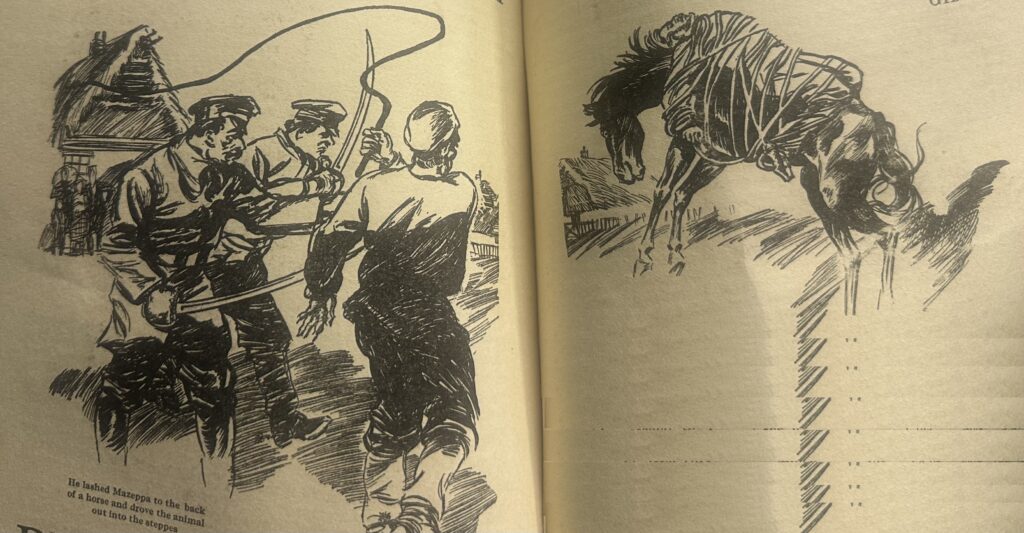
REVERTING to Houdini’s early career, which formed the basis of his late success, we have a story which he told of a thrilling and remarkable escape under the most difficult circumstances. It illustrates his great presence of mind in an emergency, and stands but as one of his greatest adventures.
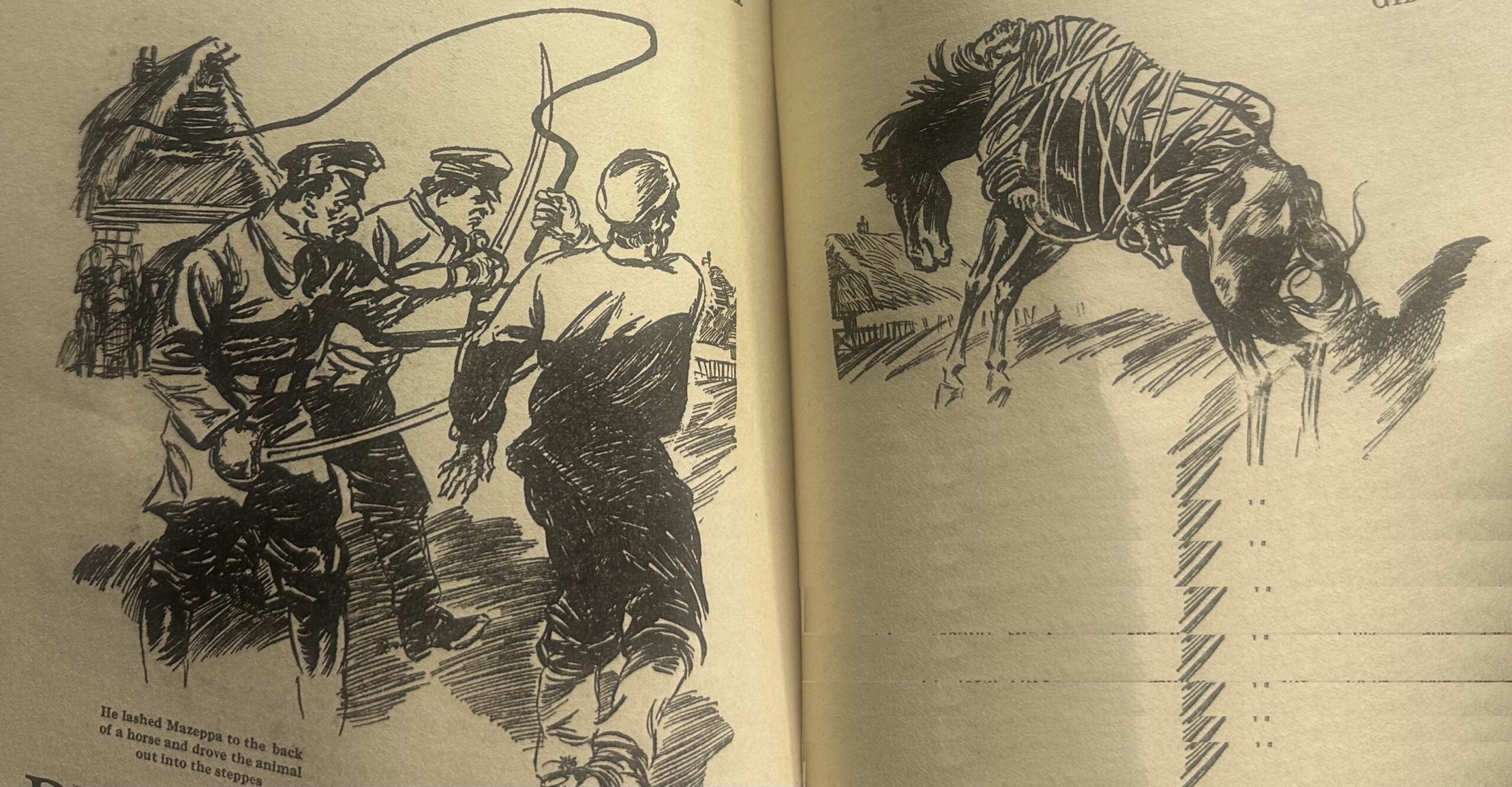
There is an old tale of a famous cossack named Ivan Mazeppa, who lived in the seventeenth century. This warrior fell into the hands of an enemy who chose a unique method of sending him to his doom. He lashed Mazeppa to the back of a horse and drove the animal out into the steppes, where it ran away, and carried its helpless rider many miles. By good fortune, Mazeppa was rescued; otherwise he would have died from exposure and starvation.
Houdini had heard of this story and he believed that it would be possible for a man to release himself under such trying conditions. It is difficult enough to obtain freedom from a tangle of ropes. On the back of a horse, however, the conditions are far worse; yet Houdini was willing to undertake the task.
The opportunity finally came, and here is his story of the event that occurred more than thirty years ago:
“I was in Novia Scotia,” he related, “in the year 1896. I was traveling with a man named Marco, of Hartford, Connecticut. The old subject of Mazeppa’s ride on the horse was brought up, and I offered to try it, stating that I could release myself while bound to the back of a horse. I stipulated that the horse could be released and run free while I was lashed to it.
“A horse was to be provided and naturally we supposed that it would be a tame one—a broken horse that could be controlled by the rider.
“The stableman made an error—so he asserted afterward—although there is the possibility that he wished to make my task far more difficult than anticipated. Whatever the case may have been, I only know that he gave me a young, fiery steed, instead of the tame horse. It was fairly quiet while I was being tied, but as soon as it was released, with me on its back, it started to run away.
“I was in a terrible predicament. There was no telling where the horse would take me. If I succeeded in partly releasing myself, I would probably have been thrown to the ground and dragged to my death.
“Fortunately I was securely bound, and in that position, I was temporarily safe, but I knew that a prolonged ride upon the back of the wild horse would be a most dangerous experience. There was no one to rescue me, and I was anxious to extricate myself from my unfortunate position.
“While the horse dashed madly along a road, I carefully worked to free one hand. I was successful, and still retained my secure position, with my body held firmly by the ropes. Then, with my free hand, I managed to obtain one of the loose ends of the rope.
“The horse began to slow down, and I beat him furiously with end of the rope, so that he started on again. Mile after mile I played the same game, driving the horse to his limit, and never letting him pause for breath. This continued until the horse had run nearly fifteen miles, when he seemed to be completely exhausted, and could scarcely respond to my lashings. Then I began to work on the ropes, and gradually I released myself, while the horse offered no further trouble.
“It took me some time to accomplish this, but when I was free, the horse was as pleased as I was. It was a wild and dangerous ride, but it ended safely, and when I returned with the horse—now completely subdued—the people were amazed to see that I had succeeded. They had virtually given me up for lost.”








 a
a