
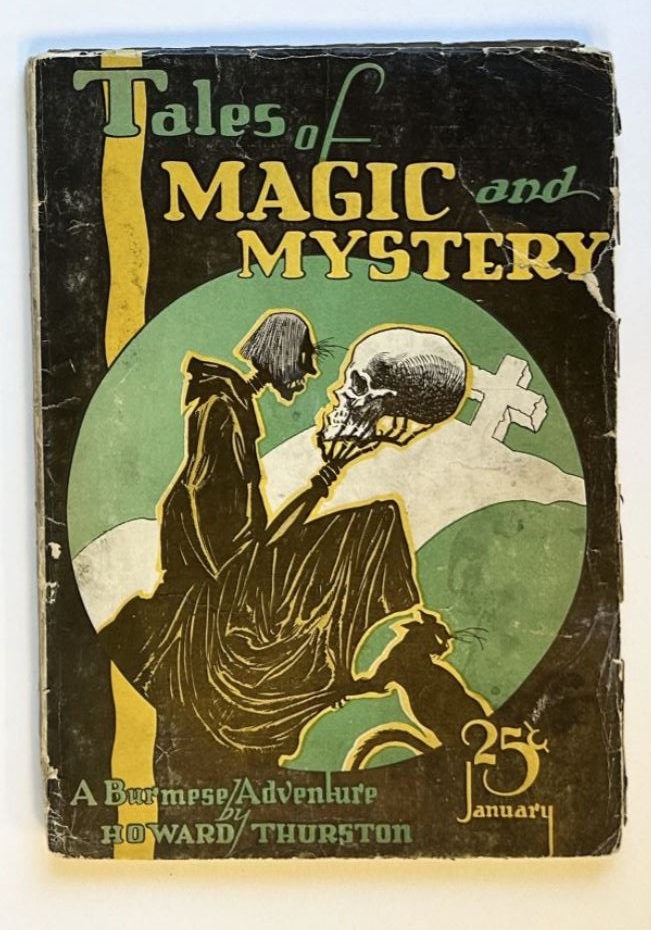
Tales of Magic and Mystery was a short-lived but highly regarded pulp magazine that released five issues between December 1927 and April 1928. Each issue had an article on Houdini by Walter B. Gibson.
- Dec 1927 – Houdini
- Jan 1928 – Houdini in Europe
- Feb 1928 – Daring Exploits of Houdini
- Mar 1928 – Further Famous Escapes of Harry Houdini
- Apr 1928 – Houdini’s Rendition of Mazeppa’s Ride
Today I share Jan 1928 from my collection:
Houdini in Europe
DURING the early years of the present century, Houdini made his first trip to Europe, and won great fame with his spetacular escapes. It was by no means an easy task for an unknown performer to win his way to prominence with a newly developed form of entertainment; and the great wizard met with continued opposition.
In Cologne, Germany, the police claimed that Houdini was misrepresenting his exhibition, and classed him as a swindler. Houdini demanded an apology, and took the case to court, where he was upheld. In one of the higher courts Houdini demonstrated his ability to escape from a specially constructed lock, accepting a challenge issued by the police officials who had slandered him.
In recalling his early adventures Houdini recalled an amusing incident which illustrated his ability to fight in the face of odds, and which clearly reveals the iron nerve which he possessed.
“Early in my career,” he said, “I set out to join a medicine show. I was an obscure performer at the time, and I felt that this meant a great deal to my future, for it afforded me an engagement that was better than any I had previously had.
“During my journey I had to change cars at a town where there was a union station, for two railroads—one line on each side of the station. I had eight minutes between trains, but the train that I arrived on was late. I hired a porter to transfer my baggage from one train to the other, yet there was barely time for the passengers to change trains, and the second train would not wait for my baggage which I had to have with me for my opening engagement.
“I appeared first to the conductor and then to the engineer. Both refused to wait, although only a few minutes were needed.
“One thought appealed to my mind, and I took advantage of it. I ran to the front of the train, and laid down with my head on one rail, and feet on the other, prepared to die rather than lose my chance to make good in my new job.
“The engineer blew the whistle; but I refused to move, so he started the locomotive. It came closer and closer, but instead of budging from my dangerous position, I clung tightly to the rails. The engineer’s nerve failed him, and he threw on the brakes before he reached me, although the cow-catcher was almost touching my head.
“I stayed there, and while the conductor, and the engineer were trying to decide upon an effective way to remove me, my porter accomplished the transfer of my baggage. I had achieved my purpose, so I left the rails and boarded the train. That ended the matter, and they were glad to be relieved of the dilemma.”
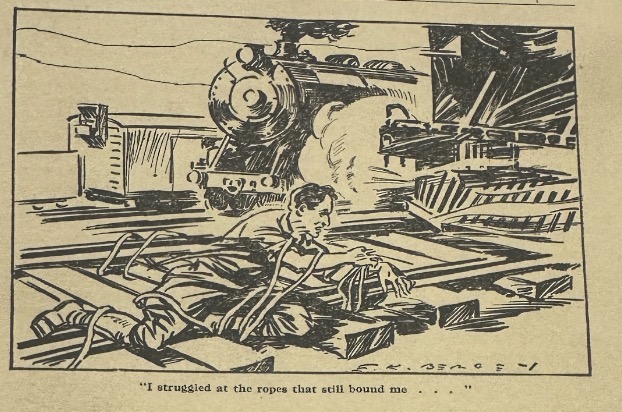
The Express Train Escape
EARLY in the days of motion pictures, one of the greatest “thrillers” was the rescue of the heroine from a railway track, effected by the hero from the cow-catcher of an onrushing locomotive. Sometime this was done with dummies; or the picture was taken backward, the man placing the woman on the tracks.
When this stunt was attempted legitimately, the result was an accident that cost the life of the actress.
Yet the thrill of escaping death before a modern juggernaut carried a popular appeal that could never fail to create excitement.
Perhaps it was Houdini’s early adventure in front of a locomotive that suggested to him the thrilling feat of escaping from ropes before the arrival of a fast express—but whatever the cause, he devised this exciting exhibition and performed it while in Europe. Through unforeseen circumstances, it came near being his last performance. The story which he told of it borders upon the miraculous.
“In Dresden, Germany,” said Houdini, “I had a most thrilling experience in connection with a railway train. I was lashed to the track and had to get loose before the train arrived.”
This was a precarious position for anyone; but the master escape wizard knew, his own ability, and he was able to calculate just how long he would need to effect his realease. He worked on the ropes and, finding his task less difficulet than anticipated, did not hurry his efforts.
But here the unexpected occured. In the twinkling of an eye, he was faced with terrible danger, his plans gone wrong, and death but a few seconds away!
“Through an error in calculation,” he said, “my time proved shorter than I had anticipated. While I still thougth I had several minutes ahead of me, the swiftly moving express train came on the scene, and roared into view a short distance away!
“I had just loosened my hands, and was working to release my feet. They were still tied to the rail, and I did not have time to free them!
“I struggled at the ropes that still bound me, and, almost at the last instant, I managed to discover sufficient slack in the rope to throw my body to one side, and pull my feet, still bound, down beside the rail.
“Less than a second later the train thundered by and missed my feet by inches, cutting the rope instead! This completed my release, and instead of finding my mangled body the spectators discovered me free and standing by the railway track!
“Some time later I learned that a motion-picture actor attempted the same stunt, planned beforehand; namely, letting the train cut the ropes; but he failed to work it and was killed.
I never did that particular type of release again, after my narrow escape.”
Luck and quick thinking saved Houdini’s life on that momentuous occasion. It stands as one of his most thrilling escapes, effected in an exciting moment, when failure meant sure death.
One of Houdini’s most dangerous experiences is related in our next issue. Heavily handcuffed, he leaped fifty feet into the ocean, risking his life under difficult and unexpected conditions. Be sure to read this spectacular story, which was related by Houdini himself.
Thanks, Joe. These are really great. Never saw this illustration for the railroad track escape before. This escape gets a mention in my book, but with a bit of skepticism, as I’ve never seen a contemporary source.
Nice stuff Joe!