Thomas Jefferson Found

Last week, I posted a blog about the Old Man Jefferson Connection which looked at Houdini’s connection with Joe Jefferson and Thomas Jefferson.  Joe Jefferson and Thomas Jefferson were sons of actor Joseph Jefferson III who was famous for creating the role of Rip Van Winkle.  Houdini appeared on the same bill as Young Joe Jefferson during his vaudeville days and he appeared with Thomas Jefferson who played Old Man Cameron in The Grim Game.  In that blog, I posted a photo of Young Joe Jefferson but not Thomas Jefferson.   As far as I know, there are no movie stills of Thomas Jefferson from The Grim Game and I have seen and cataloged most if not all of the movie stills from the movie. So what did Thomas Jefferson look like; I combed the internet numerous times and finally found 2 photos at the findagrave.com website:

Thomas Jefferson
Birth: Sep. 10, 1856 New York, USA
Death: Apr. 2 1932 Hollywood Los Angeles County, California, USA

Son of actor Joseph Jefferson who was believed to be the earliest actor to appear in films. Married to actress Daisy Robinson, Jefferson followed his father’s footsteps as a stage actor for nearly half a century.  One of his greatest stage successes was playing Rip Van Winkle which he did for twenty-five years.  Jefferson was a member of D.W. Griffith’s stock company for a time during his career. Actor in numerous films, Jefferson passed away at his home in Los Feliz following a brief illness.

Burial: Hollywood Forever Cemetery, Hollywood Los Angeles County, California, USA
Plot: Section 20B, #168 (unmarked)

Old Man Jefferson Connection

The following correspondence from Houdini to Quincy Kilby intrigued me when I read it in Houdini, The Key on page 96:

Hollywood, California June 9, 1919

Dear Q.K.

Thomas Jefferson and myself frequently converse about you, and it was through an accident that I found out young Joe Jefferson was a friend of mine.

I thought that young Joe was an old man, but it appears that he was younger than I.

Worked with him in vaudeville, that is he was on the same bill, and very pleasant, and very pleasant weeks we had

So Mr. Thomas J. and I have lots to talk about…

It intrigued for a number of reasons:

First off the date of the correspondence is during the time that he lived in Hollywood and was filming the Grim Game.

Srapbook compiled by Quincy Kilby
Img: flickr/boston_public_library

Second, who was Q.K.? Quincy Kilby, was a personal friend of Houdini, who compiled a Houdini scrapbook which is in the Boston Public Library.  He also wrote a history of the Boston theatre, and another book on actor/assassin John Wilkes Booth.  He spent 20 years accumulating the items in his Houdini scrapbook.  These include letters, newspaper clippings, and a very exciting scene and prop list.  Houdini knew about Kilby’s project.  He sent his friend items marked “for your Houdini scraps book.”

Joseph Jefferson III as Rip Van Winkle

Third, who was young Joe Jefferson?  Let’s look at who his father was first. Joseph Jefferson III (1829-1905) was the 4th generation of a theatrical family that was established by Thomas Jefferson (1728 -1807), an English actor who managed several theatres.  Thomas’s son Joseph Jefferson I (1774-1832) came to America in 1795 on tour and remained to manage the John Street and Park Theatres in New York and the Chestnut Street Theatre in Philadelphia.  He played a comic actor.  Joseph Jefferson II (1804-1842) was an actor as well.  All three Jefferson’s were noted for playing old men.  Joseph Jefferson III was born 20 February, 1829 at Philadelphia United States of America, son of Joseph Jefferson, actor, and his wife Cornelia Frances Thomas Burke.  He began is stage career at 4, and, after his father died in 1842, relied on acting for a living. At 21 he married Margaret Clements Lockyer. On February 18, 1861 his wife died, leaving four children.  On December 20, 1867, he married Sarah Warren the niece of the actor William Warren. Fame came with his creation of the role of Rip Van Winkle. He died in 1905.

Young Joe

Joseph Warren Jefferson IV was a child of the second wife.  He was born July 6, 1869.  He was a member of his father’s company.  So at the time of the Grim Game, Joe Jefferson IV would have been 50 years old and Houdini 45 years old, making young Joe Jefferson five years older not younger than Houdini. Joseph Jefferson IV (1869 – 1919) performed at Macauley’s Theatre three times in Rip Van Winkle.

And last but not least, what was the connection with Thomas J and young Joe? Thomas Jefferson played Old Man Cameron in the Grim Game.  Like young Joe Jefferson, Thomas Jefferson was one of Joseph Jefferson III sons. He acted in his dads company in several roles opposite his father.  He became an actor in D.W. Griffith’s stock company appearing with Houdini in The Grim Game.

The Plot Thickens

The following detailed plot synopsis appeared in the December 6, 1919 issue of The Moving Picture World:

Harvey Hanford, the part played by Houdini in The Grim Game, is a special writer on The Call, who is noted for his nerve and daring in gathering news.  He has an eccentric millionaire uncle who lives with his ward, Mary, and will not let Harvey come near him.  The old man knows that his nephew and his ward are in love with each other, and is opposed to the match.  He is also aware that he is surrounded by three men, any one of whom would profit by his death.  The first is his lawyer, Richard Raver, who has misappropriated some the Cameron funds.  The second is Dr. Tyson, his physician, who expects to marry Mary, heiress to the Cameron millions, when their owner dies.  Clifton Allison, owner and publisher of The Call, is heavily in debt to Cameron, and the old man has threatened several times to drive him to the wall. 

A plan is hit upon by Harvey to work up a big sensation for the paper by getting the old man away secretly and then making it look as if he (Harvey) had murdered his uncle.  After he has been convicted of the crime, Dudley Cameron will be brought back and circumstantial evidence will be given a heavy blow.  The three men agree to this, but each one is determined that the old millionaire shall never return home alive.

The scheme is set in motion and Harvey is arrested for the murder of his uncle.  Then commences a series of Houdini escapes, the last one being a genuine thrill and the most dangerous of the Handcuff King’s career.

While trying to change in midair from one flying machine to another, the two airplanes crash into each other.  This, of course, is an accident, but the camera caught it and also the dive to earth of the machines which followed.  None of the actors in the accident were seriously hurt, and The Grim Game is able to show on the screen an “escape” that is a thriller of thrillers.  The story is brought to a highly satisfactory close, and Harvey and Mary are united.

Double Take Links

On June 8th, 2012, I posted a blog titled, Double Take, which looked at a pair of magazine ads advertising The Grim Game that look the same but are are different.

On January 7th, 2012, I posted a blog titled, L302-55 versus L302-60, which showed two famous images of Houdini standing shackled in a Jail Cell with cuffs and ball & chains that are similar but slightly different images.

Kevin Connolly Collection

Today, I am posting links to two incredible double-take blogs, that our friend Kevin Connolly posted in February of 2011that show identical Houdini images being used for different movies:

I hope you enjoy these double takes as much as I did?

Houdini’s “Strange Power Over Locks”

Above all, the performer must give the impression that he possesses some mysterious power over locks.” [Burling Hull, the Challenge Handcuff Act]

According to Patrick Cullington [Houdini the Key], Burling Hull added this text to the written instructions that went with Houdini’s Defiance Handcuff act when he republished them under his own name. Hull didn’t steal that idea from Houdini’s writings, he stole it from Houdini’s act.

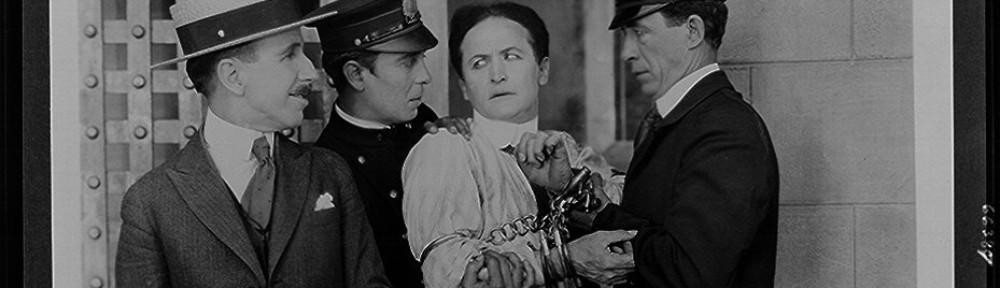
Houdini’s “strange power over locks” was demonstrated in every performance of his handcuff act and it was definately demonstrated in his movies as evidenced by The Grim Game movie stills depicted in this blog. 

Everything about Houdini’s expression indicates that he is exercising a “power”. [Patrick Cullington, Houdini the Key]


And is saved by an Awning?

According to Ruth Brandon and Milbourne Christopher, Houdini frees himself from a strait-jacket, falls into an awning, rolls into the street under the wheels of a moving truck, grasps its underside and rides away:

  • He was captured after a fight and, as one might expect, taken up to the roof of the building, strapped into a strait-jacket and suspended head down over the street below.  (He freed himself, fell into an awning, rolled into the street under the wheels of a moving truck, grasped its underside and rode away). [Ruth Brandon, The Life and Many Deaths of Harry Houdini, page 207]
  • Captured after a fight, Houdini was taken to a rooftop, strapped in a straitjacket and suspended head down over the side.  He released himself, fell into an awning, then dropped to the ground.  Then he rolled under the wheels of a moving truck, grasped the underside and rode away beneath it. [Milbourne Christopher, Houdini The Untold Story, page 163]


According to the Paramount Script, Houdini frees himself from a strait-jacket, swings like a pendulum at the end of the rope, catapults his body through a small window; and then scales a wall and disappears over the other side.

According to the Paramount Script, Houdini leaps down into an alley-way and makes a dive under a fast moving truck after he escapes from a jail cell, not after he escapes from the strait-jacket as Ruth Brandon and Milbourne Christopher suggest.


So which sequence is correct?

  • (A) Strait-Jacket,  Awning, Truck
  • (B) Strait-Jacket, Window, Wall
  • (C) Jail, Truck
  • (D) B and C
  • (E) None of the above

I believe the answer can be found in the following:

This insert appears to be in chronological order and follows the Paramount Script with the exception, that there is was no scene that mentions an awning in the Paramount Script.

So based on all of the circumstantial evidence, I believe the following:

  • Answer A is incorrect because it includes the Truck and not the Wall
  • Answer B is incorrect because it includes the Window and not the Awning
  • Answer C is correct because it follows Paramount script and chronological insert
  • Answer D is incorrect because B is incorrect
  • Answer E is incorrect because C is correct

That is, I believe that the Awning scene (lobby card L302-75) did happen as part of the strait-jacket escape and appears in the movie.  However, I believe the truck scene happened as part of the jail escape not the strait-jacket escape.

Hopefully, one day I will know for sure.  What do you think?

Patrick Culliton — The Key

Yesterday, I got to meet The Great Patrick Culliton (aka Houdini’s Ghost) in person at the Magic Castle in Hollywood, California.  It was a great experience:

Patrick Culliton is the author of Houdini –the Key (published date October 31, 2010) which has a limited edition of 278 (Note: Houdini had a New York home at 278 West 113th Street in Harlem).

Houdini — the Key is intended as a reference book on the secrets of Houdini’s magic and escapes and I was fortunate enough to receive copy# 222 from Patrick on Friday the 22nd of June (which I was reminded was Harry and Bess’ anniversary).  

In fact the only reason, this book has not sold out a long time a go, is because Patrick is maintaining a one per customer policy which I admire and appreciate. Earlier in the week, I emailed Patrick to see if he still had any copies left. He did and instead of mailing it to me, he offered to bring it to me or have me meet him at the Magic Castle to pick it up; we agreed to meet at the Castle for lunch on Friday, June 22nd.

Patrick believes that this book is a key because the notes and references, not to mention the 940 illustrations, will unlock a thousand doors for anyone researching Houdini and his methods.  The book is incredible and I am going to have fun unlocking the doors.

Patrick signed my book on top of the milk can (willed to the Magic Castle as an original Houdini prop) in the Houdini Séance Room.  He was also gracious enough to sign my copy of Houdini’s Strange Tales that I purchased in Appleton Wisconsin in the 90’s.

After signing the books, we went to the close-up room to catch a performance by Henok Negash.  While waiting for the show to start, I learned that Patrick once owned 2 different sets of lobby cards for “The Grim Game” before he sold them.

After we saw the outstanding close-up show, we went upstairs to have lunch in the transformed Dante Room. Milt Larsen transformed the Dante room into a kind of big square round table where you never know who will show up.  Patrick introduced me to a number of people, which I appreciated.

I learned that Patrick once owned an authentic substitution metamorphosis trunk before he sold it for quite a large amount of money.

Patrick asked me if I had ever heard of the Witch’s house (aka The Spadena House) in Beverly Hills.  He proceeded to tell me that it was originally built in 1921 to serve as the offices and dressing rooms for Irvin Willat’s film studio in Culver City, and was moved to its present location in 1934.  I learned that Billie Love was married to Irvin Willat but divorced him when she met Howard Hughes; Howard and Billie made 2 films together.  Note:  Irvin Willat directed The Grim Game.

During lunch, I asked Patrick if he thought I would ever get to see The Grim Game; he told me that it used to be rented out and shown at magic clubs way back in the day.  He confirmed that Larry Weeks (supposedly, Houdini’s biggest fan) is in a convalescent home and will not release his print.  He mentioned that David Copperfield was interested in acquiring a print; this is not surprising that David who has one of largest Houdini Collections would be interested, but I don’t believe he has been successful. I would love to have a copy of the print, but I would settle for just seeing the film.  I have been told by a few people now, that one day, I will get to see The Grim Game; I am looking forward to that day.

After lunch, I got a nice tour of the library and spent about a half-hour in the Houdini section looking through some booklets.

I then thanked Patrick for making my day and left with my treasures. 

I am now ready to start unlocking the treasures found in Houdini — the Key!
Double Take

What is the difference between these ads besides the variation in color?


Each version was the second page of a four-page ad created to promote the original release of the film.  The drawings on each are the same, but the text is quite different.

The first one is the version that appeared in my copy of the MUM Society of Americans Magicians Monthly, New York August 1919. The second one most likely appeared in some magazine as well due to the few staple holes.

Below is the breakdown of the text for comparison.  The text for the first version is in bold and the text for the second version is in italics.

HERE’S HOW IT HAPPENED
YOU READ IT IN THE PAPERS NOW SEE IT IN THE PICTURE!

On June First, 1919, the Associated Press carried from Los Angeles a story of the thrilling aeroplane accident that took place during the filming of “The Grim Game.”
The Associated Press on June 1, carried from Los Angeles a story of the most amazing aeroplane accident that has ever occurred. 

The story of the two planes which crashed together in mid-air and plunged to earth buzzed on the wires to every newspaper in America.
Amazing because no one was hurt, though two machines collided and fell thousands of feet to earth.

You will see the collision in “The Grim Game”.
The accident occurred in the filming of “The Grim Game”

It was an accident, but the camera man had the presence of mind to keep it turning.
The camera man in the third plane was cool-headed enough to keep on turning, though he was sure that the occupants of both machines would be killed.

The drawings on this page show how it happened.
The drawings on this page show what you see in the film. 

Houdini on the rope attempts to descend to the lower plane. 
Houdini prepares to descend to the plane beneath him. He swings off onto the rope.

The camera man was in the third machine.

The lower machine turned its propeller upward – the propellers gnashed together—
The lower plane turns its propeller upward – The propellers gnash together!

The lower plane crashed into the upper one – cutting off a wing –

The two planes, locked and helpless, crashed to earth!
The two planes lock – They plunge to earth!

It’s all in the picture – and lots more! 

The greatest thrill in the greatest thrill picture ever made!
A thrill that can never be duplicated!


Note: The third and fourth pages of the four-page ad are the same; And the first page of the four-page ad is the same with the exception that the ad that apprears in the MUM Society of Americans Magicians Monthly, New York August 1919, has one extra line of text added: Endorsed by the Society of American Magicians

S.A.M. Endorses Houdini’s Picture “The Grim Game”

The Grim Game is endorsed by The Society of American Magicians;  As well as New York Mail, Morning Telegraph, New York Times, New York Tribune, New York American and Harrison Reports:

A special meeting of The Society of American Magicians was held at the Magical Palace, 493 Sixth Avenue, on Thursday evening, August 14th at 8:30 o’clock with President Houdini in the chair.  President Houdini extended invitation to members of S.A.M. present to attend a private exhibition of his latest motion picture production “The Grim Game”, which was eagerly accepted. [MUM New York, August 1919 p 21]

The endorsement was given at a private showing of the picture for the members of the society in New York, which was attended by Houdini, Howard Thurston, Francis E. Werner, G. G. Laurenz, Hardeen, William J. Hilliar and about forty others.  [The Sphinx September 1919, page 162]

After the showing, Mr. Howard Thurston said: “I have always thought Houdini was a great showman, but I expected nothing like this,  It leaves nothing undone.  Houdini may now retire, confident that he has done his greatest work.  It is one of the most wonderful things I have ever seen” [The Sphinx September 1919, page 162]

At the conclusion of Mr Thurston’s speech, Oscar S. Teale, Secretary of the S.A.M. said: “Gentleman, I move that the Society of American Magicians pronounce this picture a glowing success, worthy of highest commendation, and that it go forth as officially endorsed by this society.”  His move was quickly seconded, and the vote was carried unanimously.  [The Sphinx September 1919, page 162]

On June First

On June First, 1919, the Associated Press carried from Los Angeles a story of the thrilling aeroplane accident that took place during the filming of “The Grim Game.”  The story of the two planes which crashed together in mid-air and plunged to earth buzzed on the wires to every newspaper in America.

You will see the collision in “The Grim Game”. It was an accident, but the camera man had the presence of mind to keep it turning.

The drawings on this page show how it happened.

Houdini on the rope attempts to descend to the lower plane.  The camera man was in the third machine.

The lower machine turned its propeller upward – the propellers gnashed together—

The lower plane crashed into the upper one – cutting off a wing –

The two planes, locked and helpless, crashed to earth!

It’s all in the picture – and lots more!  The greatest thrill in the greatest thrill picture ever made!


For more information (photos and footage) of the aeroplane accident, see my other related posts: