Part 2: Is this really how it went down?

TC Dressing Room Punch Water Cell

If we are referring to the first preliminary green screenplay (4-23-52) for the movie “Houdini” starring Tony Curtis, then the answer is, YES.  

As a result of the blow (i.e., punch) described in Part 1, Houdini is in bad shape when he goes on stage a little later that evening to do his most hazardous escape — the water  cell:

As he is placed in the water cell upside down, he sees the grotesque Halloween costumes and masks of some of the children in the packed audience and his face shows fear as he realizes it is Halloween night.

The curtains are drawn across the cell at the regularly allotted time.  Bess apprehensively signals Otto who whips the curtain aside, discovers Houdini lying unconscious, and quickly smashes the glass with an axe…

Bess is beside the dying Houdini in ambulance.  His voice is barely audible as he says, “I’ll come back, Bess — I’ll find a way — “  Bess nods through her tears…

It is Halloween night, 1936, and Bess and Sydney arrive at the abandoned Houdini house.  For the past nine years on the anniversary of Houdini’s death, Bess has come here to see if he could contact her.  She promised him to try for ten years before giving up and tonight is to be the last attempt.

Bess and Sydney wait patiently in Houdini’s study which has kept intact. Midnight comes and again nothing has happened.  Sydney is urging the intense Bess to leave when suddenly she hears the Hungarian waltz. A beatific look comes over her face, and Sydney, hearing nothing is puzzled.  Bess sways to the music and moves over to a faded poster.  It reads Schultz Dime Museum and shows a picture of Houdini at the age of twenty, wearing is ill-fitting dress suit and pulling a rabbit out of a silk hat.  The music swells to a crescendo….  [Screenplay read and summarized by Dorothy Harrington, 4-30-52]


If we are referring to the final version of the Tony Curtis movie (1953), then the answer is NO.

It went down like this:

Houdini is lying down in his dressing room, and winces, when Otto touches his stomach.

Otto: “Still hurts you there doesn’t?”

Houdini: “It’s alright.”

Otto: “You should have had that taken care of a long time ago.”

Houdini: “It’s nothing, it comes and goes.”

Otto: “I think it is your appendix”

Houdini: “Since when have you been practicing medicine?”

Otto: “You don’t have to be a doctor to know that something is wrong”

Houdini: “Alright I will have it looked at as soon as we finish the tour”

Later that evening, Houdini performs the Barrel Escape and the Steel Strait-Jacket Escape, but the audience wants more; they want the Torture Cell.

Houdini goes into his dressing room to prepare for the Torture Cell when he accidentally bumps his stomach against the handle of a sword protruded from a sword box illusion.  He is in obvious pain.

He enters the Pagoda Torture Cell. Houdini passes the time-limit and the cabinet is broken open, flooding the stage.  Houdini is still hanging in the cabinet, unconscious.

Bess is then seen beside the dying Houdini on stage.   He regains consciousness long enough to promise her that he will come back to her, he will find a way somehow.

We then hear the Hungarian Waltz and fade to a poster that reads Schultz Dime Museum and shows a picture of Houdini at the age of twenty, wearing is ill-fitting dress suit and pulling a rabbit out of a silk hat.  The music swells to a crescendo…  The End

According to the man (Jon Oliver) that currently sleeps in Houdini’s bed: It is believed that they changed the movies ending from Houdini getting punched to him dying in the cell because the lawyers at Paramount did not want to get a law suit since the students were still alive.  For another reason the ending could have changed, check out A New Twist on The End of Houdini by Tony Curtis.

If we are referring to how Houdini died in real life WRT the Houdini death blow (i.e., punch), then you will need to talk to Houdini’s Ghost (Patrick Culliton) or The Female Houdini (Dorothy Dietrich) for an answer and rethink the rethinking on the Houdini punch.

What are some things Harry Houdini and Tony Curtis have in common?

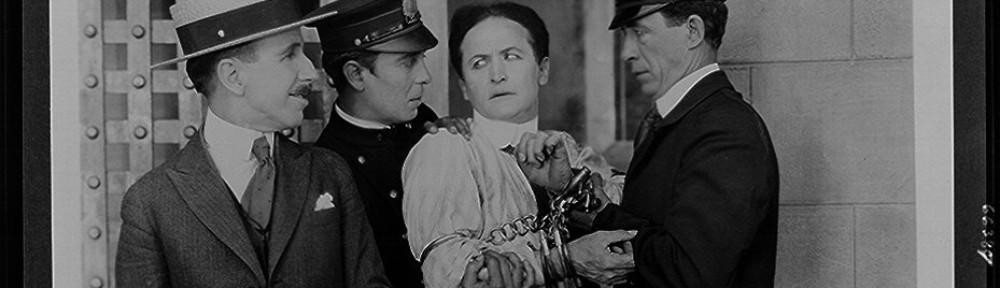
Young Tony Curtis and Young Houdini performing Magic [German Newspaper clipping from Janet Leigh Collection at Margaret Herrick Library]

Both performed most of their own tricks/stunts in their respective films:

  • Tony Curtis performs many of the tricks of the master himself in “H o u d i n i,” the Paramount picture…This accomplishment is probably worth noting, since the illusions could so easily be faked in a medium that itself used to be known as “the magic lantern.” [Newspaper clipping from Janet Leigh Collection]  In fact, George Boston (magic instructor) and Joe Dunninger (magician who inherited some of Houdini tricks and books) were technical advisors on the magic and escapes.
  • Harry performed most of his own stunts in “The Grim Game”, despite the fact that they could easily be faked by movie magic editing and using a stunt double (e.g., plane to plane transfer).

Both performed magic tricks on the set of their respective movies:

Both got injured making their respective movies:

Both are Kings of Cards:

  • Tony Curtis King of Cards Still [Paramount Pictures Corporation]

In Search of Original Houdini Material for 1953 Houdini Movie, Part 2 of 2

While looking through the production 11495 department records (In Search of the Lost Plane to Plane Transfer) at the Margaret Herrick Library Academy of Motion Picture Arts and Sciences, I came across some very interesting correspondence WRT to Paramount trying to locate some original Houdini material for use in the 1953 movie starring Tony Curtis and Janet Leigh.  Part 1 focused on the Milk Can and Part 2 will focus on Houdini’s Water Torture Cell(s).

Below is the text from a letter dated May 6, 1952 from Gordon Cole of Paramount Pictures, Inc to Mr. Sam Frey (Paramount Executive):

MR SAM FREY:

Will you please include in the night wire to New York the following message:

I have been advised that Julian B. Proskauer, 148 Lafayette, Canal 64450, may have or know the where-abouts of the original Chinese Water Torcher Cell, used by Houdini.

Could this be checked and advise us if the cell is available to us, condition and cost.

Gordon Cole

Below is the text from a letter dated May 8, 1952 from Gordon Cole of Paramount Pictures, Inc to Hillar:

Dear Hillar:

Herewith two photographs of the Chinese Water Torture Cell. You will note that they are apparently two different cells in construction and I do not know which one you have located in New York.

As I explained to you by telephone, we will undoubtedly have to fake the cell as far as our actor is concerned.  It may be necessary to put a double glass in the front with water between the two glasses so that our actor in the back doesn’t drown.  We estimate the cost of construction here of the cell at roughly Fifteen Hundred Dollars ($1500.00), and it may prove in the final analysis, better that we build it here for picture purposes, rather than use the original but we cannot afford to overlook the one in New York for the moment.  It may be that the cost of getting the cell from Massachusetts, shipping it to the Coast, reshipping it to you, working it over, etc. can be more costly than starting from scratch.

If you do not think it favorable to attempt to ship the cell from New York here, and it does match either one of the photographs, it would be a great help to us if you could give us detailed dimensions, as we have nothing but photographs from which to construct the cell.

Thanks for all your trouble and hope to see you out here this summer. Best regards,

Gordon Cole

Below are pictures of Houdini’s water torture cells:

In Search of Original Houdini Material for 1953 Houdini Movie, Part I of 2

While looking through the production 11495 department records (In Search of the Lost Plane to Plane Transfer) at the Margaret Herrick Library Academy of Motion Picture Arts and Sciences, I came across some very interesting correspondence WRT to Paramount trying to locate some original Houdini material for use in the 1953 movie starring Tony Curtis and Janet Leigh. Below is the text from a letter dated May 22, 1952 from Julien J. Proskauer (Theo Hardeen’s closest friend, past publisher of Conjurors Magazine and co-founder of Magicians Guild) to Mr. Gordon Cole of Paramount Pictures, Inc:

Dear Mr. Cole:

I am sorry that I did not get this issue of Conjurors’ Magazine off to you earlier.  It was very difficult to find a copy which was not defaced too much.

You will find on page 8 a copy of the only picture made with Hardeen and Houdini in an early model Winton motor car. On Page 13 is the story of the Milk Can which I referred.

You may recall that I mentioned the “Book of Life.” On pages 20 and 21 is the story of this illusion, and on page 35 is the complete working diagram showing the girl inside of the binding of the “Book.” Houdini and Hardeen had discussed this illusion as early as 1920 but nothing was done with it until a few months before Hardeen’s death, when we took the original working diagram from Houdini’s confidential books (found in a trunk at Hardeen’s home) and all of us doped out that which you see here.

Incidentally on page 23 is an accurate photograph of the original “overboard box.” This was the so-called “break away”which for many years was used by both Houdini and Hardeen.

Of great interest in the same issue is the picture of Houdini on page 22 in the Milk Can Escape pictured in full detail on page 1 of the book. This was the Milk Can Escape that Houdini made famous.  The original can is for sale at this date.

My interest, as I explained to you, is solely that of insuring that the picture is correct. On page 12 of this issue are the handcuffs that Hardeen inherited from Houdini and are now in the possession of members of the Magicians’ Guild. Mr. Dunninger is not a member of the Guild and does not own any of these handcuffs.

I trust that this letter is quite explanatory both as to the existence of Houdini material as shown on page 40 and throughout this entire issue.  I shall be glad to put you in touch with Douglas Geoffrey “Hardeen, Jr.”who owns all rights and titles to the “Houdini-Hardeen Show.”

Sincerely,

Julien J. Proskauer

Note: During Houdini’s life, no one ever escaped, or was permitted to escape, from the Houdini milk can. Hardeen built a second milk can which was gimmicked in 1928. No one ever used this can or knew the secret beside Jim Collins until in 1930, Theo Hardeen taught the escape to Julien J. Proskauer, who in later years became a co-founder with Hardeen of the Magicians Guild. Mr. Proskauer made the escape countless times using Jim Collins as his Assistant. [Page 13 Conjurors Magazine No. 6 July 1945]

The photograph above shows,- Hardeen making the escape with Douglas Geoffrey and Jim Vickery as his Assistants.

In Search of Original Houdini Material for 1953 Houdini Movie, Part 2 of 2 will include correspondence WRT obtaining Houdini’s original Water Torture Cell(s).

1953 Houdini: In Search of the Lost Plane to Plane Transfer

For some time now, I have been intrigued by John’s blog at Wild About Harry titled: LIFE photos reveal cut wing walking sequence in 1953 Houdini biopic.  So last year, I decided to go to the Margaret Herrick Library Academy of Motion Picture Arts and Sciences in search of the Lost Plane to Plane Transfer.  I got to look at the press book, stills, newspaper clippings, and a number of different versions of scripts for the 1953 movie starring Tony Curtis and Janet Leigh.

Unfortunately, there were no plane photos/footage, nor any mention of the plane to plane transfer in any of the versions of the script that I read.

However, I did discover the mention of the plane transfer buried in some production 11495 department records:

Apparently, on October 21, 1952, it was listed as Montage number 5 of 6 montages:

  1. Needle Trick
  2. Levitation
  3. Bullet through Woman
  4. Cremation
  5. Plane Transfer (Crank at 16)
  6. Shot of Canon Close up Tony

Note: Montages 4, 5 and 6 did not make the cut, but montages 1, 2, and 3 did appear in the movie.

It was still listed as a Plane Transfer montage on a production call sheet dated: FRIDAY, OCTOBER 31st, 1952, along with the Needle Trick, Levitation, Bullet thru Woman, and Cremation montage. Also, the Milk Can shows up for the first time on this call sheet as a montage, but the canon montage is missing on the call sheet. Note: The Milk Can did not make the cut, either.

Also, on a RETAKES AND MONTAGES sheet dated 10/31/52 there is a brief description of a plane transfer shot taken on 10/31/52 that read as follows:

  • MED. LONG SHOT – Houdini on rope swings to wing of plane – MOVES DOWN as he lands – releases rope – climbs down (BLACK & WHITE).

The RETAKES AND MONTAGES sheet also included a brief description of montage shots for the Canon, Cremation, Milk Can and others (e.g., Bullet thru Woman, needle trick, levitation, card tricks).

In reading the scripts and shooting schedule for the movie, discovered some other illusions/routines that did not make the final cut: IRON MAIDEN ILLUSION, ELEPHANT ROUTINE, PAPER BAG ESCAPE, WINDMILL ESCAPE, CARETTE ESCAPE, FOOTBALL ESCAPE, and BURIED ALIVE ESCAPE.

Although there were no photos of the plane transfer, there were some LIFE photos of Janet Leigh and Tony Curtis performing the Cremation Illusion and the Bullet thru Woman Illusion. Also, there were a couple LIFE photos of Janet Leigh escaping from a
see-thru lace straight jacket which unfortunately didn’t make it in the movie. And, there were two official Paramount Picture Corporation stills, 11495-43 and 11495-78 that showed the cremation illusion and the milk can escape respectively.

In future related blogs, I plan to describe some correspondence WRT trying to locate original Houdini material (e.g. handcuffs, Milk Can, Overboard box, Book of Life illusion, and Water Torture Cell) for use in the 1953 movie.  As well as describe in more detail some of the montage escapes and illusion sequences that didn’t make the cut.  I also plan to do a blog on what Harry Houdini and Tony Curtis have in common?