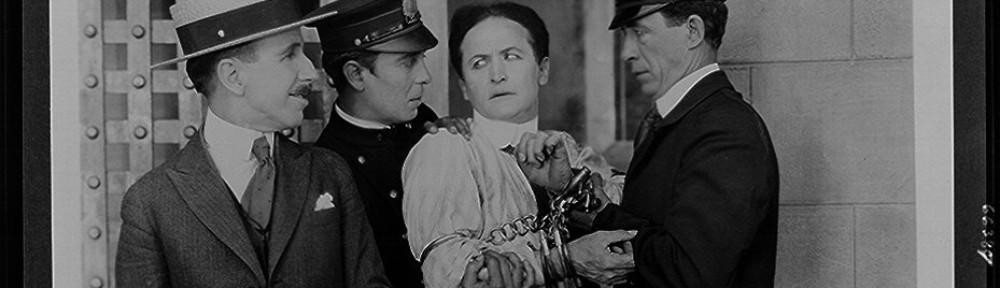
THE GRIM GAME Cinema Trade Promotion (Stills 298-54 and 298-63)

Last week I posted a snippet of an article by Bayard Grimshaw about THE STUDENT AND THE BLOW from Abracadabra Magazine Saturday 23rd March 1974.   This week, in honor of the Oscars, I thought I would share a Grim Game photo that was used in that same special edition of Abracadabra Magazine:

GG cinema trade photo 001

This came from a sheet issued to the Cinema Trade to promote The Grim Game Movie in 1919.

The bottom image is from still 298-54 .

Mary [Ann Forrest] is visiting Houdini at the jail to let him know that hoax is going according to plan.  The guard then gives them contrary news:  “They found the body [Cameron] in the old well – poor place to hide it.  Guess your trial will be a short one”.  Houdini smiles and voices his doubt.  The guard tells them he is not joking…Gradually the truth of the matter that Cameron is really dead is forced home on Houdini and Mary.  Houdini tells Mary to go see the others and tell them to explain the hoax and have him released. [scenes 212-225 Paraphrased from Paramount Files at Margaret Herrick Library]

And the top image is from still 298-63 and is part of the sequence where Houdini escapes from the jail after Mary leaves.  See the following earlier post for details:

The Student and the BOOK?

Whitehead Image

J. Gordon Whitehead circa 1950

The student is J. Gordon Whitehead, but what is the deal with the BOOK.

Whitehead is the one that punched Houdini in the dressing room at the Princess Theatre in Montreal on October 22, 1926.

Returning a borrowed book was supposedly how he gained entry to Houdini’s dressing room that fateful day.

Where did the return a borrowed book idea come from?

This question intrigued me so, I decided to investigate further.

If you examine all of the affidavits, none of them mention Whitehead returning a book.

If you examine all of the biographies, Milbourne Christopher’s, The Untold Story, appears to be the first one to mention a borrowed book being returned.  So where did Christopher and the later biographers get the idea.

The following snippet from an article written by Bayard Grimshaw gives a clue:

THE STUDENT AND THE BLOW

The full story of the events leading to Houdini’s death was first told, to the best of my knowledge, in a well-written, detailed article by Stanley Handman which appeared in the Canadian Weekend Picture Magazine for 12th September, 1953. The account is so circumstantial, and contains so many independently verifiable facts, that there is no reason to doubt its accuracy.

The full article, with its five illustrations, was reproduced as a supplement to The Magic Cauldron in October, 1965.  [Abracadabra Magazine Saturday 23rd March 1974  page 230]

Sam J. Smiley [student that made a drawing of Houdini in the dressing room] is the source of the article.  It is believed that Stanley Handman gave his column that week to Smiley.

Below is a portion of the Was Houdini Killed? article by Smiley that is applicable to this post:

While Houdini was thus discoursing and I drawing, there was a rap at the door, and Houdini’s secretary ushered in a rather tall individual – he must have been at least six foot two – wearing a blue gabardine coat that seemed much too small for him, and carrying three or four books under his arm. The newcomer appeared to have known Houdini and had, in fact, come that day to return a book Houdini had loaned him a few days before; his name was Whitehead, and he was the theological student at McGill University.
Whitehead was an oldish looking young man about twenty-seven or twenty-eight years of age. He impressed one as being the very genteel type of student. His face was ruddy, his hair very thin on top; his frame was powerful though loosely-knit, and his neck was inordinately long. He spoke softly with an exaggerated Oxford accent.
With the advent of Whitehead the conversation continued anew, and though I was disturbed from time to time by the fact that Houdini had to turn his head to answer Whitehead’s numerous queries (for he was an enthusiastic talker) I found a good deal of interest in what was said…
It seems that Houdini had been a detective for many years and had aided in unraveling so many mysteries and had read so many detective stories, that he boasted of being able to piece together any detective story, unknown to him of course, by hearing three or four paragraphs from different sections of such story. Whitehead, who had a mystery book with him, tried the experiment; he read excerpts from three or four different sections of the book, and Houdini apparently was able to give the gist of the story. At this juncture Houdini made an observation which I shall always remember, “think of the trouble I might have caused if I had used my talents for ill.”
More conversation and then Whitehead asked Houdini another question. “What is your opinion of the miracles mentioned in the Bible?”
Houdini tactfully replied, “I prefer not to discuss or to comment on matters of this nature. I would make one observation, however, – what would succeeding generations said of Houdini’s feats had he performed them in Biblical times? Would they have been referred to as ‘miracles’?”
Whitehead appeared to be somewhat taken aback at this statement.
It was at this point that Whitehead began to manifest what seem to me an astonishing interest in Houdini’s physical strength. Then, out of a clear sky, Whitehead asked, “is it true, Mr. Houdini, that you can resist the hardest blows struck to the abdomen?”

Of course much of the above now appears in the biographies by Silverman, Kalush and others.  As far as I know, Smiley’s article is the one and only source of a book being returned by Whitehead.  And it took almost 27 years since Houdini’s death to come too light. The 1953 article is also the first time that Whitehead’s name was first mentioned.

So, the return a borrowed book idea came from Smiley and only Smiley.

Thanks to Dick Brookz and Patrick Culliton for links to reference material (e.g., affidavits).

Related post:

Number 46 of top movies in 1919

Houdini The Movie Star Back Cover46. The Grim Game

Year:1919,Director:Irvin Willat
Cast:Tully Marshall, Arthur Hoyt, Thomas Jefferson, Harry Houdini, Ann Forrest, Augustus Phillips

According to movielist,

The Grim Game comes in at number 46 of top 50 movies in 1919:

The Grim Game comes in at number 4 of top 8 Irvin Willat (Director) movies:

The Grim Game does not make the top 50 Tully Marshall (Actor) Movies:

•             http://www.movieslist.in/actor-actress/tully-marshall/films#

The Grim Game comes in at number 34 of top 50 Arthur Hoyt (Actor) movies:

The Grim Game comes in at number 7 of top Thomas Jefferson (Actor) movies:

•             http://www.movieslist.in/actor-actress/thomas-jefferson/films#

And The Grim Game comes in at number 1 of top Harry Houdini movies according to Harry Houdini Circumstantial Evidence.

Whitehead Second Visit

Whitehead Image

Only Known Image of Whitehead (circa 1950 Montreal)

First, let me start off by saying that the purpose of this post is not to argue one way or another WRT the intent of the infamous Whitehead punches; I will leave that to others. My purpose is to share and comment on the fact, that according to the sworn affidavit of J. Gordon Whitehead, he visited Houdini three times (i.e., two times after delivering the punches to Houdini); I found that to be quite interesting; feel free to draw your own conclusions to the significance of this. You can find a copy of the affidavit at Patrick Culliton’s Houdini’s Ghost website:

It is the second visit mentioned in statement 25 of the affidavit that I found fascinating:

  • 25. I called again on Houdini at the theater on Friday morning the 22 October 1926 at 10 AM during our conversation we spoke of longevity and he gave me a copy of the “Scientific American” for November;

After reading that statement, I just had to get a copy of the Scientific American for November 1926.

SA Nov 1926 Cover

Click on the page links below to read the Albert A. Hopkins article in November 1926 Scientific American on longevity that Whitehead mentions.

  • How Death Deals Its Cards: Death in a Thousand Shapes is Knocking Eternally at Everyman’s Door. [Page 362] [Page 363]

The article with an interesting title presents U.S. mortality statistics for 1923 by cause of death.  Don Bell (author of The Man Who Killed Houdini) mentions that it may have interested Whitehead to know that 8.12 percent of total deaths that year or 98,030, were caused by diseases of the digestive system, and there were 7,878 homicides.

I also found statement 11 of the Whitehead affidavit fascinating as it relates to statement 25:

  • 11. I had previously mentioned a book I had read which set forth the requirements of good health, such as the care of the skin, the maintenance of an abdominal muscular corset, and a good digestion;

Thoughts?

The infamous glass of water

HandCuffHarryHoudini

This photograph of the ‘Handcuff King’ was taken while Houdini was appearing at the London Hippodrome in 1904 – the occasion of his Mirror Challenge.

The March 17, 1904 Mirror Handcuff Challenge [click link to read a full account]

In the 1929 Sensational Tales of Mystery Men by Will Goldston:

  • At the end of an hour, he asked his wife to bring him a glass of water.  This she did, placing it on the edge of the cabinet.  Houdini took the glass between his hands and drained it.  Ten minutes later, he emerged from the cabinet and flung the handcuffs on to the stage.

In Houdini by Kenneth Silverman:

  • Houdini did not reappear for another thirteen minutes [35 minute mark]. Perspiring this time, his stiff collar broken, he explained that he needed to stretch his aching knees but was determined to continue.  Parker or by one account Bess gave Houdini a glass of water and [the Mirror Representative] consulted with the manager of the Hippodrome, who directed an attendant to bring a large cushion.  [Note: Silverman incorrectly refers to the Mirror Representative as Parker]

In The Secret Life of Houdini by Kalush:

  • Then at thirty-five minutes, Houdini emerged again.  His collar was opened, and sweat poured off his face. “My knees hurt and my legs have cramped,” Houdini explained. “Please allow me to stretch them.  I am not done yet.” The crowd cheered.  Mr. Parker, the manager, brought Houdini a glass of water.  Then the Mirror Representative conferred with Parker.  Parker nodded his head and signaled to an assistant. In seconds, the assistant was back with a large cushion.

In most newspaper accounts, a glass of water is not mentioned, only the large cushion.  The newspaper account that I found that mentioned the glass of water does not mention the large cushion nor does it mention who gave him the glass of water:

  • After the expiry of 32 minutes he re-appeared, sweating profusely, and with his collar hanging down his back. He wanted a drink of water and having quenched his thirst, retired once more.

Many magicians assume Houdini must have had a key to the cuff. If this is true, how did Houdini get the key?

Will Goldston, writing in his Sensational Tales of Mystery in December 1929, claimed that an informant of his “whose sources of information are usually correct”, had told him that Bess smuggled it to him when she gave him a drink of water.  The story goes as follows:

  • Houdini never escaped from the handcuffs.  After an hour’s struggling, the magician realized he would never escape.  So he asked his wife for a glass of water and gave her to understand that she would have to procure the key at all costs.  Bessie, realizing the terrible predicament of her husband, called one of the journalists aside, and frankly told him that her husband was beaten.  Since failure would have meant the end of everything for Houdini, whilst to the paper it meant but little, she asked to be given the key to pass on to her husband.  This request was granted.  It was rumored that Bessie placed the key in the glass of water and took it to Houdini on the stage.  Shortly afterwards, he walked from the cabinet with the handcuffs free from his wrists.

Considering the size of the Mirror Key, it would be hard to hide in a glass of water according to Kalush and Silverman; however, Handcuff Experts point out that the working area of the key is all that is required and that the key could have been cut down to a length of about 1 ½ inches.  The actual nested mechanism is only about an inch from the keyhole and not deep inside the cuff lock tube.

Bringing a glass of water for Houdini to drink does figure into several of his most phenomenal escapes, including the Hodgson torturing.

The October 24, 1902 Hodgson Torturing Challenge  [click link to read a full account] 

In Houdini – The Key by Culliton:

  • According to Richard Clegg Jr.: He guarded his little cabinet so’s nobody could tamper with it. They arranged that while he was there, if Houdini wanted anything – maybe a drink or something – he would tell my father and he’d hand it through.  But his brother traveled with him, and he asked my father if he could take him a drink.  My dad, said “if he wants a drink I’ll take it”, but in the end he decided to let him go up.  My father followed him, though, and watched him give Houdini this tray.
  • According to Myrum Carruthers: After he had been in the cabinet awhile he asked for a drink. This was taken to him by a woman (I expect his wife).  A member offered to take this to him but refused.  This was repeated quite a number of times.

Note: Bess and Hardeen were both nearby on the stage at the time.

In the Northern Daily Telegraph 24th October 1902:

  • The crowd, however, was fast losing patience, and they loudly hooted as Hardeen, brother of Houdini, approached the cabinet to give a word of cheer, or maybe some advice, to his imprisoned relative.  On receiving a refreshing drink Houdini, after again calling upon the people to have a little patience, exclaimed that every lock had been changed, and that made it all the more difficult for him to get free.

In The Secret Life of Houdini by Kalush:

  • And when the brother approached the cabinet to give him a word of cheer, some of the crowd began booing.  Apparently Houdini told Theo he was thirsty, because a cool glass of water was provided him.  Then he addressed the audience again from his cabinet.

Comments and Questions about the Challenges

So in the mirror handcuff challenge there was a glass of water and a pillow and in the Hodgson Torture challenge there was a glass of water and a tray.  In both challenges, Bess is misidentified by at least one account as bringing a glass of water to Houdini.  It was Parker, in the Mirror Challenge and Hardeen in the Hodgson torturing.

All kinds of questions could be asked about either challenge.  Was Houdini milking the situation, prolonging it for dramatic effect?  Had Houdini colluded?  Did a relative assist in the escape?  And did a glass of water really have anything to do with it. We may never know the answers for sure and they may be different for each challenge.

All of this has made me thirsty for a glass of water!

What is the Story of this Martinka Magic Token

Martinka Token (Front)

Martinka Token (Back)My son wanted to surprise me with something Houdini related for Christmas.  He was intrigued by a listing for a magic token from a shop, that Houdini was once president and owner [1919].  He did some more research, found 3 other Martinka magic tokens for sale and got the best looking one which turned out to be quite unique:

Martinka issued the first palming tokens in the late 19 century.  Not gimmick’d or gaffed in any way, it was designed simply to be easier to palm and show up well when performing.  Over the years they issued multiple designs (LT, AH L/LT, D/D, V/V, Dash 1/Dash 2) and sizes in various materials (Gold, Brass, Copper, White Metal, Aluminum).  You can determine the design by what letter the right hand is below. In the D design, the hand is below the D of DECIPI, but a little to the left.

This half dollar D/D design shows a conjurer (Hermann?) standing astride the top of the world, producing a profusion of objects from the end of the wand in his right hand and from a top hat in his left hand, while around the edge of the field is the legend “MUNDUS VULT DECIPI: DECIPIATUR”.  The reverse bears the same design. The Latin phrase translates as: “The world wants to be deceived: let it be deceived”.

This brass coin covered with a thin gold wash was issued by Martinka. It is quite scarce and has a story attached to it:

The gold washed tokens appear to have been produced for, or at least used by a professional magician, Frederick Eugene Powell. Since they were the D/D type they were made later than the others.  One of the tricks in which Powell used them employed a picture frame suspended in the air by cords.  The frame had glass front and back and nothing between.  Five gold tokens held in his hands vanished one at a time, immediately reappearing visibly between the sheets of glass. FWK, Jr. acquired this frame and it still had three of the gold pieces in it.  Edgar Heyl acquired his example from the late Dr. Eugene L. Bulson of Fort Wayne.  Many years ago Dr. Bulson bought three of them in mint condition from the Martinkas, so it is obvious this issue could also be considered a commercial production. [The Martinka Magic Tokens by Edgar Heyl and F. William Kuethe, Jr.]

Houdini performed Robert Houdin’s Crystal Casket, in which five coins disappeared from Houdini’s hands and reappeared one at a time, with loud “clinks”, in a small glass casket which was hanging above the stage. [Culliton]

What was Houdini’s relationship to Frederick Eugene Powell:

  • Frederick Eugene Powell was a good friend of Houdini [Kalush]
  • In 1922, Powell headed one of the four touring companies for “The Houdini Wonder Show of 1922” which was presented in connection with Houdini’s film “The Man From Beyond” [Silverman]
  • After Houdini’s death, the Houdini Fraudulent Spirit Medium Lecture was continued by Frederick Eugene Powell. [Sparks]

I hope you liked the story of this Martinka Magic Token; I know I enjoyed receiving it and researching it.

Update:  Another F. E. Powell gold-plated Martinka token in similar condition just sold February 8th 2014 at Potter & Potter Auctions for $360.00 (includes 20% premium).


London Hippodrome Match – A Press Agents Challenge

HoudiniHandcuffedLondonIllustratedMirrorRepresentative

The Mirror Representative fastens the Cuff on Houdini’s Wrists

I have been intrigued by the London Hippodrome Match and the famous Mirror Handcuff ever since I saw the cuff along with the silver replica as a kid at the Houdini Magical Hall of Fame in June 1980. The original cuff and silver replica are now in David Copperfield’s private museum.

In the spring of 1904 Houdini was in England playing the London Hippodrome. Each day he issued his standard challenge to the audience to bring forth their handcuffs to challenge him. One day in March a representative [TBD] of the Daily Illustrated Mirror newspaper issued a special challenge to Houdini to escape from a special pair of handcuffs supposedly built by a blacksmith [Nathaniel Hart] in Birmingham over a five year period. Houdini accepted the challenge and it was scheduled for St. Patrick’s Day, March 17.  [handcuffs.org]

The account of Houdini’s great victory appeared in the Daily Illustrated Mirror March 18, 1904.

In “Houdini – The Key”, Patrick Culliton mentions a couple times (page 146 and page 155) that no one knows the name of the representative from the Mirror.

So who was this representative and what was his story?

Click the link below to finally learn the name and read the press agents entertaining story:

Some observations about the story:

The Press Agents story comes out a little over 6 years after the famous match, while Houdini is appearing at the Tivoli Theatre in Sydney, Australia.

It would have been on March 11th, 1904 that the press agent 1) suggested the challenge “gag” for the paper, 2) bribed a policeman, 3) first discovered the locksmith in Birmingham who spent 5 years of his life perfecting a lock that no mortal can pick, and 4) borrowed the cuff to test Houdini.

There is no mention of anyone giving Houdini a glass of water during the match.

The locksmith is still referred to as Nathaniel Hart.

“It was only a peculiar physical defect that enabled Houdini to defeat his beautiful mechanism”.

H A P P Y  N E W  Y E A R!