 Photo Credit: Images courtesy of Harry Ransom Center
Happy Mother’s Day !!!
Reply
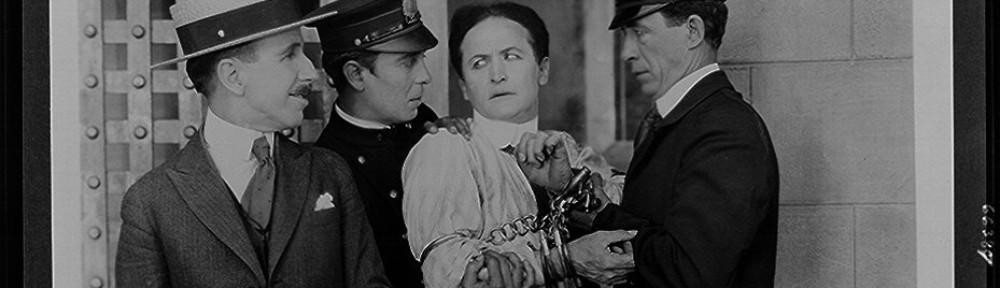
Photo Credit: Images courtesy of Harry Ransom Center
In part 1, I asked the following question:
 Well Charles F. Oursler caught up with him one day in Baltimore Maryland while he was lunching and asked him that very question:
“They had contrived a trap from a bent sapling, to which I was bound, and the devilish feature about it was that if I made one false move, I would dislodge the lowered end of the sapling, send it flying high into the air, and probably tear myself almost in half.
But I got out. I dislocated my ankle in doing so, but I got out. Yes, that was about the worst fix I ever was in. I don’t want any more like it. “
Source: The Eagle Magician Volume 1 No. 11 September 12, 1916
The Travel Channel put it up on youtube and Amazon as well.
3) HoudiniOpoly! Highest funded & most backed KickStarter in Scranton history. The 2nd highest funded Houdini project in KickStarter history.


So, if you asked Houdini what was the worst fix he had ever been in, what would he say?
“I was performing in a portion of the west where there were a great number of Indians. They were vastly interested in my performances, and when the sweeping challenges which I had issued were translated to them, they were deeply moved at what they regarded as my arrogance and effrontery. They determined to test my powers. Forthwith one of the big-wigs of the tribe sent me a messenger, who demanded to know if I would submit to be bound as they dictated, and agree to escape from their toils. At first, I was tempted to stipulate that the nature of the test be explained to me beforehand, an invariable rule in my challenges. But here was an unusual case. The teasing uncertainty of it; the advertising possibilities; and many other features about it; appealed to my imagination. I did not know what I was doing, but I told the Indians to ahead and do their worst.
The theater was crowded with Indians the next evening. I invited their committee on the stage, and told them to proceed, I was then at their disposal, and made the most of their opportunity. They bound me with thongs, and twisted the fetters until I could have struck them in my pain, but I let them go on. I got out in less time than they required to bind me.
Would you believe it, they were not satisfied? They wanted still further proofs of my prowess. The next day a committee of red-skins called upon me and begged me to come to their land, where they gave me, then and there, about the worst test to which I have ever been subjected.”
Care to guess before I reveal the details in my next post?

Trivia: What did Rudy have to do with Houdini’s last performance in Montreal?
Click here for the answer.
A P R I L F O O L S ! ! !

Image courtesy of John Cox Collection
However, according to an article, When Houdini was President” by William Frazee in a 1953 MUM:
Some of the New York City boys told me that the research department of Paramount studios discovered that Houdini and Hardeen were step-brothers. Well, it is no surprise to any of the old timers as we all knew this, but it came as a surprise to the younger generation. As Houdini was the oldest one and both had the same mother, what was Houdini’s right name?
That said, Okito, a friend of William Frazee, wrote in the January 1954 MUM, that he had often heard rumors, yet could not possibly substantiate this fact. In the same article, Okito mentioned that when he visited his late friend Ottokar Fischer in 1926 he proved to him by authentic documents that Houdini was born in Hungary and that his name was Ehrich Weiss.
 Here is a story on Penn Live that calls Scranton’s Houdini Museum one of the 9 weirdest museums in Pennsylvania. In fact they are listed as Number 2. Sounds awful, but when you read the story by the writer who attended the show he says…
“Scranton’s Houdini Museum features artifacts related to the life and career of magician Harry Houdini. Visitors are guided through the museum which is very small, yet packed with many amazing mementos from his life. The highlight of the museum, however, is the magic show conducted by two of the world’s best magicians, including Dorothy Dietrich, the only woman to ever perform a bullet catch with her mouth and escape from a straitjacket while suspended from a burning rope.”
Well, I had the distinct honor of visiting Dorothy Dietrich and Dick Brookz at the Houdini Museum in 2015 and it was one of my best experiences:
I highly recommend you check it out and decide for yourself.


In honor of Chef Gene, a fellow Houdini nut, who just got married, I thought I would do a post on Houdini recipes.
The first two recipes are courtesy of Houdini’s niece, Marie H. Blood:


The last two recipes come from a couple vintage cookbooks I recently purchased.


Congrats Gene and Kirwan! Hope you enjoy the recipes and the cookbooks.

On April 3rd 1908 in Chicago, Frank A. Gotch defeated George Hackenschmidt the “Russian Lion” in an international wrestling match for the champion of the world.

Well supposedly in 1906, Houdini Defeated Hackenschmidt. Let’s take a closer look.
According to Solomon in Disappearing Tricks:
The year 1906 also marks one of the earliest documented uses of cinema by Houdini. In March, a film listed as Houdini Defeats Hackenschmidt was shown immediately after Houdini’s performance at Keiths Theatre, Boston. All we know of this film is its title and a one-word description in the unpublished managers’ reports of the Keith vaudeville circuit: “Fair.” The title of the film is ambiguous because it is not clear how Houdini might have managed to defeat the heavyweight wrestler George Hackenschmidt.”
Houdini befriended Hackenschmidt while they were both touring Europe. Hackenschmidt’s act consisted of feats of strength and displays of his muscular body. It is quite possible that the victory over Hackenschmidt alluded to in this film’s title did not occur in an athletic contest.
According to Silverman:
“Not one to be outdone, Houdini threw Hackenschmidt. Like Sandow and other strongmen, Hackenschmidt had a popular music-hall turn, exhibiting his build in attitudes meant to recall statues. He and Houdini often compared receipts, Hack conceding that the boxoffice record of 210 pounds he set at Sheffield had been overcome only by Houdini, at 300. Houdini discussed with him the possibility of copromoting a top-rank wrestling match, and hoped to bring him to the United States, presumably as his manager to star in vaudeville.”
Well in 1908, Houdini made an offer to Frank Gotch through Harry Day the London Agent to appear in the London halls, but Gotch turned down England:

Later in 1908, there were ads that alluded to a likely return wrestling match between Frank A. Gotch, the champion of the world, and Hackenschmidt although Houdini was not the promoter or was he?
