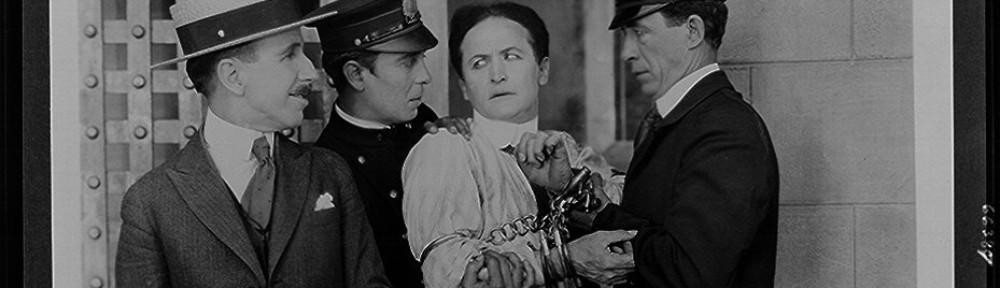
Film Treatments by Houdini – Floating Through Space

Houdini wrote, produced and starred in two of his feature films; he wrote a number of treatments – plots for potential productions; and he self-published several of these treatments. *

This post continues a series of posts where I summarize (or share tidbits about) the film treatments he wrote:

* “Film Treatment” can be found in Patrick Culliton’s book, Houdini’s Strange Tales – A Collection of fiction by the legendary Harry Houdini [1992]

Today, we look at Floating Through Space, which was one of four treatments (The Great Tontine, The Monster, The Vulture, and Floating Through Space) that turned up in 1990 and was published in 1992*.

Per Culliton:

[These treatments] turned up in 1990, when an East coast book dealer offered them for sale. This dealer was under the impression that he had in his possession several manuscripts hand-written by Houdini, and he was asking a small fortune for them (which, if genuine, they were worth). Houdini bibliographer Manny Weltman asked to see a sample and the dealer sent along a xerox of one of the stories. Weltman correctly identified the manuscript as having come from Houdini’s mind, but not written in his hand. The dealer was crushed. He put the material up for auction and Tom Boldt of the Houdini Historical Center in Appleton, Wisconsin was able to obtain all of it. It is through his kindness that we are able to include these four previously unpublished film treatments.

Floating Through Space (Story Summarized)

During one of Hero’s journeys, a wicked and cruel Hindu girl before she dies, tells him of her everlasting love, also of her peoples belief – of the souls of the dead at some time inhabiting the body of some living person.

After a strenuous career abroad, our hero returns home and falls in love with a sweet girl and asks the girl to wear a particular amulet, and asks her to swear she won’t remove it ever until her wedding day.

Fade in the sweet girl, preparing for bath, removing amulet – then retires to bed. You see the shadow of Hindu girl gloatingly over sleeping girl. You see the transformation in the girl’s face.

Fade in our Hero, who finds her seated in a chair kissing his picture. He asks her had she removed the amulet. She answers, “No.”

He realizes he had fallen asleep and dreamed she removed the amulet. The girl smiles in his face with love and trust in her eyes, both parents look indignantly at the smiling lovers–

–as the curtain falls.

Film Treatments by Houdini – The Vulture

Houdini wrote, produced and starred in two of his feature films; he wrote a number of treatments – plots for potential productions; and he self-published several of these treatments. *

This post continues a series of posts where I summarize (or share tidbits about) the film treatments he wrote:

* “Film Treatment” can be found in Patrick Culliton’s book, Houdini’s Strange Tales – A Collection of fiction by the legendary Harry Houdini [1992]

Today, we look at The Vulture, which was one of four treatments (The Great Tontine, The Monster, The Vulture, and Floating Through Space) that turned up in 1990 and was published in 1992*.

Per Culliton:

[These treatments] turned up in 1990, when an East coast book dealer offered them for sale. This dealer was under the impression that he had in his possession several manuscripts hand-written by Houdini, and he was asking a small fortune for them (which, if genuine, they were worth). Houdini bibliographer Manny Weltman asked to see a sample and the dealer sent along a xerox of one of the stories. Weltman correctly identified the manuscript as having come from Houdini’s mind, but not written in his hand. The dealer was crushed. He put the material up for auction and Tom Boldt of the Houdini Historical Center in Appleton, Wisonsin was able to obtain all of it. It is through his kindness that we are able to include these four previously unpublished film treatments.

The Vulture (Story Summarized)

Our Hero promises to save his sister. The Doctor is announced. He tries to quiet her. She is hysterical, cries “Brother, you will recognize The Vulture.  He has a –– “ But she falls back into the arms of the Doctor, dead.

After many adventures, our Hero discovers that the money lender and The Vulture are one. But there is still another side to this beast –– he tries to recall a defect that he recognizes in both the money lender and The Vulture. They each have one grey and one black eye. He arranges to have The Vulture raided in his den but he escapes. Our Hero then dashes to the money lender’s home, but he also has flown from there. The rest of the band is taken etc.

Our Hero then returns to the girl, whom he always reported his escapes. Whilst telling her of the Vultures’ escape, he looks at the Doctor, jumps on him, etc. He at last has The Vulture in his hands. It develops that the girl is not really the daughter of the Doctor. The real father and mother had died in this Doctor’s house; the Doctor then assumes the father’s name, estate, etc., really learned to love the child, continued to lead this triple life. He was really a mad genius, etc.

Film Treatments by Houdini – The Monster

Houdini wrote, produced and starred in two of his feature films; he wrote a number of treatments – plots for potential productions; and he self-published several of these treatments. *

This post continues a series of posts where I summarize (or share tidbits about) the film treatments he wrote:

* “Film Treatment” can be found in Patrick Culliton’s book, Houdini’s Strange Tales – A Collection of fiction by the legendary Harry Houdini [1992]

Today, we look at The Monster, which was one of four treatments (The Great Tontine, The Monster, The Vulture, and Floating Through Space) that turned up in 1990 and was published in 1992*.

Per Culliton:

[These treatments] turned up in 1990, when an East coast book dealer offered them for sale. This dealer was under the impression that he had in his possession several manuscripts hand-written by Houdini, and he was asking a small fortune for them (which, if genuine, they were worth). Houdini bibliographer Manny Weltman asked to see a sample and the dealer sent along a xerox of one of the stories. Weltman correctly identified the manuscript as having come from Houdini’s mind, but not written in his hand. The dealer was crushed. He put the material up for auction and Tom Boldt of the Houdini Historical Center in Appleton, Wisonsin was able to obtain all of it. It is through his kindness that we are able to include these four previously unpublished film treatments.

The Monster (Story Summarized)

Our hero calls in his men, who arrest the Chief, stepmother, and nephew. Our hero would like to know how this Chief, who was officially dead came back to life. The Chief explains it was his cell mate who had died. He changed identities with the man. The stepmother, before being taken away to prison threatens to reveal the secret of the old Doctor unless she is set free. Girl enters room and wants to know the secret that had made her father’s life miserable. It’s revealed that the Doctor transposed the brain of a little dog into a dying foundling; The child lived, the dog died, but it had the habits of the dog. Our hero takes the girl in his arms to search for the old Doctor, discover a secret room, and the doctor sitting peacefully with his arms folded lovingly around the little monster, as a mother would hold her baby.  They were both dead, at last happy together, they are where there are no monsters.

Film Treatments by Houdini – The Great Tontine

  1. Houdini wrote, produced and starred in two of his feature films; he wrote a number of treatments – plots for potential productions; and he self-published several of these treatments. *

This post continues a series of posts where I summarize (or share tidbits about) the film treatments he wrote:

* “Film Treatment” can be found in Patrick Culliton’s book, Houdini’s Strange Tales – A Collection of fiction by the legendary Harry Houdini [1992]

Today, we look at The Great Tontine, which was one of four treatments (The Great Tontine, The Monster, The Vulture, and Floating Through Space) that turned up in 1990 and was published in 1992*.

Per Culliton:

[These treatments] turned up in 1990, when an East coast book dealer offered them for sale. This dealer was under the impression that he had in his possession several manuscripts hand-written by Houdini, and he was asking a small fortune for them (which, if genuine, they were worth). Houdini bibliographer Manny Weltman asked to see a sample and the dealer sent along a xerox of one of the stories. Weltman correctly identified the manuscript as having come from Houdini’s mind, but not written in his hand. The dealer was crushed. He put the material up for auction and Tom Boldt of the Houdini Historical Center in Appleton, Wisonsin was able to obtain all of it. It is through his kindness that we are able to include these four previously unpublished film treatments.

The Great Tontine (Story Summarized)

The Great Tontine, the founder of the insurance fortune he had accumulated; the last heir had been lost for many years ago in a submarine accident, and never again heard of. The plotters [Fraser, Rabbit, Toad, recently released from prison,] intend to produce an heir [with the Tontine birthmark on the right arm], [by using recently released Rodney, who was falsely charged]. Rodney is in love with Wilma Somers, who is to marry Maurice Darleton. Maurice who is financing the scheme, had quite an affair with Dr. Fraser’s daughter Madge who helped frame Rodney. Madge is jealous and kidnaps Wilma and tells how Maurice and her framed Rodney. Rodney shows up and saves Wilma.

Fraser and his gang abandoning of hope of getting Rodney to help in their fraud, decide on another subject. The plan is kidnap a physician and take him on a chartered vessel, have him do the tattoo, then calmly dispose of him. Old Mystery [detective and benevolent old man who would take mysterious trips, stay away for weeks or months) discovers the scheme, gets on the vessel in disguise and leaves a message for his now adopted son and helper, Rodney. Rodney is hit on the head and Wilma is taken to the vessel.

Per Culliton:

Houdini never finished The Great Tontine, so why don’t you do it for him? Complete this treatment in one hundred words or less and send it to:

The Great Tontine

c/o The Houdini Historical Center

330 East College Ave

Appleton, WI 54911

A panel of judges will read each submission, every entry will be acknowledged, and the winner will be awarded a swell prize on October 31st, 1993.

I checked my complete file of Mystifier Newsletters from The Houdini Historical Center, but found no mention of a winner.

That said, I believe the story would have gone on to prove Rodney is innocent and revealed that he is the true heir, that before remarrying and having Maurice, Mrs. Darleton secretly eloped with the Great Tontine (aka Old Mystery) and had him. So the story ends with: Rodney taking care of the gang on the vessel; discovering the truth (via matching birthmarks); Mrs. Darleton being reunited with her first child and learning that her first husband survived the submarine accident; and Rodney and Wilma living happily ever after.

Film Treatments by Houdini – Il Mistero de Osiris or The Mystery of the Jewel

Houdini wrote, produced and starred in two of his feature films; he wrote a number of treatments – plots for potential productions; and he self-published several of these treatments. *

This post continues a series of posts where I summarize (or share tidbits about) film treatments (published and unpublished) by Houdini

* “Film Treatment” can be found in Patrick Culliton’s book, Houdini’s Strange Tales – A Collection of fiction by the legendary Harry Houdini [1992]

Today, we look at Il Mistero de Osiris or The Mystery of the Jewel, courtesy of Silverman (italicized text) and the Harry Ransom Center (images):


At a U.S. Customs Service auction of unclaimed films, he bought an Italian-made feature, Il Mistero Di Osiris (The Mystery of Osiris) [and copy-righted the film as his own]

The Roman company that produced it, Vera Film had also published a lengthy scenario of the action, which Houdini had closely translated to English.

He published this as a pamphlet, The Mystery of the Jewel, with his name [actually Houdini’s portrait] on the cover. Giving no indication of the Italian original, he allowed it to pass as a scenario or short-story by himself.

Il Mistero gave Houdini the notion of making a roughly similar film based on Egyptian ideas of reincarnation, to be shot partly as the Grand Hotel in Cairo. To finance it he organized late in 1921 a new company, Mystery Pictures Corporation, again headed by himself and Hardeen.

He commissioned a photoplay, bought some stock footage of Egypt (the Nile, the Sphinx, a flotilla of crocodiles), and put the film into production as “The Ashes of Passion,” using FDC as a developing lab.

The picture was retitled “Reincarnation,” but however much of it he completed, if any, has disappeared.

Below is a summary of the photoplay.

The theory of re-incarnation, and the trans-migration of souls, and the scene is laid in Cairo of the present day, where a certain Princess and a painter meet. The Princess believes herself the re-incarnation of a woman who lived in the dim ages of the past, and whose love and life were beytrayed by one, Araxez, whom she now believes to be re-incarnated in the painter. She has no difficulty in luring the painter to the underground tomb of Araxez, where, after vividly recounting the story of his treachery is stabbed to death; the mystery lies in the identity of his murderer. The modern scenes include some pictures of Cairo today, the pyramids, the tomb of Memnon, and other well-known Egyptian monuments; whilst the scenes of ancient Egypt introduce a number of ancient ceremonies, one of which is the peculiar rite of uncovering a mummy at the marriage feast.

Film Treatments by Houdini – Yar, the Primeval Man

Houdini wrote, produced and starred in two of his feature films; he wrote a number of treatments – plots for potential productions; and he self-published several of these treatments. *

This post continues a series of posts where I summarize (or share tidbits about) the film treatments he wrote:

* “Film Treatment” can be found in Patrick Culliton’s book, Houdini’s Strange Tales – A Collection of fiction by the legendary Harry Houdini [1992]

Originals have sold for $325 (2/2014), $400 (6/2018) and $200 (10/2018) at Potter & Potter auctions.

Today, we look at, Yar, THE Primeval Man, courtesy of John Cox at WildAboutHoudini.com

Note: The pen-and-ink portrait of Houdini was done by Elcock.  Also, there is a reprint put out by the Houdini Family Collection. Below is my copy:

Teaser for next week (courtesy of Harry Ransom Center):

Film Treatments by Houdini – Frizzo–Master Magician

Houdini wrote, produced and starred in two of his feature films; he wrote a number of treatments – plots for potential productions; and he self-published several of these treatments. *

This post continues a series of posts where I summarize (or share tidbits about) the film treatments he wrote:

* “Film Treatment” can be found in Patrick Culliton’s book, Houdini’s Strange Tales – A Collection of fiction by the legendary Harry Houdini [1992]

Today, we look at, Frizzo––Master Magician

Click on images to enlarge for reading.

Note: Frizzo real name was Enrico Longone, not Langone.  Frizzo was taught magic by Compars Hermann. And Frizzo taught magic to Antonio Molini.

Film Treatments by Houdini – Haldane of the Secret Service or Mysterious Mr. Yu

Houdini wrote, produced and starred in two of his feature films; he wrote a number of treatments – plots for potential productions; and he self-published several of these treatments. *

This post continues a series of posts where I summarize (or share tidbits about) the film treatments he wrote:

  • The Marvelous Adventures of Houdini (1917)*
  • The Man From Beyond (1921)
  • HALDANE OF THE  SECRET SERVICE or MYSTERIOUS MR. YU (1921)*
  • Frizzo––Master Magician (1921)
  • Yar, the Primeval Man (1921)*
  • Il Mistero di Osiris or The Mystery of the Jewel (1921)*
  • The Great Tontine (unpublished)* [Tom Boldt Collection (TBC)]
  • The Monster (unpublished)* [TBC]
  • The Vulture (unpublished)* [TBC]
  • Floating Through Space (unpublished)* [TBC]
  • Blood Brothers (unpublished) [TBC]
  • Out of the Shadows (unpublished) [HHCE Collection]

* “Film Treatment” can be found in Patrick Culliton’s book, Houdini’s Strange Tales – A Collection of fiction by the legendary Harry Houdini [1992]

A scarce pamphlet published by Houdini to secure a copyright to establish film rights. This one sold for $750 at 2018 Potter Auction and another one sold for $1600 at 2014 Potter Auction

Today, we look at, Haldane of the Secret Service or Mysterious Mr. Yu, courtesy of The Original Houdini scrapbook by Walter B. Gibson:

Note:  There is also a reprint put out by the Houdini Family Collection. Below is my copy:

Film Treatments by Houdini – The Man From Beyond

Houdini wrote, produced and starred in two of his feature films; he wrote a number of treatments – plots for potential productions; and he self-published several of these treatments. *

This post continues a series of posts where I summarize (or share tidbits about) the film treatments he wrote:

  • The Marvelous Adventures of Houdini (1917)*
  • THE MAN FROM BEYOND (1921)
  • Haldane of the Secret Service or Mysterious Mr. Yu (1921)*
  • Frizzo––Master Magician (1921)
  • Yar, the Primeval Man (1921)*
  • Il Mistero di Osiris or The Mystery of the Jewel (1921)*
  • The Great Tontine (unpublished)* [Tom Boldt Collection (TBC)]
  • The Monster (unpublished)* [TBC]
  • The Vulture (unpublished)* [TBC]
  • Floating Through Space (unpublished)* [TBC]
  • Blood Brothers (unpublished) [TBC]
  • Out of the Shadows (unpublished) [HHCE Collection]

* “Film Treatment” can be found in Patrick Culliton’s book, Houdini’s Strange Tales – A Collection of fiction by the legendary Harry Houdini [1992]

Today, we look at, The Man From Beyond (Story Summarized):

Note:  The Man From Beyond was his first picture for the Houdini Picture Corporation and was made from an original story by Houdini bearing the working title of “The Far North.”

Epilogue:

101 Years ago today, Houdini filmed rapids scene action at the Winchell Smith Dam in Farmington, Connecticut

Film Treatments by Houdini – The Marvelous Adventures of Houdini

Houdini wrote, produced and starred in two of his feature films; he wrote a number of treatments – plots for potential productions; and he self-published several of these treatments. *

This post kicks off a series of posts where I summarize (or share tidbits about) the film treatments he wrote:

  • The Marvelous Adventures of Houdini (1917)*
  • The Man From Beyond (1921)
  • Haldane of the Secret Service or Mysterious Mr. Yu (1921)*
  • Frizzo––Master Magician (1921)
  • Yar, the Primeval Man (1921)*
  • Il Mistero di Osiris or The Mystery of the Jewel (1921)*
  • The Great Tontine (unpublished)* [Tom Boldt Collection (TBC)]
  • The Monster (unpublished)* [TBC]
  • The Vulture (unpublished)* [TBC]
  • Floating Through Space (unpublished)* [TBC]
  • Blood Brothers (unpublished) [TBC]
  • Out of the Shadows (unpublished) [HHCE Collection]

* “Film Treatment” can be found in Patrick Culliton’s book, Houdini’s Strange Tales – A Collection of fiction by the legendary Harry Houdini [1992]

Today, we look at, The Marvelous Adventures of Houdini

The above copy sold at a Potter auction for $9000 in 2017:

Houdini, Harry (Ehrich Weisz). The Marvelous Adventures of Houdini The Justly Celebrated Elusive American. New York: Harry Houdini, 1917. Brown printed wrappers. Bust portrait of Houdini on the recto of the first leaf. 20pp. 4to. Old cellotape reinforcing spine, one piece on verso of upper wrapper, tears to spine, one corner of lower wrapper lacking, scuffing and general wear. One of two examples known, the other held institutionally a variant copy. Most likely a treatment for a film, the booklet lays out a cast of characters including Houdini, his leading lady (“Beulah”), and several “heavies” who take part in the scenario its pages describe. Houdini’s movie career began in 1918, a year after this work was published, and his first film, The Master Mystery, debuted in 1919. Perhaps this treatment was a first attempt at working in Hollywood. This example is the same copy reproduced as an appendix to Milbourne Christopher’s Houdini: A Pictorial Life.


According to Kalush:

…he presented the Williamson Brothers with a scenario for a film that he tentatively called The Marvelous Adventures of Houdini, the Justly Celebrated Elusive American

By July of 1917, three months after signing a contract, Houdini was still hashing out the script with the Williamsons.  Both the war in Europe and a war between the Williamsons derailed the project. Desperately trying to salvage  his film, Houdini entered into an arrangement with a company called Westart to film the opening scenes of his scenario, a manacled jump into the sea off the pier at Atlantic City.  Though Westart would in a few years produce a series of low-budget Westerns, this one-day shoot appears to be all that became of The Marvelous Adventures of Houdini.

Per Silverman:

Houdini wrote and copyrighted a treatment for a film that would display his talents dazzingly. Entitled “The Marvelous Adventures of Houdini The Justly Celebrated Elusive American,” its thrill-a-minute plot, a harbinger of rockem-sockem action picture, provided for him to write a code message by a pencil gripped between his toes; wrestle a thug to death, underwater; climb a wall human-fly fashion; get fired from the torpedo tube of a submarine; and escape from [being thrown from a pier in chains; and strung up in ropes], among other things [a ships anchor, a piano box, a diving suit], a straitjacket suspended from a ship’s yardarm, a steel submarine net, and a burning warehouse in which he sat roped to a chair.

What I found fascinating, are the many elements of the story that make their way into his other films:

  • Master Mystery: Wrestling a thug to death underwater; Patented diving suit escape after life-line is cut

  • The Grim Game: Suspended straightjacket escape; bound and spread in the air

  • Terror Island: Packing Box Scene/Escape; Burning Warehouse Scene/Escape; Submarine; Natives

  • The Man From Beyond: Scales the walls of a building; Uses sheets from bed on side of warehouse; makes his way down waterpipe or from window to window

Highly recommend you give it a read.

Related: