
Magician Harry Kellar, Harry Houdini, and director Irvin Willat on the set of The Grim Game (1919). Photo: Paramount/Arthur Moses Collection
Click the links below to find out more about the Grim Game that hasn’t been publicly seen in years.
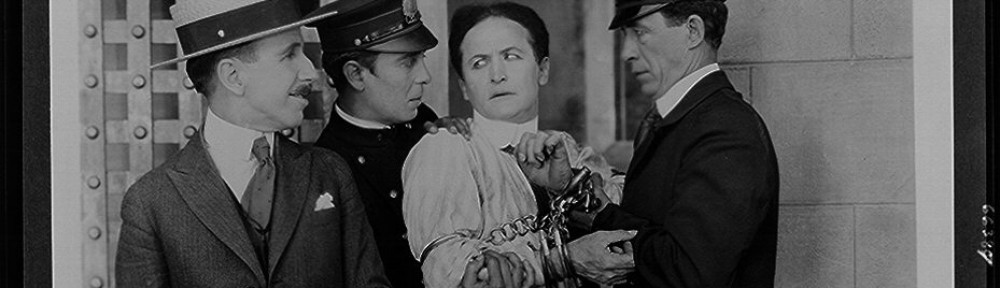
Magician Harry Kellar, Harry Houdini, and director Irvin Willat on the set of The Grim Game (1919). Photo: Paramount/Arthur Moses Collection
Click the links below to find out more about the Grim Game that hasn’t been publicly seen in years.
Below are five romantic photos of Houdini with his leading ladies from his movies. Can you guess which movie each is from and who the lady is?

Image 1 – courtesy of Harry Ransom Center

Image 2 – courtesy of Wild About Houdini

Image 3 – courtesy of Wild About Houdini

Image 4 – courtesy of Random Treasures

Image 5 – courtesy of Harry Ransom Center
Each correct movie is worth one point and each correct lady is worth another point.
Click here for the answers.
How many did you get correct?
Hopefully you got lucky and scored a perfect 10.
And enjoyed the images and had a Great Valentine’s Day!

Courtesy of Kimberly Tarr
Click the link below to find out how NYU helped recover Houdini’s film, The Grim Game.

Courtesy of Kimberly Tarr
I’d like to watch Houdini do one or two of his stunts in this serial you’re making, I remarked to the representative of the B.A. Rolfe Company. Maybe I could convince the fans that it’s all on the level, as you say, and not trick photography – if you can convince me. Seeing is believing, you know.
You’re on! was the reply.
A few days later I was summoned to New Rochelle, where “The Master Mystery” was being produced, and was taken into the yard, where the big tank, shown below had been built.
This said my guide, is where we’re doing the under-water stuff. Houdini is to go down into this tank in a diving suit. Another diver, who plays the villain, will also descend. Under water, the two will meet. The villain, with a knife which he carries, will cut Houdini’s life line and air pipe. No other diver ever escaped death under such conditions. Yet Houdini ——————- Here he comes!
We clankered up onto the platform which had been built around the tank.
On two opposite corners the wizard and the huge villain took seats, like prize fighters, in their respective corners, while assistants, like seconds, helped them into their suits.
Before the large pate glass in the front of the tank, the cameras had been placed, while at the smaller windows, like the one marked “5” in the picture, powerful lights were turned on, illuminating the entire interior of the tank.
At last all was ready. The two actors descended by means of ladders. All we could see on top were the seething bubbles which rose from the exhaust valves of the diving suits. Suddenly the director, watching through the glass, fired a revolver. One tug, and up came Houdini’s air pipe and life line — completely severed!
A few seconds of anxious waiting followed. Then up popped Houdini, clad only in a bathing suit. How he got out from that cumbersome suit I do not know. Perhaps the picture will show, as it was all recorded. It was from the film itself that the two small cuts showing Houdini under water and the struggle were taken.
Want to go this afternoon and see him thrown into the river, bound hand and foot? My guide asked.
I’ll take your word for it this time, and use a picture of it, if you’ll send me one. He did so, and here it is.

Source: Picture Play Magazine March 1919
Last November, I did a blog about when were some handcuff photos taken?
There was some discussion about when the following famous photo was taken that focused mainly on 1903 or 1904.

At the end of the day, we thought Houdini got it right and it was taken in March 1904 during his engagement at the London Hippodrome.
If that is the case, then how do we explain this rookie card of Harry Houdini from 1902.

So, the pictorial credits in “Notes to Houdini!! By Ken Silverman may have been correct.

They state that even though Houdini’s handwritten note on the photo above in the Morris Young collection says 1903, the identical photo in the Carrandi collection,shown on p. 2 has been dated 1900, by either Houdini or Bess.
Although the image shown on p.2 (similar left image below) is not quite the same.

So we have now ruled out 1903 and 1904, unless the 1902 date on the rookie card is wrong?

John Cox at Wild About Houdini shares HUGE Houdini news today:
Turner Classic Movies (TCM) has acquired the only known print of Houdini’s 1919 feature, The Grim Game. The movie has undergone a full restoration by renowned preservationist and silent film scholar Rick Schmidlin. The restored film will have its world-premiere at the TCM Classic Film Festival in Hollywood in March with a live score conducted by composer Brane Zivkovic. It will then play on the TCM network later this year.
Click here for a link to the rest of the news shared by John Cox.

1904 image of Will A. Bennet
One of the many mysteries of the famous Mirror Handcuff Challenge on March 17, 1904 is the identity of the “Mirror representative” who challenged Houdini with the famous cuff. His name, Will A. Bennet was not known to Houdini Historians until January 1, 2014, when I shared an April 1910 article I found from an Australian Newspaper.

1913 image of Will A. Bennet. (Image courtesy of New York Public Library Digital Collections)
Later in 2014, Paul Davies at Handcuffs.org found evidence that Will A. Bennet was a real person and shared another version of the “How I Handcuffed Houdini” article that appeared in February 1909.
However, the 1909 version of the article did not mention the Mirror representative’s name.
The main difference between the 1909 article and 1910 article is the following sentence:
“Will A. Bennet, press representative, Moss Empires, London and the London Hippodrome, recently told in “Pearson’s Weekly” of a match he made at the Hippodrome with Houdini the Handcuff King, now appearing at the Tivoli Theatre, Sydney.”
Both articles reference the “Pearson’s Weekly” Magazine as the original source.
So did the Mirror representative’s name appear in the original article or did it manifest itself in 1910?
And what is the significance of when and where it appeared?
Thus, the search to find the original article that must have appeared in “Pearson’s Weekly” Magazine sometime between March 1904 and Feb 1909 [April 1910].
Well, thanks to Paul Davies, we know that the original article is not in Pearson’s Weekly in 1904, 1905 or the last half of 1906.
And thanks to a Librarian that I contacted at The British Library, we know it is not in the first half of 1906. So that leaves 1907, 1908 and Jan/Feb 1909 left to search, which are held in microfilm at the British Library. Given its scope, the Librarian suggested I hire a freelance researcher to finish the search. That is when I contacted Narinder Chadda, a Houdini colleague of mine, who grew up in Birmingham and had been following the excellent discussion on Handcuffs.org.
Narinder and his daughter who is completing her MSc studies in London were delighted to carry out this search on everyone’s behalf. Narinder’s daughter did all of the legwork on Thursday.
So what did we find and what is the significance of it?
The “Pearson’s Weekly” was a UK 16PP tabloid magazine published by C A Pearson Ltd, edited by Peter Keary and others. It ran weekly from 26 July 1890 to 1 April 1939. “Pearson’s Weekly” was the first magazine C. Arthur Pearson set up when he left the employ of George Newnes and “Tit-bits” weekly tabloid in 1890. “Answers” magazine created in 1888 by Alfred Harmsworth [who owned Daily Mirror in 1904] was the other imitator of the Tit-bits weekly. The “Tit-bits”, “Answers” and “Pearson’s Weekly” were all successful popular journals that thrived and for around fifty years formed parts of a trinity.
“Tit-Bits” measured about 12 inches high by ten inches wide, normally had 16 pages, and was bound in green covers smothered in advertising. “Answers” was similar, but bound in salmon-pink covers. “Pearson’s Weekly” elected on a larger format, about 15 inches high by 11 inches across, and its 16 pages consequently gave its readers rather more words for their pennies; it was bound in dark red-covers.
“Pearson’s Weekly” was notable for its publicity stunts and fictional short stories.
Fiction – literature in the form of prose, especially short stories and novels that describes imaginary events and people.
Does this mean that the story appeared in Pearson’s Weekly as fiction?
Well I can tell you, that the story (How I Handcuffed Houdini) is not listed in George Locke’s 1990 book, titled Pearson’s Weekly – A Checklist of Fiction 1890-1939.
So did the story appear in Pearson’s Weekly as non-fiction?
Click this link to find out what Narinder and his daughter found.
Click this link for some observations of what was found.
Special Thank You to Narinder Chadda and his daughter of the UK and Paul Davies of Australia for their significant efforts in the search for “The Pearson’s Weekly”.
Continuation of HOUDINI THE GREAT Story Treatment by Frank O’Connor and Dore Schary, dated January 3, 1936:
That night at the show, thousands of people have crowded into the theatre to listen to the startling expose that Houdini has promised.
Houdini is back stage making preparations for his Chinese torture cell trick.
Houdini tells his assistants that he will perform the trick after his talk and expose.
Houdini goes to his dressing room to prepare himself for his appearance. When he gets to his dressing room, a figure of a man clothed in black hat and coat approaches him. He tells Houdini that he is here to convince him, that he, Houdini, must not give his message tonight.
The man takes a gun from his pocket; Houdini rushes him and the man fires and Houdini staggers under the impact of the bullet which hits him in the stomach. There is a sound of another shot and the black garbed man falls into the shadows of the curtained corner.
The door is opened by a group of excited people who want to know what has happened. Houdini doesn’t say that he has been wounded. He merely, says – I’ve seen a man kill himself – for his God.
Houdini, still not telling anyone that he has been wounded, goes out on the stage and gives his message to the audience.
He tells them that the subject of the message has been slightly altered due to something he has suddenly learned.
He tells them that there is a God, that they must believe that. He tells them that there is a hereafter and they must believe that too. And he says that they must not believe those crooked and ruthless charlatans who bleed them in the misled hope that they can establish contact with the spiritual world.
He tells them that someday they will all learn the secret but that they will not learn it from fakers who produce phony hands and spooky voices form wired chambers.
And after his speech, he prepares for his trick, a dangerous ordeal which he accomplishes successfully.
After he gets out of the cell at the conclusion of his act, he staggers and falls to the floor. The curtain is rung down as the audience applauds and cheers wildly. Bess and Powers and some others rush to Houdini. He tells them that he has been hurt – that he is dying.
Bess holds him in her arms. He tells her not to be frightened – that someday, somewhere, they will see each other again. He tells her that someday she, too, will learn the secret he is learning now but she will never learn until her time has come.
He tells them all that they must believe in God and that he is happy that he has found out the truth before he died.
THE END!
I thought I would start the New Year by sharing a couple paraphrased parts of a Story Treatment titled HOUDINI THE GREAT by Frank O’Connor and Dore Schary, dated January 3, 1936
Bess gives birth to a baby boy but it dies at the same time Houdini frees himself from the buzz saw escape.
Later on in the treatment…
Bess is taken. Houdini is told that if he will agree to cancel his proposed unmasking of the spiritualists, his wife will be returned to him safe and sound, but if he goes through with his plans, his wife will be in serious danger.
Houdini, stalling, asks for some proof that his wife is still alive and he is told that he will receive a message from her in the form of a letter which will indicate to him that she is all right.
The following morning, Houdini receives a note from Bess. It is apparently a simple, straight-forward note, telling him that she is well and that he should do whatever he thinks best. However, this note employs the use of many of the words used in the mind-reading code that Bess and Houdini had worked years ago during the vaudeville days.
Houdini gets the significance of the message which tells him very plainly where she is being held. Houdini contacts the police and Bess is liberated and the spiritualists are apprehended.
TO BE CONTINUED…
93 Years Ago Today, December 27, 1921, Houdini became the figurehead of The Mystery Pictures Corporation. Note: This is not the Houdini Picture Corporation (HPC), nor the Film Developing Corporation (FDC) which wishes you all A Merry Christmas and A Happy and Prosperous New Year

FDC: Houdini invested in the FDC in 1916. It was founded upon a novel invention: a method of automated film processing, developed by Gustav Dietz. Offices were opened on Broadway, and a factory in Hoboken, New Jersey. Houdini’s initial investment was $4,900 but the company was never able to turn a profit. In April, 1918, Houdini fired Dietz and attempted to improve upon the mechanism himself, assigning his brother, Theodore W. Hardeen, to run the company, all to no avail.

HPC: It seemed only natural that, owning a film processing company, he should make his own films, rather than relying on the resources and expertise of a motion picture studio. He formed the Houdini Picture Corporation (HPC) in early in 1921. By October of 1921, seven months after incorporating HPC, Houdini had wrapped up two full-length feature films, The Man From Beyond and Haldane.
Even though The Moving Picture World had announced that the HPC would produce “four feature productions a year, in which Houdini will be the star,” the filmmakers must have quickly realized how impossible it would be to live up to this ambition. So Houdini sought other ways to keep the FDC busy, and to shore up his film-making empire.
The Mystery Pictures Corporation was formed.
During his tours through Europe, he had discovered that there were many high-quality films there that might never be exported to the U.S. What they lacked in popular American stars, they made up for in production values. Harry Houdini was the President. Hardeen was vice president and Harry H. Poppe served as Secretary.
 Films imported for distribution included: 1918 French Film L’Ame du bronze (Soul of Bronze), Les Contes de mille et une nuits (A Thousand and One Nights), and 1919 Italian Film II mistero di Osiris (The Mystery of the Jewel). Note: The Mystery of the Jewel was renamed and released as Ashes of Passion.

Realizing that producing his own features (as the Houdini Picture Corporation) and acquiring foreign films for distribution (as the Mystery Pictures Corporation) were losing propositions, Houdini finally brought his commercial film career to a close.
Source:


