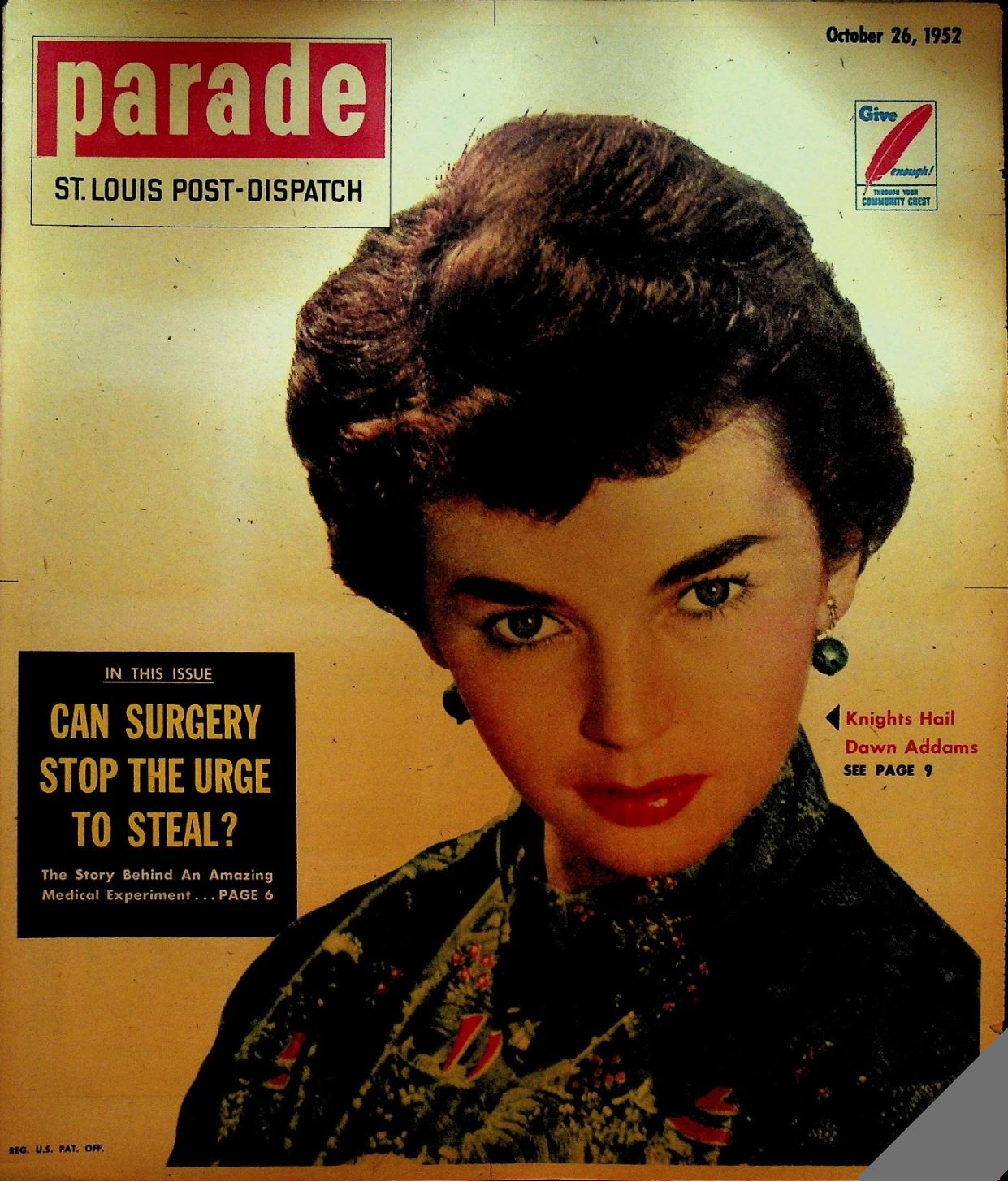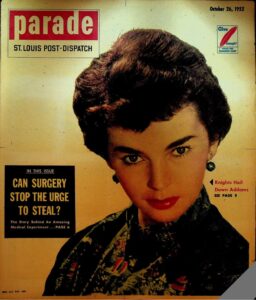
The Parade Magazine issue from October 26, 1952 is a vintage newspaper Sunday supplement featuring prominent 1950s celebrities. The popular syndicated magazine supplement was included in Sunday newspapers across the U.S.
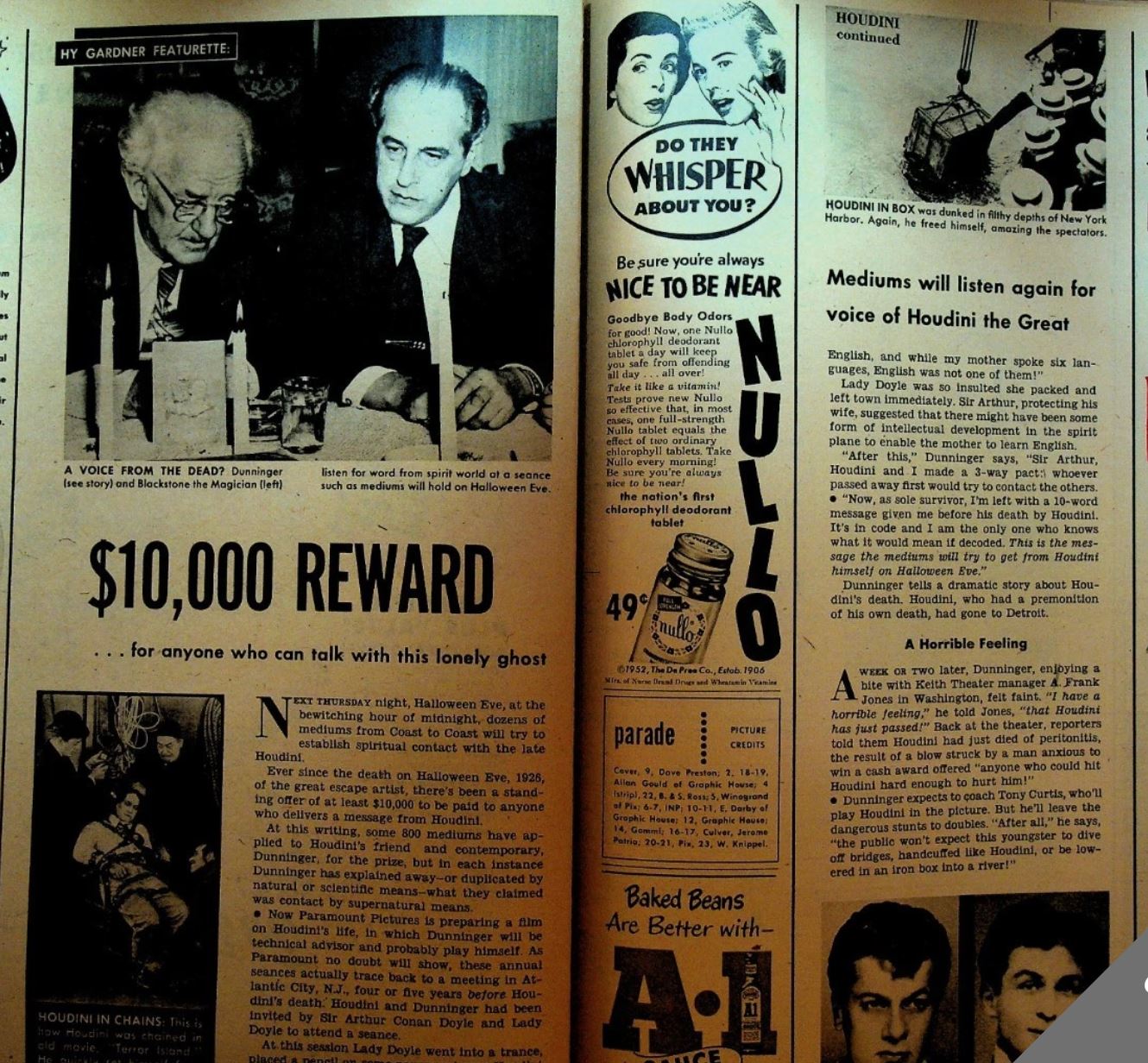
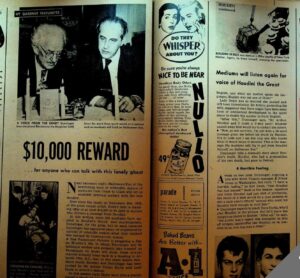
This specific issue [recently added to my collection] includes a very interesting Houdini/Dunninger article by Hy Gardner [an American entertainment reporter who interviewed celebrities on his radio show in the early 1950’s], which I am sharing with my annotations in brackets [ ]:
$10,000 REWARD…for anyone who can talk with this lonely ghost
NEXT THURSDAY night [10/30/52], Halloween Eve, at the bewitching hour of midnight [12a Friday 10/31/52], dozens of mediums from Coast to Coast will try to establish spiritual contact with the late Houdini.
Ever since the death on Halloween Eve [10/30], 1926, of the great escape artist, there’s been a standing offer of at least $10,000 to be paid to anyone who delivers a message from Houdini.
[This is the first mention (albeit subtle) of “Death on Halloween Eve” from Dunninger that I am aware of. Dunninger also annotates “the date should have read Oct 30, 1926” on a 1968 letter received from Dr. Kennedy (chief of surgery at Grace Hospital in Detroit that took care of Harry Houdini during his final days in October 1926). All bios have the death as Halloween Oct 31, 1926.]
At this writing, some 800 mediums have applied to Houdini’s friend and contemporary, Dunninger, for the prize, but in each instance Dunninger [like Houdini] has explained away—or duplicated by natural or scientific means—what they claimed was contact by supernatural means.
- Now Paramount Pictures is preparing a film on Houdini’s life, in which Dunninger will be technical advisor [true] and probably play himself [false]. As Paramount no doubt will show, these annual seances, actually trace back to a meeting in Atlantic City, N.J., four or five years before Houdini’s death. Houdini and Dunninger had been invited by Sir Arthur Conan Doyle and Lady Doyle to attend a séance. [This is the first and only mention of Dunninger being invited, that I am aware of. It does not appear in the movie, nor are the Doyle’s featured in the movie.]
At the session [June 18, 1922] Lady Doyle went into a trance, placed a pencil on some paper and gave Houdini an 8 page message [17 page message in Copperfield Collection] from his departed mother. “This is extraordinary, Lady Doyle,” he admitted, “but one thing puzzles me. This message is in English, and while my mother spoke six languages, English was not one of them!”
Lady Doyle was so insulted she packed and left town immediately. Sir Arthur, protecting his wife, suggested that there might have been some form of intellectual development in the spirit plane to enable the mother to learn English.
“After this,” Dunninger says, “Sir Arthur, Houdini and I made a 3-way pact: whoever passed away first would try to contact the others. [First I heard of a 3-way pact. AFAIK, Dunninger had a code with Houdini and may have had a code with Sir Arthur; according to The New Yorker (November 22, 1941), “Dunninger is fond of that particular sum of money {$10,000} and from time to time has offered it to anyone who with astral aid, can disclose the translation of secret code messages entrusted to him by the late Harry Houdini, the late Sir Arthur Conan Doyle, and the late Thomas A. Edison, all of whom wanted to investigate the possibilities of communication with spirits.]
- “Now, as sole survivor, I’m left with a 10-word message given me before his death by Houdini. It’s in code and I am the only one who knows what it would mean if decoded. This is the message the mediums will try to get from Houdini himself on Halloween Eve.” [In 1947, Dunninger chaired a “Waiting for Houdini” committee and held this 10-word code; Dunninger would continue these seances for the rest of his life, though the 10-word code was never successfully used to prove communication from Houdini; supposedly, the original envelope with Dunninger’s signature and seal, which held the original message between Houdini and Dunninger was stolen from Houdini Museum in Niagara Falls]
Dunninger tells a dramatic story about Houdini’s death. Houdini, who had a premonition of his own death, had gone to Detroit. [This dramatic story can be summarized as follows:
“In New York, on a rainy night in October, 1926 he phoned Joseph Dunninger, the famous magician and mentalist, and asked him to come to his house. When Dunninger arrived, Houdini explained that he wanted Dunninger to help him take some boxes to a storage place the other side of the city. As they were driving away, Houdini suddenly told Dunninger to turn back. They arrived before the house, and Houdini got out of the car. He stood silently in the rain and then got back in. ‘I just wanted one last look’, Houdini said, ‘I’ll never see it again alive.’” {Berkley/Reader’s Digest The Great Entertainers (1983) The Man No Lock Could Hold article by James Stewart-Gordon (February 1976)}
The full story appears in Gresham’s, Houdini The Man Who Walked Through Walls (1959):
About two o’clock one morning in October, 1926, I got a phone call from Houdini. He said, ‘Joe—I just got in town today and have to hurry right out again. I want to move some stuff from the house. Can you come up with the car?’ I told him I was on my way. When I got to 113th Street Houdini was waiting for me in the doorway. It was raining cats and dogs.
A Holmes partrolman was with him to let him in the house so as not to set off the burglar alarms. Houdini had some bales of paper and magazines to take out and the Holmes man helped us stack them in the car. Houdini was wearing old clothes, and a straw hat—let’s get something to eat.’ We went around the corner to a delicatessen and had pastrami sandwiches. We came back, got in the car and Houdini said, ‘Driver through the park, Joe.’ When we got to the exit on Central Park West around 72nd Street he grabbed my arm; in a hollow, tragic voice he said, ‘Go back, Joe!’
“ ‘Go back where’
“ ‘Go back to the house, Joe’
“ ‘Why—did you forget something?’
“ ‘Don’t ask questions, Joe. Just turn around and go back.’
“I drove back to the house. By the this time it was raining even harder, if that was possible, but Houdini ignored it; he got out of the car, took off the straw hat and stood looking up at the dark house with rain streaming down his face. Then he got back in the car, saying nothing. When we again approached the western exit of the park his shoulders began to shake. He was crying. Finally he said, ‘I’ve seen my house for the last time, Joe. I’ll never see my house again.’ As far as I know, he never did. We drove a way in silence and then he said suddenly, ‘Joe—you know that bronze coffin I made to expose that faker, Rahman Bey? Not only for that, Joe I made it to be buried in.’
‘Like so many of these incidents, we have no way of knowing how many other ‘presentiments of death’ Houdini had before, which did not come true. But this one I know about for I was there.” So Dunninger contributes to the Houdini legend.
And Kalush’s, The Secret Life of Houdini (2006) chose to repeat Dunninger’s story as told to Gresham, with the exception he gives us a date in October when it possibly occurred; he has it occurring after Providence tour (which ended 10/9) and before Albany tour (which started 10/11). Maxine Dunninger’s, Daddy was a Mind Reader (2012), also shares her dad’s story. FWIW, the story does not appear in Silverman’s Houdini (1996) which means he could not corroborate it. I couldn’t find it recounted anywhere else before the story surfaced in the 1950s; My search included AskAlexander, Newspapers.com, Houdini’s Spirit Exposes and Dunninger’s Psychical Investigations (1928), Science and Invention (October 1929) When Fate Fooled Houdini article by Dunninger, Inside the Mediums Cabinet (1935) and others. Also doesn’t appear in Kellock’s Houdini A Life Story (1928) or Christopher’s The Untold Story (1969).]
A Horrible Feeling
A WEEK OR TWO later, Dunninger, enjoying a bite with Keith Theater manager A. Frank Jones in Washington, felt faint. “I have a horrible feeling,” he told Jones, “that Houdini has just passed!” Back at the theater, reporters told them Houdini had just died of peritonitis, the result of a blow struck by a man anxious to win a cash award offered “anyone who could hit Houdini hard enough to hurt him!” [On October 30th, Dunninger performed an afternoon and evening show at the Maryland Theater in Baltimore; And on October 31st, Dunninger made his vaudeville premier at Keith’s Theater in Washington D.C.; A. Frank Jones from the New York offices of Keith-Albee acted as Dunninger’s personal manager; Rolan Roberts was the manager of Keith’s who is said to have discovered Dunninger; November 1st, is when papers reported Houdini’s death on Halloween from peritonitis, with some saying caused by a blow, but there is no evidence of a cash award offered for hitting Houdini hard enough to hurt him, so…]
- Dunninger expects to coach Tony Curtis, who’ll play Houdini in the picture. But he’ll leave the dangerous stunts to doubles. “After all,” he says, “the public won’t expect this youngster to dive off bridges, handcuffed like Houdini, or be lowered in an iron box into a river!” [Dunninger aquired an iron box from Bess Houdini, and it was used in the movie, but there is no evidence of Houdini using it in performance.]
In summary, Dunninger definitely added to Houdini’s legend with these stories, but there’s not a lot of supporting evidence and really no way to substantiate Houdini’s premonition of seeing his house for the last time, or Dunninger’s premonition of when Houdini passed.
For those of you who believe…no explanation is necessary, and for those of you, who do not believe …no explanation is possible.”…DUNNINGER
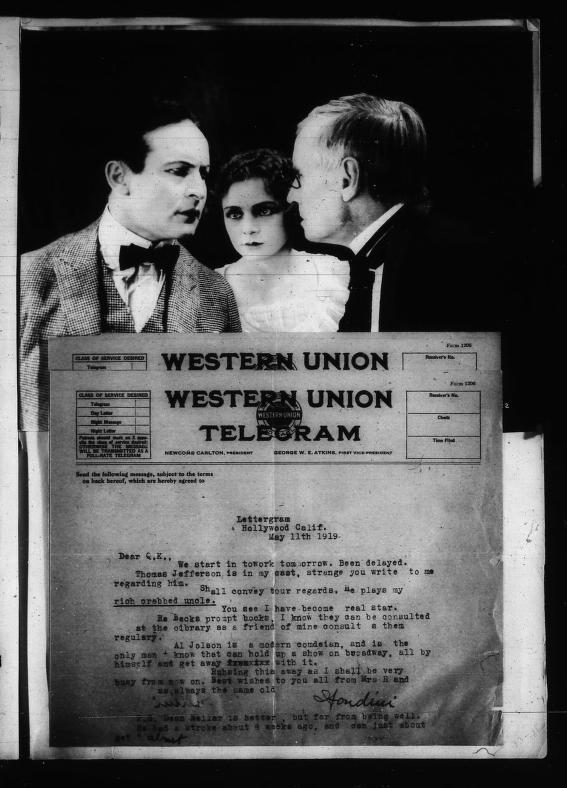
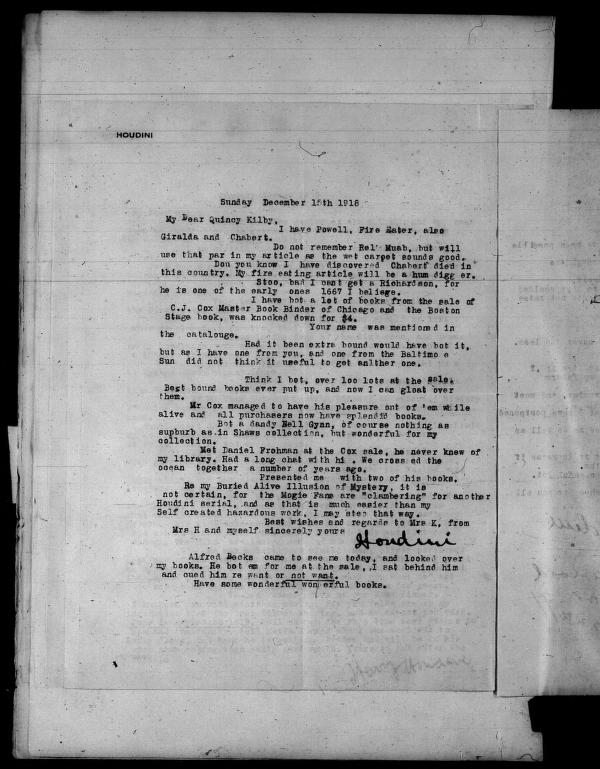
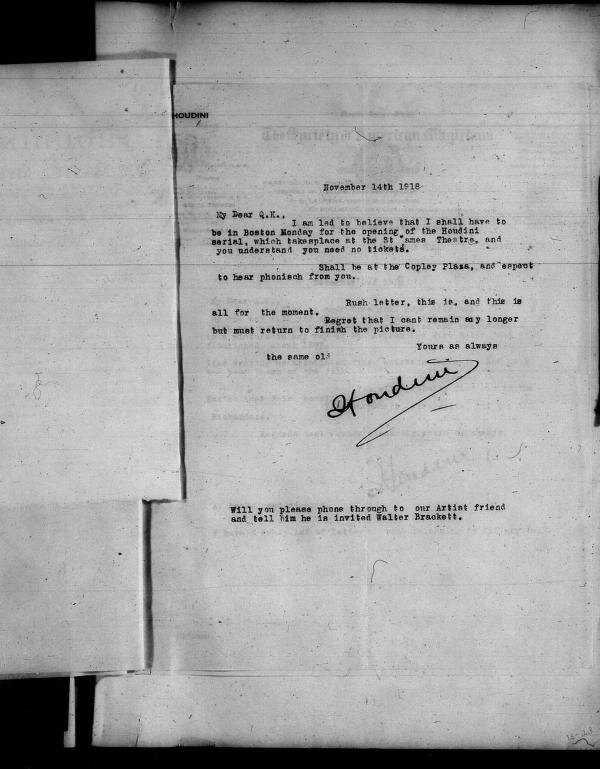
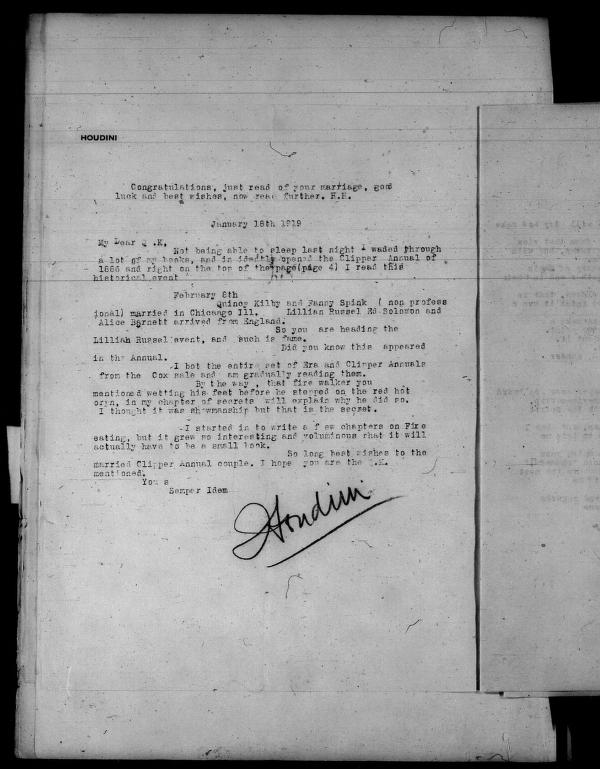
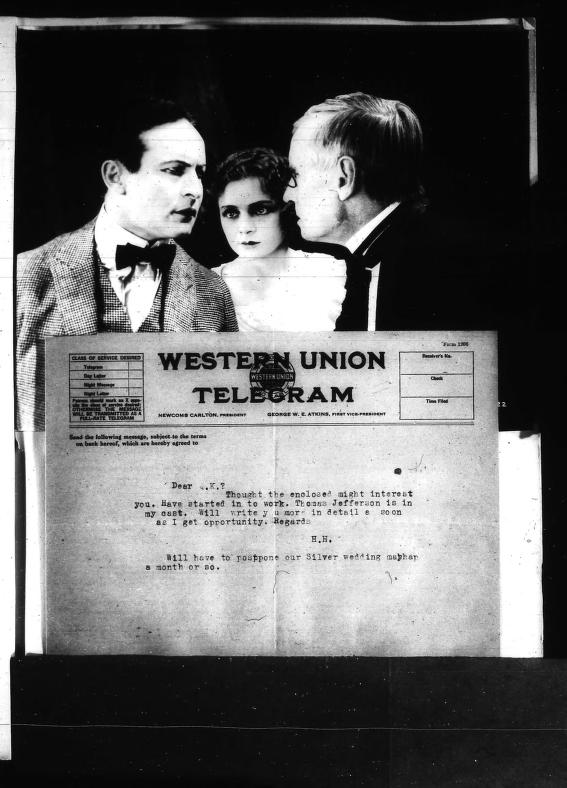 Dear Q.K.?