Related: |
New Houdini Book Celebration at The Houdini Museum
2
Related: |

Hanging out on a tropical island on the day of the long awaited release of Joe Posnanski’s book, The Life and Afterlife of Harry Houdini.

You can get the book by ordering it at Amazon.com (US release Oct 22) and Amazon.co.uk (UK release Oct. 31)
My copy should be waiting for me, when I return from vacation. Can’t wait to finally read it.
BTW, I have been told that how I discovered the name of the daily mirror reporter, my current thoughts on how Houdini escaped the mirror cuff, and my research on two other endings to the Tony Curtis movie, are in the book. which is very exciting.
My next planned post will be on Halloween.


I am honored to be able to share Noel’s incredible story about discovering this rare item:
Hi, greetings from Australia,
I got your link from the wildabouthoudini site, and since your site is devoted to this movie I thought you might be interested in this..
I discovered this heavy paper stock card (approx playing card size) advertising what I believe to be the first screening of the movie (possibly in Australia) at the Haymarket Theatre in Sydney, in 1920. Note the personal written movie synopsis in Houdini’s own words, (MESSAGE FROM THE CLOUDS… or at least from an imaginative theatre employee??) and that it is the first opening of the movie ‘TODAY’ on the 12th June.(1920) … I believe this would have been a card/flyer handed out to the public to get them to the cinema (haymarket theatre in Sydney, aka Capitol theatre) ….I literally found this only yesterday by chance in an old diary I had bought at a market about 6 months earlier, and presume it was used as a bookmark or the like, as I was repacking some of my paper ephemera collectibles into plastic tubs, it just fell out as I flicked the pages of the diary/journal of what appears to be diary of a road works workman. This may well be the only copy of this item??
Kind regards Noel
I love Noel’s story, especially the fact that the card was used as a “bookmark” and fell out of the book on its own steam. Noel informed me that the book was destined to be put in a plastic tub along with other ephemera and into storage. So, it could have been years before it came to light again. At first when Noel saw the planes and Houdini, he thought it was a ticket to his flight demonstrations in Australia in 1910, but soon realized it was relating to a movie. Prior to finding this card, Noel had no idea that Houdini was featured in films, but he does now.
And now his incredible find can be enjoyed by others.
Thank You Noel!
Bonus:
Below is an advertisement (The Sydney Morning Herald) for a screening of The Grim Game, June 12th, 1920 at the Haymarket Theatre in Australia.

Update:
Related:
Dorothy Dietrich and Dick Brookz will be doing their annual Original Houdini Seance again this year on HALLOWEEN as they have been doing them since the 1970’s under the guidance and direction of Bess Houdini via Walter B. Gibson, along with Milbourne Christopher.

Over the years they have done them in such locations as NYC’s Magic Towne House, outside Houdini’s home on 113th St, The Houdini Museum in Scranton, Pa., and Houdini’s first home in Manhattan, etc.
Anyone interested in attending this year’s event email magiccus@comcast.net for details as they are finalized.

Also, NOV 1 is set for a book signing at Houdini Museum 1433 N. Main Avenue, Scranton PA with Joe Posnanski, author of new book The Life and Afterlife of Harry Houdini. Dorothy and Dick will both be on hand as well.

Last week, I shared parts of Mondays, October 2, 1950 Detroit News Town Talk Column, where Dr. Kennedy writing to Mr. Stark shares the history of his famous patient. This week is a continuation, where I present parts of Tuesdays October 3, 1950 Town Talk Column, where Dr. Kennedy writing to Mr. Stark considers the case of Houdini, the Man:
“I was with Houdini almost constantly in his last illness and we had many interesting discussions about his work, about spiritualism and many other philosophical fields.
One evening he said to me, ‘Doctor, you know I always wanted to be surgeon, but I never could. I have always regretted it.’
I answered him, ‘Why, Mr. Houdini, that is one of the most amazing statements I have ever heard. Here you are, the greatest magician and the greatest entertainer of your age. You make countless thousands of people happy. You have an unlimited income and you are admired and respected by everybody, while I am just an ordinary dub of a surgeon trying to struggle through life.’
He looked up and smiled. ‘Perhaps those things are true, doctor, but the difference between me and you is that you actually DO things for people and I, in almost every respect, am a fake.’
The Mediums Approach
I have never forgotten that conversation. You know, of course, that Houdini’s real name was Weiss and he was the son of a Jewish rabbi who lived in Milwaukee and that of the 23 members of his amazing troupe, 21 were relatives.
You probably knew too that his wife was the little page who followed him around on the stage and was constantly taking care the perfection of his art should be in no way marred.
But you do NOT know that he said to me just before going into the operating room, ‘Please keep that woman’ pointing to his wife, ‘out of my room all of the time, because she is the most peculiar woman I have ever known in my life.’
So you can see that when it was claimed in California that for 10 years a group of good folks was trying to get in touch with him through an approved spiritualistic medium, I took little interest in the prospect of such an accomplishment. I was quite sure that if he really intended to communicate with anybody, it would not be is apparent soul mate.
The Huge Insurance
As a final interesting touch, to me at least, you might like to know that after his death, it was found that Houdini carried upwards of a million dollars in insurance and that he carried two polices with tow of the largest companies in the country totaling approximately $200,000, which paid double indemnity in case of accidental death.
The insurance companies sent various representatives to me and tried to convince me that injury had nothing to do with Mr. Houdini’s death. But inasmuch as I knew that he had been struck on the left side of the abdomen, that his symptoms had started immediately following the blow, that he had no symptoms prior to that injury and that from the beginning of the injury, event progressed steadily to his death, there was nothing for me to say to the insurance representatives except that I believed this was a case of traumatic appendicitis.
The Best God Gave Us
It is the only case of traumatic appendicitis, I have ever seen in my lifetime, but the logic of the thing seemed to me to indicate that Mr. Houdini died of appendicitis, the direct result of the injury.
Morris Ernst, now a lawyer of national reputation, was Houdini’s attorney and eventually the insurance companies paid the double indemnity on the policies involved, because I had told Mr. Ernst the facts as they were and gave my professional opinion that the injury had been the inciting cause of death.
It is too bad that we did not have in those days the antibiotics which are now available. It might well have been that life of a magnificent entertainer and a fine character could have been prolonged for some years.
Who knows? In any event, we did the best we could as God gave us the light to see and a fine gentleman went to his premature reward.”
To kick-off October, thought you might like to hear from the surgeon who took care of Houdini.
In Mondays, October 2, 1950 Detroit News Town Talk Column, George W. Stark shares correspondence he received from his friend, Dr. Charles S. Kennedy, who had recently read the Sept 15 1950 Town Talk piece on Houdini:
The Nature of the Fatal Illness
“Perhaps you do not know it, but I was the surgeon who took care of Houdini.
He had been struck in the left lower abdomen by a medical student from McGill University in the wings of one of the theatres in Montreal, 24 to 36 hours before he arrived in Detroit.
I saw him first in the Hotel Statler about 3 o’clock in the morning, got the history of the blow to his abdomen and thought that he had either a ruptured intestine from the blow or had clotting of the large blood vessels (because of the blow) supplying a portion of his intestine.
Appendicitis was considered, but was not very seriously kept in mind because of the location of the injury.
Houdini, bear in mind, had gone through his whole strenuous performance, I believe at the Garrick Theatre, the night before I first saw him and collapsed at the end of the show.
The Ideal Patient
I sent him to Grace Hospital and there he was put in a double room, because there was no other place at the time. Considerate chap that he was and that I always found him to be during his terminal illness, he said, “Well, if there is nothing but a double room, that will do for me.”
At operation early the same day, we found that his appendix was a great long affair which started in the right lower pelvis where it normally should, extended across the midline and lay in his pelvis, exactly where the blow had been struck.
Reconsidering the history afterwards, we concluded that his appendix had ruptured some place near St. Thomas, Ont, and the Garrick Theater with a ruptured appendix and spreading peritonitis. The peritonitis was caused by a bug known as streptococcus, which, up to recent years in my experience is peritonitis has been fatal,
The Game Fight
Houdini put up a tremendous fight, living somewhat more than a week after the operation, and for the first few days, it seemed almost as though his tremendous recuperative powers would result in recovery. During the entire time of his terminal illness, he was an ideal patient.
Nobody did anything for him, including such small services as to mop his brow or give him a sip of water, that he not look up into the face of the attendant or the nurse, smiling and saying, “Thank You.”
I repeat, he was the ideal patient!
Next week, I will present Tuesdays October 3, 1950 Town Talk Column, where Dr. Kennedy writing to Mr. Stark considers the case of Houdini, the Man.
Six years ago, I did a post, titled: First Suspended Straitjacket Escape Not 98 Years Ago Today (September 29). The Minneapolis escape was the second public suspended straitjacket escape, after the September 8, 1915 escape from the Kansas City Post building in Kansas City, MO.
 At the time of the September 29 post, I didn’t have a photograph for this Minneapolis escape, nor much information, but that changed when I visited the McCord Museum last year. The very first scrapbook, I looked at had a lot of newspaper clippings that included straightjacket escapes, like the one that took place 104 years ago on September 30, 1915. That’s right, the escape actually took place on September 30, 1915, not September 29, 2015 as previously documented by others.
As evidence, I share the photo and text from the following two newspaper ads:
At 12:05 today, Harry Houdini, to whom padlocks and cells present no more difficulty than that offered to the ordinary person by an open door, will essay to make his escape from a straight-jacket while suspended by his heels from the sign in from of the Tribune. This is a feat similar to one he accomplished upon a previous occasion, and unless Minneapolitans succeed in fastening the straight-jacket more securely that Houdini supposes he promises to extract himself with a few moments. The jacket will be adjusted by entirely disinterested parties so that there is no chance for any suspicion of collusion, and the jacket used is of a regulations type.
Houdini, who is appearing at the Orpheum, is said to enjoy an international reputation for the case with which he escapes from handcuffs, prison cells and other impediments. He has appeared in almost every large city of the civilized world and in each metropolis had baffled the police by his dexterity. He is said to be the only man ever to escape from one of the famous Siberian convict wagons, a conveyance far more dreaded and more formidable than the Black Marias familiar to citizens of American towns.
Before a crowd which thronged Fourth street from Nicollet to Marquette avenue, Harry Houdini, the “worlds champion self-liberator,” freed himself from a straitjacket while suspended by the feet—which were bound—from the electric sign in front of The Tribune building at noon yesterday. When the jacket had been adjusted by Minneapolis detectives and policemen and his feet securely bound, Houdini was swung high over the heads of the crowd. The immense throng was unexpectantly quiet as Houdini began his work.
A few convulsive , serpentine wriggles, a few movements of his powerful shoulders, and Houdini’s arms, which a moment before had been securely held by leather and canvas jacket were free. As he unfastened the straps which had defied all comers, he smiled down at the officers who had adjusted the straitjacket and remarked that he would join them in a moment. He slipped the apparatus over his head and allowed it to fall into the arms of the officers below and gave the signal to “lower away.”
The straight-jacket was furnished by the police and was the most powerful they have. It was put on by several plain clothes men under the direction of Thomas P. Gleason, who tested each strap and said he was satisfied it was “according to Hoyle.”
Tonight on the Orpheum stage, Houdini did attempt to escape from a packing case which has been prepared by the employees in the shipping room of the New England Furniture & Carpet company. The packers have made a box which they believe will defy all the powers of the wizard.
“I do not promise to get out the box,” declares Houdini. “However, I have never failed yet, and certainly will try.”
This feature will be presented instead of the regular act which Houdini offers.
Bonus:
Also, courtesy of the McCord Museum, here is a newspaper image not previously posted for Houdini’s December 4th, 1915 suspended straightjacket escape from the Express Tribune building.

For details of this escape and other images, see John Cox excellent post:
According to a scrapbook clipping at the McCord Museum, it was Houdini night at the Checker Inn 93 years ago today:
A $1.50 dinner and all kinds of smokes free for all members in good standing. Remember, everything free, “HOUDINI” will be there, and we also have a magical surprise for you. Remember the date, time, and place, -Wed, Sept. 22 at eleven P.M. at the “Checker Inn” – 477 Stuart St. near Huntington Ave. Seats still on sale at the box office of the Majestic.
If you are not in good standing – Bordicott will be there – nuff sed!
Bring a guest if you wish, but remember that it is a stag party, and it will cost you $1.50 per guest.
Related:

During my visit to the McCord Museum, I was fortunate enough to have read a compilation (April 24, 1920 v1 n1 to June 5th 1920 v1 n7) of “The Amazing Exploits of Houdini” found in The Kinema Comic.
Each issue contains a several page serialized fictional story (by-lined by Houdini). This week I share my paraphrased version of “The Jewel Thieves” found in the May 1 1920 v1 n2 issue:
Houdini is sleeping in a hotel room on the seventh floor. When he stays in a hotel with a telephone in the bedroom, he makes it a point of screwing off the bell before retiring, thinking that the shock of ringing will not be so great. On this night, the sound of the vibrating hammer was more terrifying than any bell would be.
Houdini answered the phone and was told that the hotel was on fire and he needed to leave his room at once and make his way outside by the back staircase, since the main staircase was ablaze and impossible.
Half asleep, Houdini jumped out bed, and dashed out the door toward the back staircase used by the servants. To make his way down the pitch-dark stairs, he had to feel his direction with his hands on the wall. Suddenly, Houdini received a blow on the back of his head from some hard instrument, dropped to the ground, and was hurriedly searched, but nothing was found.
Houdini was awakened by the corner of a door pushing into his ribs. A man with no shoes on dashed across to a window, opened it, and disappeared.
Houdini slowly rose to his feet, crashed through some swinging doors and on to the floor of one of the hotel corridors. He had a splitting headache and didn’t remember that the building was on fire.
Rising to his feet again, Houdini staggered forward perhaps a dozen yards, when a door opened and a man whose face was drenched in blood from a cut on his forehead, yelled that “They’ve bagged the lot. Taken every dashed thing.”
Houdini asked what happened?
Thieves broke into his room, hit him on the head and stole his diamonds.
Houdini told the man he got hit on the head also and that he should telephone the cops.
Houdini staggered towards the man’s room and threw himself on his bed.
The police were sent for. Slowly recuperating and trying to gather his scattered and wounded wits together, Houdini was able to reconstruct the adventures of the night. Houdini remembered the alarm of fire sent over the telephone, his scramble down the back stairs, then being hit on the back of the head by some unknown assailant. Then it dawned on him, that the thieves somehow called him up on the telephone instead of their victim, their purpose evidently being to decoy the man from his room whilst they robbed him of his jewels.
Houdini rose from the bed and pushed his way past the hotel servants who were attending to the victim of the robbery. Houdini made his way through the door of the room which the man had climbed was situated. It was still open.
The window gave on to a lower roof of an adjoining building. The drop from this window to the roof would be about eight feet. Houdini curiosity was aroused, and despite his aching head he decided to investigate.
Just beneath Houdini, on the top floor of the building, he could see a lighted window. There was no reason for a lighted room at that time. Almost before the resolution was made, Houdini’s leg was over the parapet; a drainpipe ran down the front of the building, Houdini tested its strength. It appeared to be safe enough. Houdini risked it, and clinging almost like a fly, slipped down the sill of the window.

Only a corner of the room was visible, but a side of a table was in view. At this table, he could see one hatted man removing precious stones from their settings.
Suddenly, without the slightest warning, the spring of the blind was released. Houdini discovered there were three men in it, the one at the table, another one at the other side of the table, and the one who by letting up the blind had exposed Houdini.
The man nearest the window moved towards Houdini and raised the sash. As Houdini waited his fate, he felt a strong hand grip his ankle and then another took hold of his other ankle.
Houdini was dragged into the room and bound hand and foot. Houdini smiled!
Houdini’s back against the wall, freed his hands; Tied behind him, it was quite a simple matter to hide his actions from view of the men. Then, working very gingerly, got his feet loose, undetected.
Houdini reached for a revolver from his hip pocket and covered the three men.
Houdini ordered the men into the corner of the room. When they were safely in the corner, Houdini picked up one of the instruments which they had been using and threw it through the window.
Down below in the street, you could hear pattering of feet, and then the shrill blast of a policeman’s whistle.
Within five minutes, three policemen, hammered their way into the room where Houdini held the men prisoners. All facts were so conclusive. The jewels on the table were sufficient to condemn the men.
Of course, Houdini was thanked by the victim of the robbery. “You must have been called up on the telephone instead of me.” he said. “As a matter of fact, I occupied your room on the previous evening.”
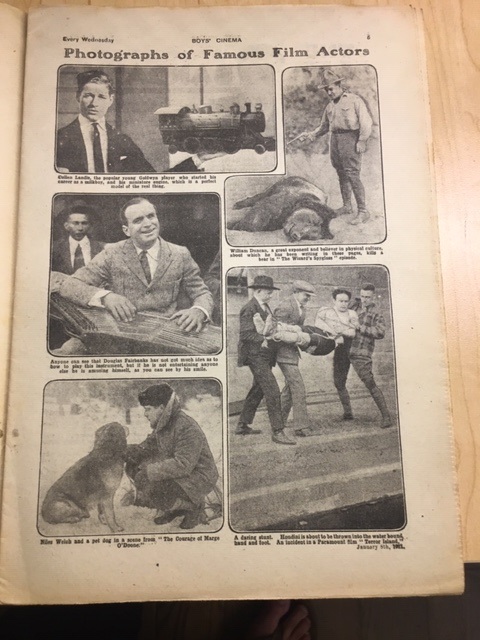
The photo below is from my personal copy of the January 5th, 1921 issue of Boys Cinema. It shows Houdini about to be thrown into the water bound hand and foot.
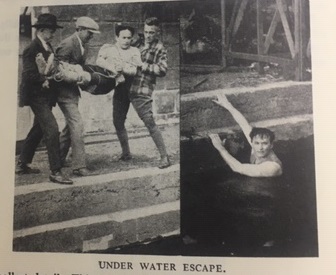
Many of you may recall seeing this “Under Water Escape” image in “Houdini on Magic” by Walter B. Gibson:
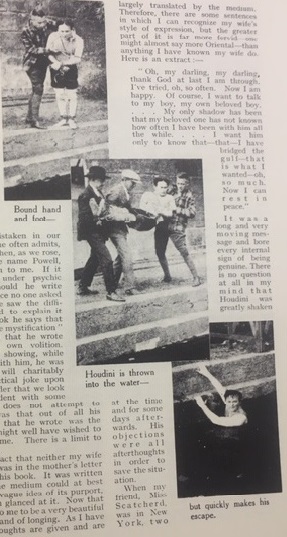
It also appears in the Strand Magazine “Houdini the Enigma” by A. Conan Doyle:
But it first appeared in “Magical Rope Ties & Escapes” by Houdini in 1920:
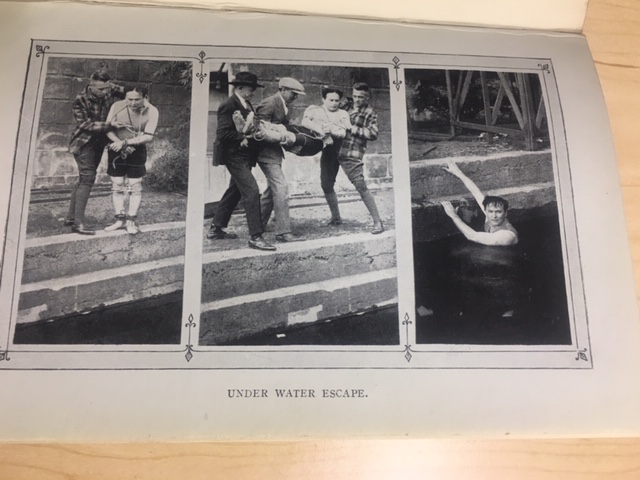
Although, the Boys Cinema photo incorrectly identifies it as an incident in the Paramount Film, “Terror Island”, I believe it, along with Houdini’s dyed black hair for the movies helps support that it was taken during the making of Terror Island in 1919 for inclusion in his 1920 book Magical Rope Ties & Escapes.
Could it have been taken in Elliotta Springs while he was doing his underwater stunts for “Terror Island”?
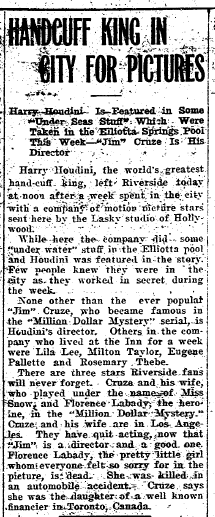
Or was it taken at Lasky Studio, where we know Houdini did a series of photos with actors Thomas Meighan and Jack Pickford for the 1920 book, Magical Rope Ties & Escapes?


Regardless, comparing photo(s) with all of the stills from Houdini’s two Hollywood movies, “The Grim Game” and “Terror Island”, I believe that is Houdini’s Hollywood hair from “Terror Island”.
Thoughts on when and where under water escape was filmed?
