Today, I thought I would share The Magic and the Myths that appeared at the bottom of the article (Houdini Knew There Was No Escape From The Other Side) I shared last week.


Today, I thought I would share The Magic and the Myths that appeared at the bottom of the article (Houdini Knew There Was No Escape From The Other Side) I shared last week.
Last week, I shared the Vanishing Elephant Photo (with Milbourne Christopher) from an article to celebrate the 100 year anniversary of Houdini’s birth.
Today, I thought I would share the main article, Houdini Knew There Was No Escape From The Other Side, from my personal collection:


As promised, here is the caption and additional info on the photo I teased last week.

The National Star April 4, 1974
The image (with Milbourne Chrsitopher in tux performing the Vanishing Elephant) was used in an article to celebrate the 100 year anniversary of Houdini’s birth.
Unlike other authors (e.g., Gresham, Silverman, Culliton, Steinmeyer), Milbourne Christopher’s, Houdini The Untold Story, mentions Houdini firing a pistol to make the elephant disappear. Per Linking Ring [Vol. 48 No. 6], Walter B. Gibson would also echo this, “Four men push cabinet on wheels in center stage, Magician leads elephant up ramp into cage. Fires gun. Elephant disappears.”
And per WAH, David Haversat has Christopher’s” unpublished notes “explaining how he vanished his own elephant. Christopher writes that he believes the method is the same that Houdini used.”
On January 1, 1967, CBS presented, The Garry Moore Show, The Greatest Magicians in the world, where:
Milbourne Christopher [co-producer] closed the all too fast hour taking us back through time and space to present the Asrah Floating Lady, the Sword Basket and ending with the biggest effect in magic the vanish of an elephant, Miss Ronnie by name. Ronnie was brought on stage, a slat framed cabinet built around her and with a flash of flame and a puff of smoke she vanished. Needless to say, CBS, got a lot of publicity out of this effect and the audience wasn’t disappointed. [Genii Vol 31, No. 5]

Image from DVD
I recently acquired the hard to find historic magic special (of Milbourne Christroper performing the vanishing elephant effect) on DVD.

The sword basket from that special is on YouTube:
What are we looking at? Who is is the magician and what illusion is he performing?

Clue: The image from an article, now part of HHCE collection, came from the Houdini Magical Hall of Fame and was used to advertise a famous illusion.
Will share the caption and additional info about the famous illusion and performer next week.

HHCE Collection
I recently acquired a very scarce German book (90 pages) by P Richards that had a splendid sketch on Houdini in it.

HHCE Collection
This led me to try and find out more about P. Richards and his connection to Houdini.
According to THE NEW YORK CLIPPER
P. RICHARDS, LIGHTNING CARICATURIST 6 February 1892
Recognized by leading papers and responsible managers as Strongest Comical Specialty. A1 Advertising Artist (late of NEW YORK HERALD, CHICAGO DAILY NEWS and LONDON ARGUS). Minstrels, Combination Companies of Circus, wishing to arrange for season at moderate terms. Address GENERAL DELIVERY, Chicago , Ill
P RICHARDS LEFT EUROPE SEPT 8, 1902 for AMERICA [Chicago]
He traveled for the past Summer in Europe, in the interest of Richard Pitrot, manager of European novelties for this country, visiting Germany, France, Russia, Italy, Holland and Austria, and has contracted for many attractions for America, and also booked many American acts in Europe.

Starting in 1903, P. Richards profusely illustrated his “Vaudeville Favorites” magazine devoted exclusively to Vaudeville, which led to a book in 1905, The Vaudeville Review of Vaudeville Favorites:

Ad from Stanyon’s Magic Magazine May 1905
In May 1905, THE CLIPPER announced that Mr. P. Richards would be one of THE CLIPPER Staff and produce each week a full page cartoon, illustrating in a humorous way, the leading features of theatrical and vaudeville productions.
In 1906, THE CLIPPER added a new publication entitled CLIPPER CARTOONS, that contained original drawings by the celebrated artist P. Richards.
THE NEW YORK CLIPPER announced that P. Richards, THE CLIPPER’s artist started his European tour on June 8, 1907. The artist continued his popular “Patsy Bolivar” series from abroad, sending to THE CLIPPER his impressions of every large city he visited, in the form of a full-page cartoon.
P Richards left Europe Sept 7, 1907 for America [New York] to resume for THE CLIPPER his original idea of cartooning the principal features of the leading dramatic and vaudeville productions.
In 1907, Harry Houdini’s Conjurer’s Monthly Magazine for July and August mentioned P. Richards sketches of magicians and men of mystery:
P Richards, the well-known cartoonist of the New York Clipper has gone abroad and is sending home every week a full page cartoon of “Patsy-Boliver.” Richards has drawn more magicians and men of mystery in his sketches than any other artist that we have heard of.
In 1908, THE CLIPPER Cartoonist, left for Europe again:
The growing interest of foreign performers in THE NEW YORK CLIPPER, together with the difficulties which the American performers appearing in Europe for the first time have to overcome, have induced the publishers of THE CLIPPER to establish a branch office in Berlin, Germany. This office will be known as the Berlin Bureau of THE NEW YORK CLIPPER, and will be under the direction of Mr. P. Richards, our widely known and popular cartoonist.
Having been born in Vienna, and thoroughly versed in the language and customs of the country, together with an extensive personal acquaintance with most of the foreign performers, Mr. Richards is eminently fitted for the position of manager of our Bureau. It will be his pleasure to give all the assistance in his power, both to foreign acts coming to America and in American acts visiting Berlin. He will also render valuable aid in receiving and forwarding the mail of performers traveling in Europe, and being familiar with the show business is both countries, he can give valuable advice to foreign performers contemplating coming to America, as well as important information to those American artists visiting Berlin. It is expected that this Berlin Bureau will be a great convenience to the performance of both continents. Mr. Richards will sail for Europe on July 25, 1908 and immediately upon his arrival will establish the Bureau, the location of which we will announce later.
P RICHARDS LETTER New York Clipper, 3 October 1908:
Circus Busch opened on Sept. 10, 1908 with Houdini as the feature, and the kind reception which was given to this performer proved the good memory of the audience, since he has not appeared in Berlin for the last five years. Houdini introduced, besides his famous escape from the straitjacket, an entire novelty in the form of his original can trick, where he allows himself to be handcuffed and then to be locked into a big can filled up the brim with water, from which he comes forth after a couple of minutes unharmed and—minus handcuffs. As he has a standing offer for 1,000 marks to anyone proving any portion of his exhibition a “fake”, the committee in the ring tries its utmost to earn the tempting prize, and submits Houdini, tin can and even the sawdust, around them, to a most thorough examination, without success (so far). Frobel and Ruge, besides Houdini are the only Americans on the bill.
P RICHARDS’ FAREWELL LETTER New York Clipper, 6 January 1912
This being my last letter in these columns (my contract with THE CLIPPER expiring on Jan. 1, 1912, and my time of being too much occupied with my illustrative work to permit me a continuance of thanking THE OLD RELIABLE, its highly esteemed managing editor, and also my friendly co-workers on THE CLIPPER staff, for all the kindness and congeniality bestowed upon me during the nearly seven years of our pleasant relations, and conclude herewith by wishing them, one and all, A HAPPY AND PROSPEROUS NEW YEAR.
P RICHARDS’ BOOK New York Clipper, 22 February 1912
“Zeichner and Gezeichnete,” “Sketcher and Sketched,” the new publication by P. Richards, the well-known artist and cartoonist, has reached THE CLIPPER. It is richly illustrated with original sketches, some of which had been drawn for THE CLIPPER, and cuts made from photos collected by Mr. Richards during his extensive travels. Interesting descriptions of incidents and places have found their way into this volume in German text, and it should find a ready sale among all classes of readers.
SHOULD AULD ACQUAINTANCE BE FORGOT New York Clipper, 31 May 1913
When P. Richards, the artist-author of International fame, some time ago reluctantly discontinued his Berlin Letters , which had been a most entertaining feature of THE NEW YORK CLIPPER for the past few years , he informed us that he was going to devote ln future all of his time and best efforts to the issue of a series of books, for which task he had been engaged by one of the most prominent publishers ( The Reflecklor-Verlag , Berlin-Leipzig ), of Germany. How conscientiously he must have been at work ever since ls amply proven by the first two volumes of his publications, which have been Issued recently and have just reached our office: “Zeichner Gezciehnete (“Caricaturists and Their Victims”) is a handsomely printed and bound volume , in which all of Richards wealth of distinguished acquaintances (especially in the theatrical and vaudeville field) have been utilized . A man possessing such a wide and rich experience has a right to glory in the memories upon which he can draw for his own pleasure and for the public’s benefit. The book contains a great number of photographs and also many sketches by the prolific pen of the author (two hundred and sixty-five illustrations in all), and ought to prove highly interesting and amusing , even to those who are not able to follow the German text. “Amerika Durch die Lupe der Karikatur” (America as Seen by a Caricaturist) . A beautiful album of large dimensions, most handsomely bound and printed . This is a picture work in the first place , being decorated throughout with full-page drawings , although there Is enough descriptive text to it to make it interesting reading as well. All phases of American life ore subjected to good-natured caricatures of sparkling, effervescent humor, quite in harmony with the vivacious tone of the work. Both of these volumes are enjoying a most enthusiastic reception by the public and the press of the Continent, and Richards may well be congratulated upon renewing his American success as an artist-author, also on German soil . Zeichner and Gezciehnete” sent post-free on receipt of $1.25, and “Amerika durch die Lupe der Karikatur” sent post-free on receipt of $ 1.75 , by Reflecklor Verlag, Querstrasse 26, Leipzig ( Germany ).
In 1914 he published this book, Varieté-Humor – Heiteres vom Brettl, Berlin (Reflektor), with sketchen on celebrated performers of the Music Hall (Variety Theatre) World. I am very lucky to have this extremely rare book in my collection. Unlike P. Richards other books, this is the only copy I have ever seen; and its the only one with a sketch of Houdini.

HHCE Collection
The following is from an article in my personal collection:
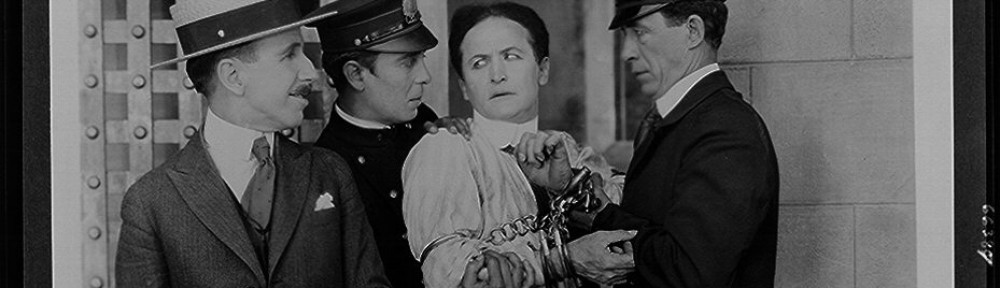
The first stunt Houdini performs is the opening of a barred door by manipulating a piece of wire and a bunch of keys so that he can draw back the bolt and so gain entrance. Then, whilst taking forty winks at this desk, his fellow reporters play a joke upon him and place handcuffs upon his wrists. They are amazed at the ease at which he removes them. Next he causes an automatic pistol to appear miraculously in his hand, which is held high in the air. He also opens a locked gate by manipulating the lock. When the hero is arrested for murder, he puts up a strenuous fight, but is finally overpowered by nearly a dozen men. Then he is chained, handcuffed, and locked so that it seems impossible that a man could get away. But he performs the feat right in front of the camera. Removing the chains he attaches them to a prison bed, and, using leverage, forces the bars over the window. Then he climbs to the ledge, and clinging to the wall makes his way straight up to the roof. He goes out to the end of a horizontal flagpole to secure the rope and climbs downward to earth.
Here comes one of the most interesting actions of the picture, although one of the quickest. Crouching in an alleyway, Houdini hurls himself between the front and rear wheels of a moving motor car, and with what seems like a continuous movement grasps the underhanging portion of the chassis and so escapes. He climbs up a drain pipe to the roof of a house, and by a clever move and by a clever move sends his pursuers on a false scent. But he is captured and is taken to an asylum, where he is placed in a strait-jacket, removes the ropes and falls to an awning many feet below. One of the most difficult of the stunts, however, is when Houdini, pinioned hand and foot to four separate bended trees, which keep him swinging in mid-air, effects an escape.
The greatest scene of all, and one in which was entirely unpremeditated, is when Houdini crawls out of the fuselage of an aeroplane and lands upon the top plant of another. But the machines, running too close together, suddenly strike, and the plane containing Houdini, the heroin and Allison makes a mad spiral dive to the ground and strikes the earth with tremendous force. The machine is broken up, but fortunately no one is injured. It had been intended to land in the ordinary manner.
[February 21, 1920 The Film Renter & Moving Picture News]
Today, I share from my personal collection, the verdict of the Press on Houdini’s “The Man From Beyond”:

HHCE Collection
Double-click image to enlarge for reading.
Related:
Houdini wrote, produced and starred in two of his feature films; he wrote a number of treatments – plots for potential productions; and he self-published several of these treatments. *
This post continues a series of posts where I summarize (or share tidbits about) film treatments (published and unpublished) by Houdini
* “Film Treatment” can be found in Patrick Culliton’s book, Houdini’s Strange Tales – A Collection of fiction by the legendary Harry Houdini [1992]
Today, we look at Out of the Shadows, from my personal collection.

Like the film treatments in the Tom Boldt collection, this manuscript was dictated by Houdini. It is 4 leaves written (entirely in pencil) on stationary with HOUDINI engraved in the upper left corner.
Out of the Shadows
The story concerns a man (called “Hero” in the outline) who went to jail to protect his younger brother. Upon his release, he has his heart broken, becomes a wastrel, falls in love, becomes a D.A., survives blackmail and several attempts on his life and finally marries the girl.
Note: Although Out of the Shadows was never filmed, there are elements in the story that echo in some of his other films.
Houdini wrote, produced and starred in two of his feature films; he wrote a number of treatments – plots for potential productions; and he self-published several of these treatments. *
This post continues a series of posts where I summarize (or share tidbits about) film treatments (published and unpublished) by Houdini
* “Film Treatment” can be found in Patrick Culliton’s book, Houdini’s Strange Tales – A Collection of fiction by the legendary Harry Houdini [1992]
Today, we look at Blood Brothers
Per Silverman:
Despite Houdini’s sudsy reasoning, in his affections he had always ranked his mother on a level with his wife, expected Bess to accept the fact, and even in some degree confused her with Cecilia. In one of his unpublished short stories, “Blood Brothers,” he named his hero Haddon Harcourt — HH — and gave Bess’s middle name, Beatrice, to HH’s mother.
Note: Unfortunately, this all the info I have on Blood Brothers at this time. I hope to get to read it one day. Especially, with the fact that he actually named the hero in this one, unlike most of the other unpublished film treatments. And we know, that the 4 feature movies he starred in, all had his characters initials as HH (Harvey Hanford–The Grim Game, Harry Harper–Terror Island, Howard Hillary–The Man From Beyond, Health Haldane–Haldane of the Secret Service).
Houdini wrote, produced and starred in two of his feature films; he wrote a number of treatments – plots for potential productions; and he self-published several of these treatments. *
This post continues a series of posts where I summarize (or share tidbits about) the film treatments he wrote:
* “Film Treatment” can be found in Patrick Culliton’s book, Houdini’s Strange Tales – A Collection of fiction by the legendary Harry Houdini [1992]
Today, we look at Floating Through Space, which was one of four treatments (The Great Tontine, The Monster, The Vulture, and Floating Through Space) that turned up in 1990 and was published in 1992*.
Per Culliton:
[These treatments] turned up in 1990, when an East coast book dealer offered them for sale. This dealer was under the impression that he had in his possession several manuscripts hand-written by Houdini, and he was asking a small fortune for them (which, if genuine, they were worth). Houdini bibliographer Manny Weltman asked to see a sample and the dealer sent along a xerox of one of the stories. Weltman correctly identified the manuscript as having come from Houdini’s mind, but not written in his hand. The dealer was crushed. He put the material up for auction and Tom Boldt of the Houdini Historical Center in Appleton, Wisconsin was able to obtain all of it. It is through his kindness that we are able to include these four previously unpublished film treatments.
Floating Through Space (Story Summarized)
During one of Hero’s journeys, a wicked and cruel Hindu girl before she dies, tells him of her everlasting love, also of her peoples belief – of the souls of the dead at some time inhabiting the body of some living person.
After a strenuous career abroad, our hero returns home and falls in love with a sweet girl and asks the girl to wear a particular amulet, and asks her to swear she won’t remove it ever until her wedding day.
Fade in the sweet girl, preparing for bath, removing amulet – then retires to bed. You see the shadow of Hindu girl gloatingly over sleeping girl. You see the transformation in the girl’s face.
Fade in our Hero, who finds her seated in a chair kissing his picture. He asks her had she removed the amulet. She answers, “No.”
He realizes he had fallen asleep and dreamed she removed the amulet. The girl smiles in his face with love and trust in her eyes, both parents look indignantly at the smiling lovers–
–as the curtain falls.