Pushing the Envelope
Rather that wait for the United States Postal Service to some day issue a stamp that honored Houdini.
It was 1976, the year of the Bicentennial, as well as the 50-year milestone of Houdini’s Halloween death in Detroit, Michigan, and Kaiser, owner of the Premier Company, a printing firm in Houston, deemed it the ideal time to go postal with Houdini. “While still hoping to enlist the cooperation of philatelic and magical societies,” stated a notice circulated at the SAM National Convention in Philadelphia that year, “Mr. Kaiser feels that this important occasion should not go unnoticed in collaboration with accompanied cachet designer, John J. Henler, the Premier Company will proceed on its own and produce an attractive cover that will appeal to both stamp collectors and magicians as a once-in-a-lifetime keep-sake.”
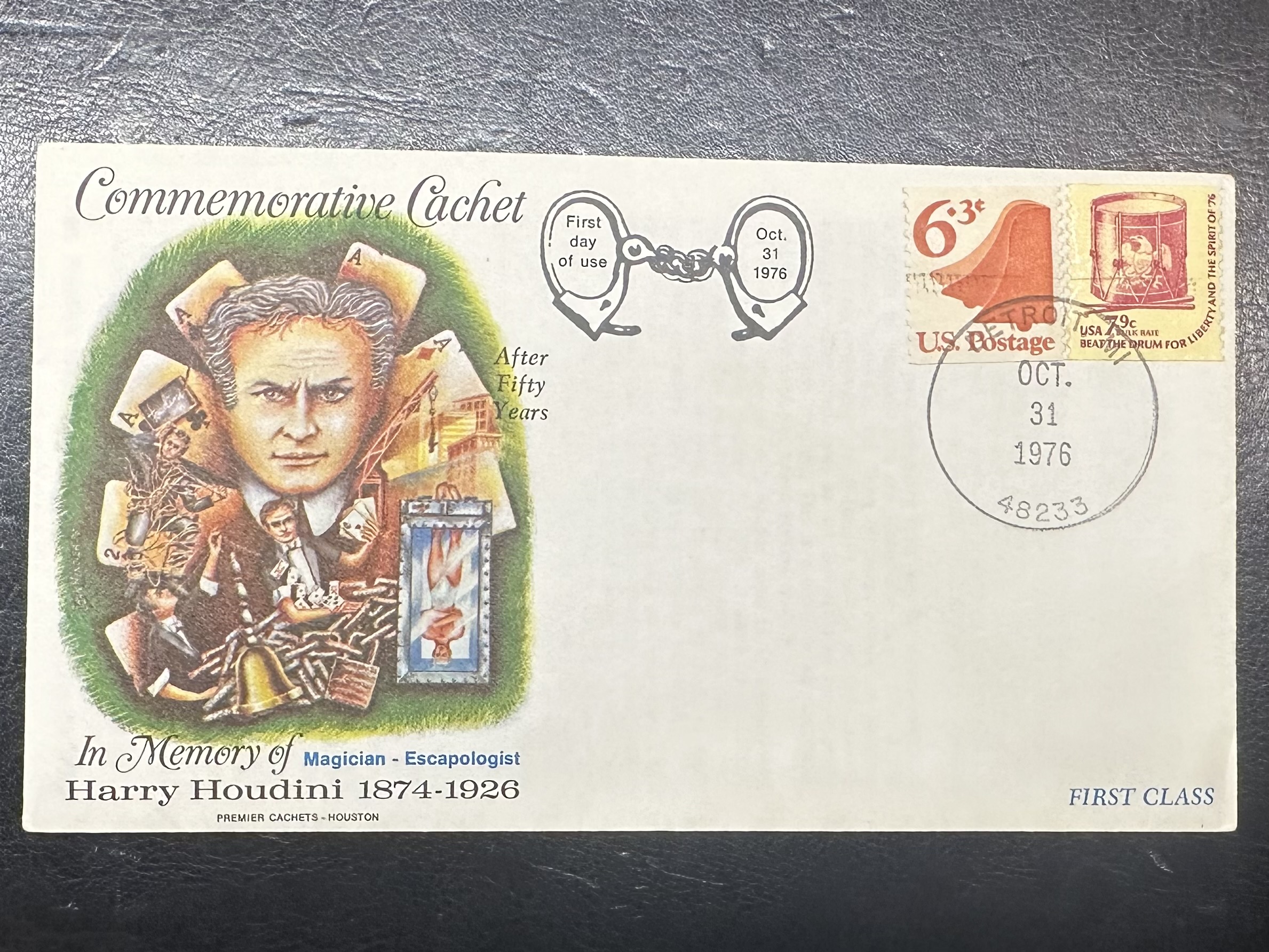 The distinctive four-color “Houdini Commemorative Cover” was privately issued, sans an official stamp. Attached was a 6.3c Liberty Bell stamp and a 7.9c Snare Drum stamp, captioned “Beat the drum for liberty, and the spirit of ‘76” [both were U.S. bulk rate issues), and they were canceled with a “DETOIT, MI /OCT 31, 1976 / 48233” postmark.
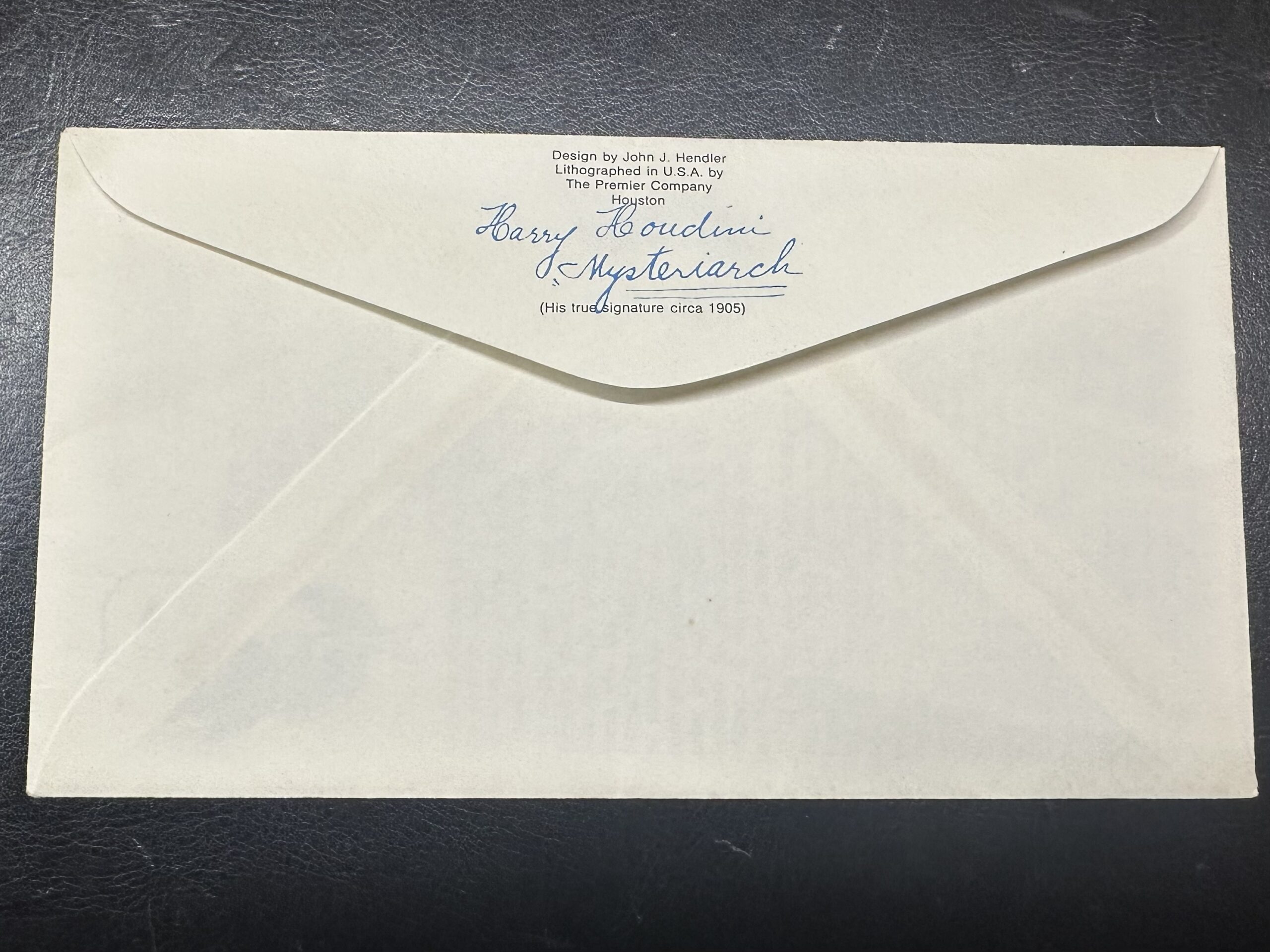 The flap of the envelope carried a reproduction of a blue-ink signature of “Harry Houdini Mysteriarch,” and printed beneath it was a caption: “His true signature circa 1905.”
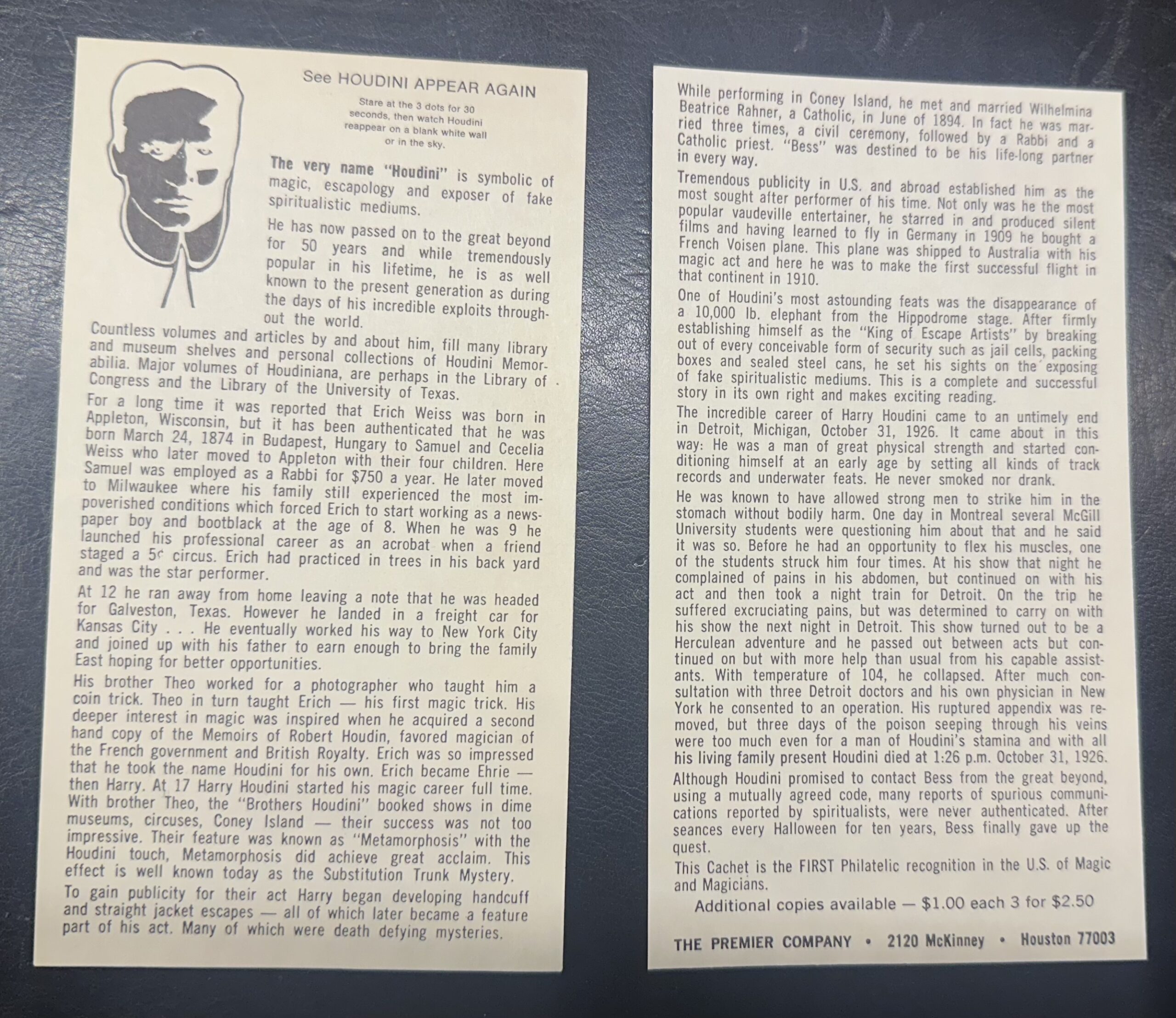
Inside was a 3-1/2 by 6-inch card with a synopsys of Houdini’s career that concluded with the statement: “This is the FIRST philatelic recognition in the U.S. of magic and magicians.”
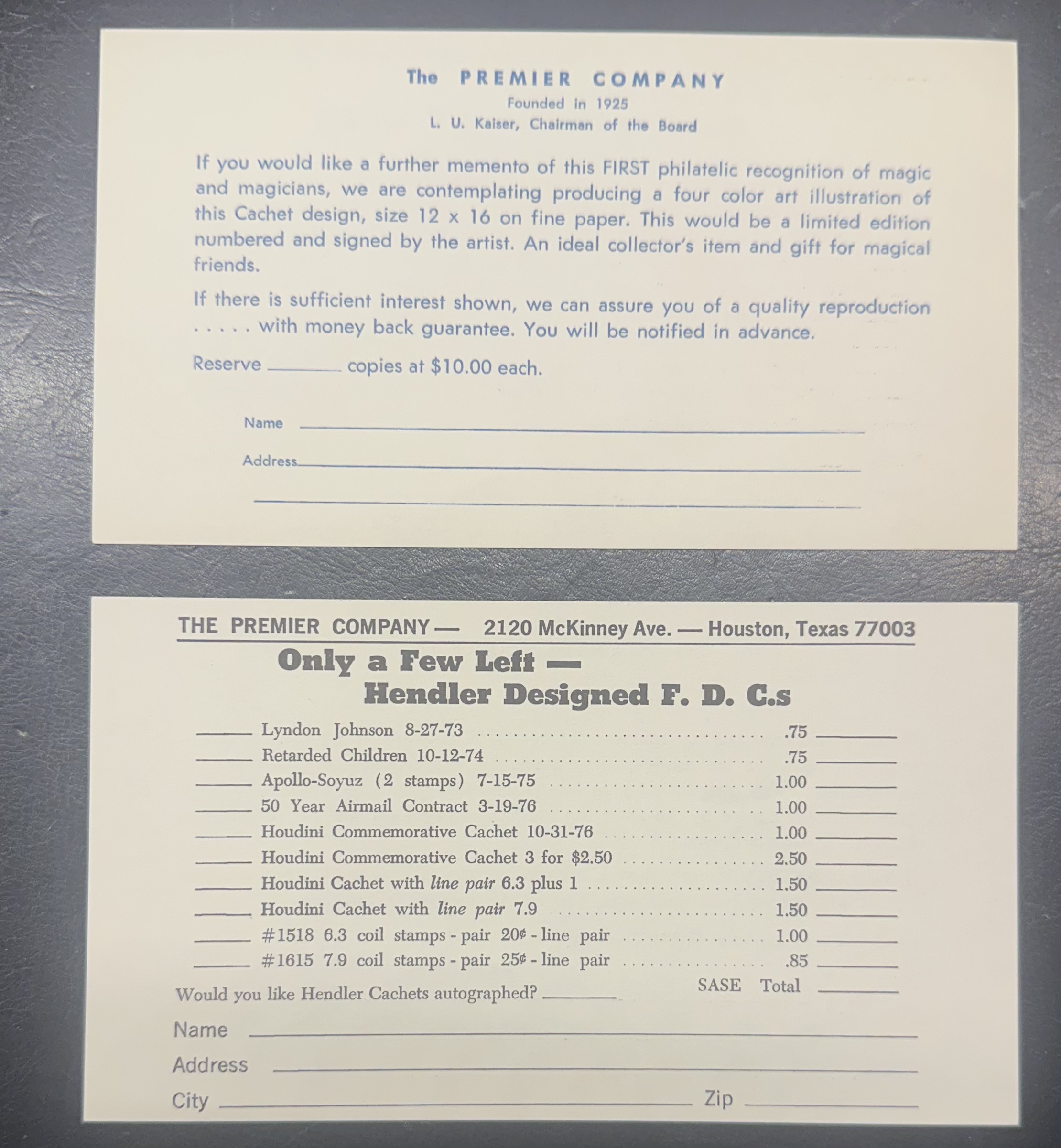 Ads in The Linking Ring, M-U-M and Genii announced the “Memento Cachets” were available from the Premier Company for $1 each or three for $2.50. And, as with most printers, the more you ordered the less the unit price became: 60c each for 25 to 100 copies; 50c each for 100 or more.
[MAGIC DECEMBER 2001]
Photos: HHCE Collection
Thank you for this post, Joe! This brings back memories. I remember seeing these advertised in The Magic Magazine. I didn’t understand what it was, but I know I loved the artwork. Took me a few years to get one. I haven’t looked at it in years (decades?) and didn’t remember the “Harry Houdini Mysteriarch” signature on the back. That is pretty rare. He used “Mysteriarch” for such a short amount of time. Wonder where it came from?
You’re welcome, glad it brought back memories.
Mysteriarch was primarily used during his breakthrough European run. (e.g. UK Mirror Challenge 1904 [Gresham]). But it did make an appearance on a playbill when he played Auditorium Theater in Baltimore 1906 [Christopher]. And also in Australia 1910, he was billed as “the Great Mysteriarch” [Silverman]. And there’s that 1915 Mysteriarch Lithograph by Atelier J. Zaire. [Houdini Art and Magic].
Kellock mentions that: “when a circus came to town, Ehrich made straightway for the dusty platform where the “Peerless MYSTERIARCH of Three Continents” performed”.
Houdini Art and Magic dates that Atelier J. Zier lithograph as 1915? Goodness. It’s 1903/04.
He doesn’t source it, but Silverman is right about HH using “The Great Mysteriarch” in Australia. Or at least the papers did. Interesting. Thanks for bringing that to my attention. That’s an interesting beat for his Australian tour.
Also, I actually have that 1906 Auditorium playbill in my book. Don’t think I ever clocked that “Mysteriarch” there. Nice.
Houdini Art and Magic dated it 1915, because HRC lists it as circa 1915. But agree Atelier J. Zier first created it (along with German Courtroom Poster [1902] and Houdini in Russia Poster [1903]) during the early European tours [1901-1904] in his renowned lithographic printing house based in Leipzig, Germany [where Houdini performed in 1901].
Funnily, I just found an ad for The Master Mystery playing in Kansas City in 1918 that calls Houdini “The Mystery-Arch.”