Weird Tales Sketch Card

This is a scan of an original character sketch card by Studio-Hades that sold on eBay last month.  The scan contains slightly more contrast and considerably less detail than the original, the scan really does not do this piece justice.

It is from the WEIRD TALES 2 sketch collection and is numbered 13 in the series; there is only one of each card in a series.

The following text appears on the back of the card:

Few periodicals have had such a lasting impact on literature and popular culture as Weird Tales. First published in 1923 during the heyday of the pulp magazine, Weird Tales broke the constraints of what was conceivable in popular fiction at that time. Crafted by a diverse group of authors, including Robert E. Howard, Clark Ashton Smith, Robert Bloch, Tennessee Williams and August Derleth, they seamlessly melded themes as disparate as space viruses and necrophilia to sword and sorcery and historical speculation – all for a penny a word. Conan the Barbarian, arguably Weird Tales most famous son, enjoys more fame now than at the time of his creation.

Acheron Mint celebrates the unholy legacy of the strange, occult, the supernatural and bizarre and the fearless writers who conceived it with the Weird Tales Sketch Collection Set Two.

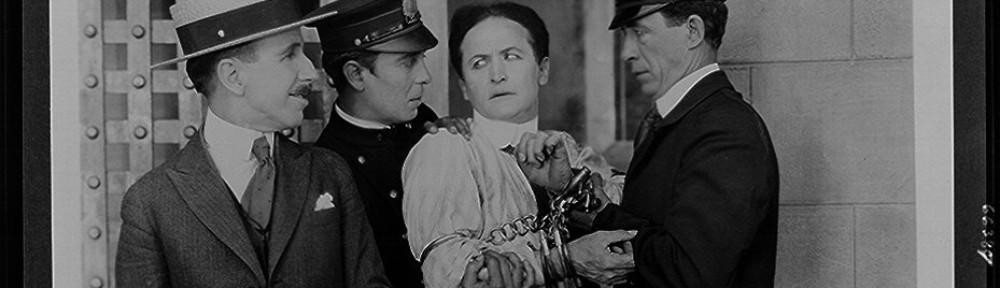
The sketch is of course from The Grim Game.  In fact, it was from the following famous image that can found in the Library of Congress.

Harry Houdini was a frequent Weird Tales contributor.  Here are some Houdini Weird Tales covers.

  • Weird Tales Volume 3 No. 3 March 1924 
  • Weird Tales Volume 3 No. 4 April 1924
  • Weird Tales Volume 4 No. 2 May June July 1924

Houdini Opens at Broadway


NY Tribune August 24th, 1919

93 years ago to the day, August 25th, 1919, The Grim Game opened at B.S. Moss’s Broadway Theatre at the corner of B’way & 41st St.

NY Tribune August 27th, 1919

Houdini appeared in person explaining on the stage a few of the dare-devil mystifying stunts portrayed in the film.

Below is a review of the film, story and Houdini’s speech from the NY Tribune.  Enjoy!

Houdini Shows How Easy It Is to Do Hard Things and Make a Good Photo Play

“The Grim Game”, at the Broadway Theatre is entirely different from any picture we have seen, and it seems to us a smashing success in every sense of the word.

Our only criticism is that the story is too long in getting started.  We wanted less preparation and more Houdini, and after the picture was finished we felt still more strongly that a lot of time had been wasted in the first two reels.  The last three are crammed full of miraculous escapes, aeroplane flights and disappearing heroes.

All of the things which Houdini does (they are not tricks) are done in plain sight of the camera, so that if you cannot do them too it is not because you do not know how they are done.

The story is by Arthur B. Reeve and John W. Gray.  It tells of a miser, Thomas Jefferson, who lives alone a beautiful old home with his niece.  Her fiancé is Harry Hanford, a reporter.  This is Houdini.  The owner of the newspaper is in debt to old Cameron, who holds his notes.  A Richard Raver, lawyer, is also in debt and has forged his clients name to secure money.This part is cleverly played by Tully Marshall. Dr. Tyson who completes the triumvirate, would benefit by old Cameron’s death, because his will states that the doctor must marry his niece and inherit his money.

Hanford arranges a bet concerning circumstantial evidence, which if his employer wins, will bring him money enough to redeem the notes held by Cameron.

The old miser is to be spirited away and he himself is to be the suspect. Only the plan goes astray, for some one really does murder the old man, and the three men who have been in the game with Hanford all claim that they know nothing about it, and refuse to clear him.

As all three of them would benefit by Cameron’s death the story resolves itself into one of those mystery murder plays.

Houdini makes a speech at the end of the picture in which he tells of the aeroplane collision which is shown so plainly in the pictures.  The ending was to have been quite different, but when the propellers on two planes interlock, and the planes are sent whirling around in the air 4,000 feet above the earth and the camera catches it we do not wonder that they to keep it in the picture.

The plane in which Houdini is chasing his enemy is directly over the other plane. He lets himself down by a rope, and it was the intention of the scenario writer to have climb in the enemy plane and take the wheel, but the other way was much more exciting only, of course no one would voluntarily take such a risk.

Houdini’s speech is dignified and effective.  He makes no attempt to be facetious, but merely tells of the danger of making such a picture.  Irvin Willat  directed the picture and risked his life to photograph some of the scenes.

H. U.
Famous Players-Lasky Backlot

Houdini came to Hollywood, California in 1919 to film his two features (The Grim Game and Terror Island) for the Famous Players Lasky. The Famous Players-Lasky Backlot sat on the corner of Vine Street and Selma Avenue in Hollywood.  Click here to see other photos of the backlot.  See below for images of Houdini on the backlot.

The photo above is from my copy of the Magical Bulletin (April 1921 Vol. 9, No. 4). It shows Mr. Harry Houdini in the act of entertaining some of his associates at the Hollywood Studios during the filming of his famous pictures.

The photo above sold on eBay back in July. It shows Houdini standing on what is most likely the Famous Players-Lasky studio backlot.

To see another fantastic photo of Houdini on the Famous Players Lasky backlot, check out John’s blog at WildAboutHoudini.com titled, Houdini in HOLLYWOOD; the image on the blog is from Arthur Moses Collection.

Rare Houdini Poster

This poster is an awsome find in the world of Houdini collectibles – a fantastic photo of a classic Houdini pose (L302-60). These were made around the late 1970s and are rare enough to be collectible but not so rare that that they break your bank account.  I was fortunate enough to pick one up for $29.99 and that included shipping.  It measures 16×20 and is on a high grade semi-gloss paper.  It is proudly displayed in my Houdini room.

Thomas Jefferson Found

Last week, I posted a blog about the Old Man Jefferson Connection which looked at Houdini’s connection with Joe Jefferson and Thomas Jefferson.  Joe Jefferson and Thomas Jefferson were sons of actor Joseph Jefferson III who was famous for creating the role of Rip Van Winkle.  Houdini appeared on the same bill as Young Joe Jefferson during his vaudeville days and he appeared with Thomas Jefferson who played Old Man Cameron in The Grim Game.  In that blog, I posted a photo of Young Joe Jefferson but not Thomas Jefferson.   As far as I know, there are no movie stills of Thomas Jefferson from The Grim Game and I have seen and cataloged most if not all of the movie stills from the movie. So what did Thomas Jefferson look like; I combed the internet numerous times and finally found 2 photos at the findagrave.com website:

Thomas Jefferson
Birth: Sep. 10, 1856 New York, USA
Death: Apr. 2 1932 Hollywood Los Angeles County, California, USA

Son of actor Joseph Jefferson who was believed to be the earliest actor to appear in films. Married to actress Daisy Robinson, Jefferson followed his father’s footsteps as a stage actor for nearly half a century.  One of his greatest stage successes was playing Rip Van Winkle which he did for twenty-five years.  Jefferson was a member of D.W. Griffith’s stock company for a time during his career. Actor in numerous films, Jefferson passed away at his home in Los Feliz following a brief illness.

Burial: Hollywood Forever Cemetery, Hollywood Los Angeles County, California, USA
Plot: Section 20B, #168 (unmarked)

Old Man Jefferson Connection

The following correspondence from Houdini to Quincy Kilby intrigued me when I read it in Houdini, The Key on page 96:

Hollywood, California June 9, 1919

Dear Q.K.

Thomas Jefferson and myself frequently converse about you, and it was through an accident that I found out young Joe Jefferson was a friend of mine.

I thought that young Joe was an old man, but it appears that he was younger than I.

Worked with him in vaudeville, that is he was on the same bill, and very pleasant, and very pleasant weeks we had

So Mr. Thomas J. and I have lots to talk about…

It intrigued for a number of reasons:

First off the date of the correspondence is during the time that he lived in Hollywood and was filming the Grim Game.

Srapbook compiled by Quincy Kilby
Img: flickr/boston_public_library

Second, who was Q.K.? Quincy Kilby, was a personal friend of Houdini, who compiled a Houdini scrapbook which is in the Boston Public Library.  He also wrote a history of the Boston theatre, and another book on actor/assassin John Wilkes Booth.  He spent 20 years accumulating the items in his Houdini scrapbook.  These include letters, newspaper clippings, and a very exciting scene and prop list.  Houdini knew about Kilby’s project.  He sent his friend items marked “for your Houdini scraps book.”

Joseph Jefferson III as Rip Van Winkle

Third, who was young Joe Jefferson?  Let’s look at who his father was first. Joseph Jefferson III (1829-1905) was the 4th generation of a theatrical family that was established by Thomas Jefferson (1728 -1807), an English actor who managed several theatres.  Thomas’s son Joseph Jefferson I (1774-1832) came to America in 1795 on tour and remained to manage the John Street and Park Theatres in New York and the Chestnut Street Theatre in Philadelphia.  He played a comic actor.  Joseph Jefferson II (1804-1842) was an actor as well.  All three Jefferson’s were noted for playing old men.  Joseph Jefferson III was born 20 February, 1829 at Philadelphia United States of America, son of Joseph Jefferson, actor, and his wife Cornelia Frances Thomas Burke.  He began is stage career at 4, and, after his father died in 1842, relied on acting for a living. At 21 he married Margaret Clements Lockyer. On February 18, 1861 his wife died, leaving four children.  On December 20, 1867, he married Sarah Warren the niece of the actor William Warren. Fame came with his creation of the role of Rip Van Winkle. He died in 1905.

Young Joe

Joseph Warren Jefferson IV was a child of the second wife.  He was born July 6, 1869.  He was a member of his father’s company.  So at the time of the Grim Game, Joe Jefferson IV would have been 50 years old and Houdini 45 years old, making young Joe Jefferson five years older not younger than Houdini. Joseph Jefferson IV (1869 – 1919) performed at Macauley’s Theatre three times in Rip Van Winkle.

And last but not least, what was the connection with Thomas J and young Joe? Thomas Jefferson played Old Man Cameron in the Grim Game.  Like young Joe Jefferson, Thomas Jefferson was one of Joseph Jefferson III sons. He acted in his dads company in several roles opposite his father.  He became an actor in D.W. Griffith’s stock company appearing with Houdini in The Grim Game.

The Plot Thickens

The following detailed plot synopsis appeared in the December 6, 1919 issue of The Moving Picture World:

Harvey Hanford, the part played by Houdini in The Grim Game, is a special writer on The Call, who is noted for his nerve and daring in gathering news.  He has an eccentric millionaire uncle who lives with his ward, Mary, and will not let Harvey come near him.  The old man knows that his nephew and his ward are in love with each other, and is opposed to the match.  He is also aware that he is surrounded by three men, any one of whom would profit by his death.  The first is his lawyer, Richard Raver, who has misappropriated some the Cameron funds.  The second is Dr. Tyson, his physician, who expects to marry Mary, heiress to the Cameron millions, when their owner dies.  Clifton Allison, owner and publisher of The Call, is heavily in debt to Cameron, and the old man has threatened several times to drive him to the wall. 

A plan is hit upon by Harvey to work up a big sensation for the paper by getting the old man away secretly and then making it look as if he (Harvey) had murdered his uncle.  After he has been convicted of the crime, Dudley Cameron will be brought back and circumstantial evidence will be given a heavy blow.  The three men agree to this, but each one is determined that the old millionaire shall never return home alive.

The scheme is set in motion and Harvey is arrested for the murder of his uncle.  Then commences a series of Houdini escapes, the last one being a genuine thrill and the most dangerous of the Handcuff King’s career.

While trying to change in midair from one flying machine to another, the two airplanes crash into each other.  This, of course, is an accident, but the camera caught it and also the dive to earth of the machines which followed.  None of the actors in the accident were seriously hurt, and The Grim Game is able to show on the screen an “escape” that is a thriller of thrillers.  The story is brought to a highly satisfactory close, and Harvey and Mary are united.

Double Take Links

On June 8th, 2012, I posted a blog titled, Double Take, which looked at a pair of magazine ads advertising The Grim Game that look the same but are are different.

On January 7th, 2012, I posted a blog titled, L302-55 versus L302-60, which showed two famous images of Houdini standing shackled in a Jail Cell with cuffs and ball & chains that are similar but slightly different images.

Kevin Connolly Collection

Today, I am posting links to two incredible double-take blogs, that our friend Kevin Connolly posted in February of 2011that show identical Houdini images being used for different movies:

I hope you enjoy these double takes as much as I did?

Houdini’s “Strange Power Over Locks”

Above all, the performer must give the impression that he possesses some mysterious power over locks.” [Burling Hull, the Challenge Handcuff Act]

According to Patrick Cullington [Houdini the Key], Burling Hull added this text to the written instructions that went with Houdini’s Defiance Handcuff act when he republished them under his own name. Hull didn’t steal that idea from Houdini’s writings, he stole it from Houdini’s act.

Houdini’s “strange power over locks” was demonstrated in every performance of his handcuff act and it was definately demonstrated in his movies as evidenced by The Grim Game movie stills depicted in this blog. 

Everything about Houdini’s expression indicates that he is exercising a “power”. [Patrick Cullington, Houdini the Key]