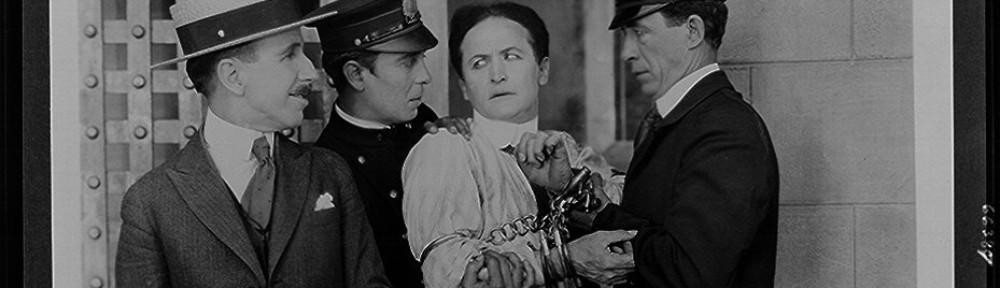
The Amazing Exploits of Houdini – The Jewel Thieves

During my visit to the McCord Museum, I was fortunate enough to have read a compilation (April 24, 1920 v1 n1 to June 5th 1920 v1 n7) of “The Amazing Exploits of Houdini” found in The Kinema Comic.

  1. The Bride & The Orangutan.
  2. The Jewel Thieves.
  3. “Stop Thief!
  4. The Gold Melters.
  5. Adventure of the Midland Express.
  6. In The Dead of Night.
  7. Out of The Sky.

Each issue contains a several page serialized fictional story (by-lined by Houdini). This week I share my paraphrased version of “The Jewel Thieves” found in the May 1 1920 v1 n2 issue:

Houdini is sleeping in a hotel room on the seventh floor. When he stays in a hotel with a telephone in the bedroom, he makes it a point of screwing off the bell before retiring, thinking that the shock of ringing will not be so great. On this night, the sound of the vibrating hammer was more terrifying than any bell would be.

Houdini answered the phone and was told that the hotel was on fire and he needed to leave his room at once and make his way outside by the back staircase, since the main staircase was ablaze and impossible.

Half asleep, Houdini jumped out bed, and dashed out the door toward the back staircase used by the servants. To make his way down the pitch-dark stairs, he had to feel his direction with his hands on the wall. Suddenly, Houdini received a blow on the back of his head from some hard instrument, dropped to the ground, and was hurriedly searched, but nothing was found.

Houdini was awakened by the corner of a door pushing into his ribs. A man with no shoes on dashed across to a window, opened it, and disappeared.

Houdini slowly rose to his feet, crashed through some swinging doors and on to the floor of one of the hotel corridors. He had a splitting headache and didn’t remember that the building was on fire.

Rising to his feet again, Houdini staggered forward perhaps a dozen yards, when a door opened and a man whose face was drenched in blood from a cut on his forehead, yelled that “They’ve bagged the lot. Taken every dashed thing.”

Houdini asked what happened?

Thieves broke into his room, hit him on the head and stole his diamonds.

Houdini told the man he got hit on the head also and that he should telephone the cops.

Houdini staggered towards the man’s room and threw himself on his bed.

The police were sent for. Slowly recuperating and trying to gather his scattered and wounded wits together, Houdini was able to reconstruct the adventures of the night. Houdini remembered the alarm of fire sent over the telephone, his scramble down the back stairs, then being hit on the back of the head by some unknown assailant. Then it dawned on him, that the thieves somehow called him up on the telephone instead of their victim, their purpose evidently being to decoy the man from his room whilst they robbed him of his jewels.

Houdini rose from the bed and pushed his way past the hotel servants who were attending to the victim of the robbery. Houdini made his way through the door of the room which the man had climbed was situated. It was still open.

The window gave on to a lower roof of an adjoining building. The drop from this window to the roof would be about eight feet. Houdini curiosity was aroused, and despite his aching head he decided to investigate.

Just beneath Houdini, on the top floor of the building, he could see a lighted window. There was no reason for a lighted room at that time. Almost before the resolution was made, Houdini’s leg was over the parapet; a drainpipe ran down the front of the building, Houdini tested its strength. It appeared to be safe enough. Houdini risked it, and clinging almost like a fly, slipped down the sill of the window.

Only a corner of the room was visible, but a side of a table was in view. At this table, he could see one hatted man removing precious stones from their settings.

Suddenly, without the slightest warning, the spring of the blind was released. Houdini discovered there were three men in it, the one at the table, another one at the other side of the table, and the one who by letting up the blind had exposed Houdini.

The man nearest the window moved towards Houdini and raised the sash. As Houdini waited his fate, he felt a strong hand grip his ankle and then another took hold of his other ankle.

Houdini was dragged into the room and bound hand and foot. Houdini smiled!

Houdini’s back against the wall, freed his hands; Tied behind him, it was quite a simple matter to hide his actions from view of the men.  Then, working very gingerly, got his feet loose, undetected.

Houdini reached for a revolver from his hip pocket and covered the three men.

Houdini ordered the men into the corner of the room. When they were safely in the corner, Houdini picked up one of the instruments which they had been using and threw it through the window.

Down below in the street, you could hear pattering of feet, and then the shrill blast of a policeman’s whistle.

Within five minutes, three policemen, hammered their way into the room where Houdini held the men prisoners.  All facts were so conclusive. The jewels on the table were sufficient to condemn the men.

Of course, Houdini was thanked by the victim of the robbery. “You must have been called up on the telephone instead of me.” he said. “As a matter of fact, I occupied your room on the previous evening.”

What really happened on October 24th, 1926 between the train arriving and the show in Detroit?

What really happened on October 24th, 1926 between the train arriving and the show in Detroit?

Let’s see what the biographers have to say.

According to Williams & Epstein [1951]:

he took his scheduled train that evening, to Detroit. The doctor’s summoned to meet him at the station in the morning diagnosed appendicitis and ordered an immediate operation, but Houdini insisted that he must appear in the theater that evening. When he walked out on the stage he had a temperature of 104 degrees.

According to Gresham [1959]:

Urged by Bess, Collins sent a wire ahead of them from the train. When they pulled into Detroit, they were met by a doctor. Houdini’s temperature was one hundred and two degrees.

He scorned going to a hospital. But when they got to the hotel he crawled into bed and had Bess pile blankets on him. His chill, which shook the bed, lasted a half hour.

In spite of his loud refusals, Bess sent for a committee of doctors. They were unanimous—Houdini had appendicitis and needed an operation at once. Bess wept and argued all day when Houdini was not dozing uneasily. When curtain time approached he asked for news from the box office. The report came back, “Sold out. Not a vacant seat in the house.” That settled it, “Help me up. They’ve paid their money to see Houdini. “By God, they’re going to get a show.” His temperature was now one hundred and four.

According to Kendall [1960]:

“You can’t take that train to Detroit tonight,” Bess insisted, “show or no show”. He was scheduled to appear in Detroit the next evening.

“A train ride won’t hurt me. I always do my best thinking on trains.”

Stubbornly, he had his way. But as the train clacked onward across the autumn-colored landscape, all thought was driven from him. He was conscious of only one thing, pain driving through him with every turn of the iron wheels on the rails. At last he was forced to give in to the pleas of the nurse and Bess that a wire be sent asking a doctor to meet the train at the station in the morning.

The doctor was there. As soon as Houdini could be gotten to a hotel, the doctor his temperature and examined him. The thermometer measured 102 degrees. Then a severe chill gripped him and he lay shaking for almost a half hour. Other physicians hurried to his bedside.

“Your symptoms indicate acute appendicitis,” one of them told the shivering and sweating magician. You must be operated on at once.”

Houdini clenched his teeth and asked Bess, “How many tickets have been sold for the show tonight?

“All of them, someone else spoke up. “A full house.” “I’ll go through with my act,” Houdini said.

That evening when he walked out onto the stage his temperature was 104 degrees.

According to Christopher [1969]:

A telegram was hurriedly dispatched to George H. Atkinson, the show’s advance man in Detroit, when the train made a brief stop at London, Ontario. He was instructed to have the best doctor in the city ready to give Houdini a thorough examination before the opening, Nurse Rosenblatt took Houdini’s temperature, it was 102 degrees.

The Montreal train arrived late. Collins doubted they could track the equipment to the theater, hang scenery, and get the magical apparatus uncrated and assemble before curtain time. Rather than check in at their hotels, the entire company went directly to the theater. There was no doctor waiting at the Garrick despite the urgent wire. Houdini pitched in and helped stagehands and his assistants set up the heavy gear.

Dr. Leo Dretzka and the show’s advance man paced the lobby at the Statler Hotel. The doctor had to leave for a medical convention that night, but he had promised to examine the ailing escape artist first. After asking a dozen times at the desk if Houdini had checked in, Atkinson finally phoned the theater.

There was no cot in Harry’s dressing room at the Garrick. He stripped off his clothes and stretched out on the floor. Dr. Dretzka knelt and touched the inflamed stomach. Bess didn’t hear the doctor say that an ambulance should be called immediately, that Houdini was suffering from acute appendicitis. Had she known the danger her husband was in, there would have been no performance that night.

Harry dressed for the show. The theater manager had stopped to say the house was sold out and standees were lined outside to get in. “They’re here to see me,” Harry explained as the worried doctor rushed away to make his train. “I won’t disappoint them.”

According to Fitzsimons [1981]:

After the show the company boarded the train for Detroit, where they were booked for a two-week run. When the train started, the pain was so intense that he could hide it no longer. He told Bess about the blows to his stomach. Nurse Rosenblatt took his temperature and it to be 102 degrees.

The train was scheduled to stop at London, Ontario, and from there a telegram was dispatched to the show’s advance man in Detroit, instructing him to have a doctor waiting. When Houdini arrived the doctor examined him. He diagnosed acute appendicitis and ordered an ambulance to be called immediately. But Houdini refused to go into hospital right away. The theatre was sold out and he would not disappoint the audience.

According to Brandon [1993]:

Houdini closed in Montreal that Saturday, 23 October, and was due to open in Detroit the following day for a two-week run. On the train he was no longer able to conceal his suffering. Bess, distraught, and barely recovered from her own illness, telegraphed ahead to the show’s Detroit advance man instructing him to get the best doctor in Detroit ready to examine Houdini before the opening.

The train was late – too late for them to check in at the hotel before leaving for the theatre. The doctor was waiting, meanwhile, in the hotel lobby. Finally the advance man, waiting with the doctor, thought to telephone the theatre. The doctor rushed round and examined Houdini on the dressing room floor, there being nowhere else he could lie down. He diagnosed acute appendicitis and said an ambulance should be called at once to take Houdini to hospital. Bess did not hear this, and Houdini did not tell her. Nor did the theatre manager, who was present during the examination. He had his own worries. The house was sold out and queries were still waiting outside the theatre. He said, “We have a $15,000 advance sale. What are we going to do? to which Houdini replied, “I’ll do this show if its my last”.

He was now running a temperature of 104 degrees.

According to Silverman [1996]:

Scheduled to open in Detroit the next evening, he, Bess, and their entourage got to the train late that night. Once on board he experienced such severe stomach pains that a wire was sent ahead asking for a physician to meet the train at the Detroit station in the morning.

Houdini arrived in Detroit with a temperature of 102. After examining him hurriedly, a physician found signs of appendicitis. Houdini nevertheless checked into the Statler Hotel, where for a half hour he shook with chills. He was determined to give his opening night show, even though at curtain time his temperature had risen to 104.

According to Kalush [2006]:

After Saturday’s evening show, the troupe prepared to take an overnight train to Detroit, where they were scheduled to open their run on Sunday night.

The opening night sold-out crowd at the Garrick Theater in Detroit was getting antsy Houdini’s show was scheduled to start at eight-thirty, but after a short announcement that there was a delay due to the late arrival of personnel and equipment from Toronto, it was almost nine and there was still no sign of the mystifier. Suddenly, the familiar strains of “Pomp and Circumstance” echoed through the theater and Houdini walked onstage.

“We have just made a thousand-mile journey from Montreal, and we are tired,” he exaggerated, as he began to perform magic.

A doctor had examined him before the show and had urged him to the hospital immediately, but Houdini had refused. “They’re here to see Houdini,” he spoke of the sold-out house. “I won’t disappoint them.”

So what is the source for these different versions.  It appears, Williams & Epstein, Gresham, Kendall, and Silverman’s source was Kellock [1928] and the New York Times, 1 Nov 1926.

According to Kellock [1928]:

He had to make a train for Detroit, where the show was due to open the next evening.

Houdini was so ill on the train that his attendants wired for a physician to meet him at the station in the morning. His temperature on arrival was 102. As soon as he reached his hotel in Detroit he had a chill which lasted twenty-five minutes. Several physicians, who had been called insisted that he cancel his performance. They said that his symptoms indicated appendicitis, and an immediate operation was imperative.  Houdini, informed that the house was sold out, doggedly declared that he must go on. Just before the curtain went up his temperature was taken at 104.

According to NYT:

He suffered no distress at the time but after he had boarded a train for Detroit, he complained of pain. At first he attributed it to something he had eaten but as it increased he called in the company’s nurse, who in turn arranged by wire to have a physician meet the magician in Detroit.

Dr. Leo Kretzka, a prominent physician, made a hurried examination and told the patient there were symptoms of appendicitis. He left it to Houdini to decide whether it would be advisable for him to appear that evening at the Garrick Theatre for the opening night of the show. Houdini would not disappoint his admirers.

Fitzsimons, Brandon’s and Kalush source was Christopher, although neither mention a Dr. Dretzka. And Christopher’s source was the Conjurer’s Magazine May 1948 article, The Last Man to see Houdini Alive, by Bruce Reynolds:

George Atkinson, Dean of Theatrical Press Agents, told me the story one evening in the Lambs Club in New York City. “Then the fateful day when I was in Detroit where Houdini was to play next. I received a wire from his manager who was in Montreal, that ‘The Great Man’ had suddenly been stricken ill and that I was to have a doctor meet the train upon his arrival.  He was due in Detroit on Sunday afternoon and was scheduled to give a performance that night. I had a doctor waiting at the hotel but Houdini did not come to the hotel; instead he went directly to the theatre, and there in grave alarm I found him running hither and thither, anxious about his props. I quickly phoned the doctor back at the hotel. The doctor rushed to the theatre and found Houdini sitting on a packing case, with his funny little hat pulled down over his eyes. His temperature was 103. The doctor hurried him into his dressing room, laid him on the floor and made an examination. ‘Appendicitis,’ the doctor said. He ordered Houdini to his hotel and to bed. Cold compresses were to be administered at regular intervals. Houdini scoffed at the doctor’s orders. Defiantly, he went on about arranging his props and he gave a show that night.”

So did a physician see Houdini on the train, the floor of the dressing room at the Garrick Theatre, or at the Statler Hotel? Did Houdini go to the Statler Hotel before going to the Garrick Theatre, or did he go directly to the Theatre?  I tend to believe the following:

According to Sophie Rosenblatt’s (nurse) affidavit [Feb 15th, 1927]:

He had to leave Montreal that night for Detroit and on the way to the railroad station and at the station itself, he was very sick and constantly complained of pains in his stomach. I took him in a restaurant to get a cup of hot boiled water and took a bottle of black coffee for him on the train. He was unable to sleep all that night after leaving Montreal and constantly stated that he had pains in his stomach.

The following morning I took his pulse and told Mrs. Houdini that her husband was a very sick man. I asked Mr. Stuckel, his manager, to have a physician meet the train at Detroit as I realized that Houdini was very ill and was getting worse ever since the blows were struck in his dressing room. Dr. Leo Dretzka of Detroit was the physician who first saw him in Detroit. His temperature was 102, his pulse from 120 to 128 and his respiration 46. At the hotel in Detroit where he went upon leaving the train, he had severe a severe chill which lasted for about twenty-five minutes. At that time his temperature was 103.6, his pulse was 130 and his respiration 48. We then called Dr. Richards, the hotel doctor, who saw Houdini at about 6:30 in the afternoon and prescribed pills for Houdini to take every half hour for his pulse and respiration. He went to the theatre to give his evening performance. He was practically helpless and was unable to dress himself for the performance. We took him to the theatre and he was in bad shape throughout the performance. It seemed that he was unable to open his eyes while he was putting on his make-up for the performance. After each act he literally fell down almost helpless and dragged himself on the stage again. After the performance he was carried to the hotel and his condition was reported to Dr. Richards who was then out of town. Dr. Richards recommended Dr. Cohn and Dr. Cohn called on Dr. Owen who took a blood count. It was then decided to call in Dr. Watkins and Dr. Kennedy, distinguished surgeons of Detroit, to examine Houdini. He was taken from the hotel to the Grace Hospital in an ambulance and an operation was decided upon.

I suppose its also possibly that Houdini went to the theatre first, saw Dr. Dretzka, who ordered him to his hotel where he saw Dr. Richards and then returned to the theatre to perform.

What do you believe?

Related:

Escape From a Nailed Packing Box – Advertising Calendar

Back in 2017, five of the six 1977 Stuart Pharmaceutical calendars from the series numbered DM-73301 to DM-73306 were shared:

  1. June: Escape from Prison when Manacled in Handcuff and Irons (HHCE Collection)
  2. July: The Celebrated Straitjacket Release (HHCE Collection)
  3. August: The Challenging Release From Wet Sheets (John Cox Collection)
  4. September: The Perilous Escape From the Spanish Maiden (HHCE Collection)
  5. October: The Spectacular Release From the Cannon (HHCE Collection)

Each featured Spectacular Houdini Feats and original artwork by James Barkly. At the time, we didn’t know what the number 6 (DM-73306) calendar was, but we do now.

It is for the The Daring Underwater Escape from a Nailed Packing Box and covers the month of November and December.
Stuart Pharmaceutical’s also created six 1978 Houdini calendars, of which five ot them I will be sharing at later dates; the September/October 1978 calendar still alludes me.

Houdini items of Interest at Haversat & Ewing Auction

There were two Houdini items (Lot #260 and Lot#267) that I had my eye in in the July 12-13 Haversat & Ewing Howie Schwarzman Auction Part II.

Lot# 260 [Price Realized $1,925,00] :

Laurel Canyon, California. Bess Houdini writes in her hand: My home on Lookout Mountain, Laurel Canyon, Hollywood, Calif. Very rare! [Estimate $125-150]

Note: This is also the home that Houdini may have stayed in when he came to California in 1919 to film, The Grim Game.

Lot #267 [Price Realized $460.00]:

Small scrapbook with clipping mostly pertaining to Houdini. Other articles on Blackstone and Kellar. two dozen pages along with many additional blank pages.

[Estimate $80-100]

Note: The scrapbook contains an original 1925 Parson’s Theatre Program

I am not surprised that both items went for way more than their estimate.

Congratulations to winner(s).

Related:

The Amazing Exploits of Houdini – Out of The Sky

During my visit to the McCord Museum, I was fortunate enough to have read a compilation (April 24, 1920 v1 n1 to June 5th 1920 v1 n7) of “The Amazing Exploits of Houdini” found in The Kinema Comic.

  1. The Bride & The Orangutan.
  2. The Jewel Thieves.
  3. “Stop Thief!
  4. The Gold Melters.
  5. Adventure of the Midland Express.
  6. In The Dead of Night.
  7. OUT OF THE SKY.

Each issue contains a several page serialized fictional story (by-lined by Houdini). This week I share my paraphrased version of “Out of The Sky” found in the June 5 1920 v1 n7 issue:

One moment the plane was gliding smoothly on its journey, and the next it appeared to take a decided list and to wobble anywhere, with a peculiar fancy for a spiral dive.

Houdini climbed out of the passenger seat with a jack knife and a pair of pliers. He began to move forward slowly until he reached the damaged section. He hacked away at the woodwork, ripped the canvas, and then cut the whole section free of the wires. At the end of five minutes he had finished the job and watched the damaged part go sailing down to earth.

The pilot yelled: The balance! The balance!

Houdini moved toward the extreme edge of the plane, testing each inch as he went in the manner of a child on a see-saw. An equal balance was not achieved until he passed the place beneath where he had cut the damage away. The machine gradually righted itself and was able to land.

On their way to London, they landed somewhere between the border country of England and Wales. The countryside was particularly desolate. Not a house of any sort within view.

The pilot’s nerves were considerably shaken. For a long time, he remained in his seat, recovering from the strain of the landing.

Houdini crossed over to the pilot, who thanked Houdini for saving him.

Houdini and the pilot were interrupted by a clatter of hoofs on the hard ground, and the next moment a youngster on a pony swept round the end of the machine and asked if he could help anyway.

Houdini asked if he could direct them to the nearest house or railway station.

The youngster not more than sixteen years of age, directed them to his brother’s house. The youngster couldn’t accompany them, because there was a bit of trouble and he needed to stay on look-out. He would keep an eye on the machine and catch up with them later.

After thanking the youngster, Houdini helped the pilot from his seat and they walked to the farm house where they met the older brother and sister, who insisted they have a meal and spend the night.

During the meal, they learned that the older brother had been a major in the Army and on retiring had bought a stud farm from a widow who had been unable to carry on with it after her husband’s death.

Houdini asked about the trouble that the younger brother had mentioned. The major mentioned that the people in the district regard him in the light of an interloping foreigner. Somewhere at the back of their minds they believe that he did the widow wrong, but that is not the case.  The widow could not carry on, and advertised the place for sale, and he bought it at her price and is making it pay. That morning he got an anonymous letter, telling him that unless he makes preparations to leave the place, his ponies would be wiped out. It means that the youngster and his older brother have to be up and out all night. After hearing this, Houdini volunteered to be out all night, too.

Before setting out for the stables, Houdini procured a small quantity of flour and a white sheet.

They set out across a huge plain. It was decided to prowl about separately, and if anything should happen, they would call one another by firing a shot in the air.

It was a lonely job. There was no moon out, and the night, consequently, was pitch black. Houdini’s animal trotted along at a nice comfortable pace for about an hour, when suddenly he stopped and planted himself firmly on his four legs. They were at the top of a hill, and not fifty yards away was the damaged plane.

All of a sudden, a shot rang out on the clear night air, it was the signal. Stopping by the aeroplane had given Houdini an idea.

Carrying the sheet and the flour with him, Houdini rushed across the machine and threw them into the driver’s seat. He turned the nose of the aeroplane in the direction from whence the sounds had come and pushed the machine towards the slope, which was steep enough to carry her down. When the speed was sufficient, he jumped aboard and rigged himself has a ghost.

Houdini made a beautiful-staged entrance. The machine ran down the slope across the little valley, and came to stop a few yards on the other side.

Peeping over the side, Houdini discovered that he was in the midst of a crowd of about twenty men. Some were mounted, and other were on foot. On seeing them, Houdini rose to his full height and raised his arms above his head. Then, without uttering a sound, climbed from the pilot’s pit and walked with a stately tread along the broken plane. Every eye was on him.  They all stood still as if petrified or in fright.

Then, as Houdini came nearer, there was a stampede, as you heard flying hoofs and feet running away in fear.

Houdini then laughed out loud and removed the sheet from his shoulders.

Summary of 1950 Houdini Screenplay (Property of Film Producers)

In 1950, Film Producers, Inc was going to make a Houdini Pic. They commissioned a 150-page screenplay (June 25, 1950) by Stephen Longstreet which led to a 172-page screenplay by Endre Bohem and Hilda Gordon (August 29, 1950).

Below is a summary of the 172-page screenplay:

It is Halloween in New York City and the year is 1927 – the first anniversary of the Great Houdini ‘s death. In accordance with his instructions, a group assembles in a bare room of his house on 113th Street to conduct a séance in the hopes that Harry Houdini can return to them. Among them are Bess, his attractive beloved wife, in her middle forties; Roy, sixty, his manager; Tony, fifty, his best friend; Dr. Jamieson and Dr. Schaeffer, scientists; Joe Quinn, a reporter. A sealed envelope left by Houdini is opened and read by Tony. Houdini promises to come back tonight if he can, and to help him he wants his friends to concentrate on him. Each of them has a different thing to remember. Tony will remember him as a child, when he was still little Ehrich Weiss…

Ehrich is only thirteen when he astounds his pal Tony and their school teacher by mysteriously getting out of a locked classroom where he is supposed to remain as punishment for not paying attention. Ehrich then runs off to the carnival grounds where he accepts the challenge of Roy and Stella Comstock, a young couple performing cycling and magic stunts, to duplicate the great needle trick. Ehrich is bound, suspended head first and picks up the needle with his eye-lid. Roy is impressed and offers Ehrich a job, but the boy insists on having his five dollars instead. With it Ehrich buys a coveted Chinese puzzle lock from the junkman and exasperates Mama Weiss and Tony with the long hours he spends before he finally opens it. Mama is a pleasant, careworn woman, who resignedly realizes that her beloved Ehrich is a problem boy who may spend all his life trying to find the answers to mysteries…


By the time Ehrich is in his early twenties, he is performing as a magician with Roy and Stella Comstock and gets billing as “The Great Houdini.” During a show at a high school auditorium, Houdini selects the pretty, eager Bess Rahner from the audience to assist him. A pebble from a small boy’s slingshot breaks the beaker of chemical water and ruins Bess’s dress, but this give Houdini an excuse to make amends and see Bess again. Despite the opposition of Bess’s stern mother, a romance develops between them and leads to an early marriage, which alienates Bess and her mother. Mama Weiss, however is very pleased that her son has found as pretty and sweet a girl as Roy’s Stella

Bess’s first appearance at a third-rate theater as Houdini’s assistant finds her frightened, and angry with Houdini for making her wear tights, but his glib patter and sensational feats of magic overcome her fear, and afterwards he kids her out of her anger

Houdini constantly practices new stunts and escape routines, and hoping to get into big-time vaudeville, he and Bess go to Detroit with Roy and Stella for an audition. They are booked, but when Houdini tries to escape from a strait-jacket, he finds he hasn’t yet mastered it and as a result they all lose their jobs. To get fare back to New York, Houdini performs a daring stunt by being handcuffed, leg-ironed and weighted, then diving through a hole in the ice into the Detroit River. Bess, Stella and Roy, in the waiting crowd, become panicky when Houdini fails to come up. Roy is on the point of going after him, when Houdini at last emerges triumphantly, having located the hole in the ice barely in time. This stunt is highly publicized by Joe Quinn, a young newspaperman, and as a result Houdini accepts a lucrative offer from the Orpheum Circuit and hires Joe as his press agent. Realizing he will be doing daring stunts for the rest of this life, Houdini feels it’s wrong to ask Bess to face the torture of having to stand by and wait and never be sure he’ll emerge alive, but Bess shares his confidence in himself as well as returning his love and she insists on sticking with him

Houdini becomes well-known as an escape artist. When he appears at the Palace Theater in Pittsburgh, Tony, Mama Weiss and Mrs. Rahner, Bess’s mother whom Mama has as last gotten to accept her daughter’s marriage, are in the audience. Houdini escapes from an ancient Chinese water-torture chamber, but in the process his ankle is broken. Tony, who is studying medicine, tries to make Houdini take proper care of his ankle, but Houdini insists on keeping his engagements in New York

Houdini confounds the N.Y. police by escaping from a locked cell in the Tombs. Then, although his ankle is still in a cast, Houdini, dangling head downward and supported by ropes, works himself out of a strait-jacket, has he is lowered from a building in Times Square

Photo courtesy of Fred Pittella

On tour across the country with Bess, Houdini continues to perform more and more spectacular escape stunts and he becomes famous for them and for his showmanship. When he learns that Stella has been injured during the performance of her and Roy’s bicycle act, he talks them into going to London to look over the act of a Harvey Houdini who claims that Houdini is imitating him. Houdini wants Roy to set up a way for him to debunk the phony. Meanwhile, Houdini buys a home for Bess in New York, and has Mama Weiss and Mrs. Rahner get it in shape so they can move into it when they return from England. Before they go, Houdini performs an escape feat for an assemblage of Boy Scouts in which he is tied to a stake from which he has to free himself before a ring of fire envelops him. It very nearly leads to his being burned to death since kerosene has been used on the fire. Afterwards Tony, now a doctor, warns Houdini that he must give his body a chance to recover from the many beatings he’s been giving it. Houdini refuses to do so, but insists that Tony go abroad with him and Bess to be on hand for occasional checkups.

Aboard ship, Houdini and Bess amuse the passengers by conducting a séance, but it disturbs Houdini when one of his guests, a Dr. Schaeffer, insists on taking the supposed message from his dead son seriously

In London, Houdini cleverly debunks the trickery of the phony Houdini, making the latter a laughingstock to the audience

Houdini captivates Europe with his fantastic feats, but in Paris he has a narrow escape from a trickily locked safe when an attendant tampers with the lock

In Russia, the Secret Police are furious when Houdini pulls off the impossible feat of escaping from a large safe-like metal box-car. Celebrating afterwards with Bess, Stella and Roy at a nightclub, Houdini witnesses Hindu Ramandra’s endurance test of remaining locked in an air-tight coffin for eighteen minutes. Houdini determines to do the stunt the next night and remain inside twice that long, despite Bess’s apprehension. However, Houdini doesn’t get to perform this feat, for the critical illness of his mother sends them all hurrying back to New York.

Mama Weiss dies before Houdini gets there, and he becomes haunted by a fragmentary message to him which she was unable to complete – a message about something he should know about. Houdini feels that it may be possible to contact Mama and with the worried and understanding Bess, he investigates the possibilities through various mediums, all of whom he finds to be fakes. He discovers that Dr. Shaeffer is being duped by these phonies, and he launches a crusade to expose them, giving lectures and staging exposes, with Bess’s help. A Dr. Jamieson, head of a psychological foundation, enlists Houdini’s aid in exposing the famous Angelus Sisters, which Houdini does by duplicating their supposed spiritual phenomena by mechanical means. But this whole business seems to depress Houdini and to get him interested in his former feats, Roy gets Ramandra to challenge him. At the Hippodrome Theatre, Houdini astounds the world by remaining in a sealed, airtight glass casket for an hour and thirty-one minutes. However, afterwards, Houdini seems like a changed, broken man, and Bess becomes frantic with worry because she can’t seem to reach him at all. She is very apprehensive when several months later, Houdini insists on being locked in a sealed casket and buried in a grave. When he remains inside for three and half hours, Bess suffers agony, but at last, he frees himself and, like a frightening apparition, emerges from the earth

Bess thinks it a miracle that Houdini is now his cheerful self, and he asks her forgiveness for having had to undergo this experiment which he hoped would put him in touch with his mother. While it failed, he feels that perhaps after his death, he may be able to contact Bess

And so, a year after the death of the Great Houdini, Bess and his friends are assembled in the hope that Houdini will return. They sit in expectant silence with Bess nervously playing with Houdini’s Chinese puzzle lock, which she’s always carried for good luck. They wait many minutes past the scheduled time, and then Bess suddenly is elated to discover that the puzzle lock, which no one has ever opened except Houdini, is now open. She took tenderly at Houdini’s photograph and it is almost as if he were smiling…

Credits:

  • Summary Snippets courtesy of Paramount Files at Margaret Herrick Library

Related:

Ehrich born in 1873?

Although there is no real evidence to support this claim, Houdini’s sister Gladys once stated that Houdini/Ehrich was named after an infant son [born April 6th, 1873?] who died through a fall.

That said, John Cox wrote a wild blog post, The Houdini Earth birth year conundrum, that suggested Houdini believed he was born in 1873 until he discovered his true birth year [1874] during his weekend visit to Budapest with his mother in 1901. John speculates:

Having discovered the truth in 1901, Houdini recorded his real birth year in official records. But for the public record, one that his mother might read, it remained 1873 for HER. Tellingly, the 1914 edition of his pitchbook [The Life, History and Handcuff Secrets of Houdini pitchbook], published after her death, his birth year is updated [from 1873] to 1874.

So, after Houdini’s mother died, that was the end of 1873 or was it. Well, I just recently acquired Houdini’s Book of Magic and Party Pastimes (Copyright 1927, by Beatrice Houdini, Executrix of the Estate of Harry Houdini), where it surfaced again:

I wonder where the publishers got their source for the date and brief story of his extraordinary life?  Obviously, not from Bess?

Happy Father’s Day!  And special congrats to my son, who just became a father to my grandson that the hospital nurses nicknamed “Little Houdini”.

Related:

The Amazing Exploits of Houdini – The Bride & Orangutan

During my visit to the McCord Museum, I was fortunate enough to have read a compilation (April 24, 1920 v1 n1 to June 5th 1920 v1 n7) of “The Amazing Exploits of Houdini” found in The Kinema Comic.

  1. The Bride & The Orangutan.
  2. The Jewel Thieves.
  3. “Stop Thief!
  4. The Gold Melters.
  5. Adventure of the Midland Express.
  6. In The Dead of Night.
  7. Out of The Sky.

Each issue contains a several page serialized fictional story (by-lined by Houdini). This week I share my paraphrased version of “The Bride & The Orangutan” found in the April 24 1920 v1 n1 issue:

A car on the wrong-side of the road with blinding headlights is bearing down on Houdini, as he jumps up in the air and lands on the hood of the vehicle. The driver who appeared to be up to no good, yells that he can’t stop and that Houdini will have to jump for it. Houdini climbs over the short door of the driver’s compartment and grips the man around the throat, but is confronted by another man with a gun. Houdini gets the driver’s body between him and the gun and discovers the man holding it was not the only occupant in the cab. With him was another man and girl. After a struggle, Houdini receives a blow to the head and then is drugged with chloroform.

When Houdini gains consciousness, he is lying on the floor of a room, bound hand and foot. He hears the sound of rushing water, accompanied by the grind of some machinery. He also smells a distasteful odour, that reminds him of his old circus days. But then he hears someone breathing heavily in the opposite corner of the room. He his pleasantly surprised it’s the girl from the car.

She tells Houdini he should not have exposed himself to danger and that now they are both trapped and helpless now.

Houdini rolls over on his side and within thirty seconds he his free. She remarks that not even Houdini could have gotten out of those ropes any quicker that you did.

Houdini lets her know that he is Houdini. She tells him that she is Mary, the third daughter of the Countess of Millingham and this morning is her wedding and she doesn’t see much chance of getting away in time for the ceremony. She has been kidnapped and is being held for ransom by the men that kidnapped her. Three weeks ago, the men wrote to her father, threatening this action on her wedding, unless he paid them a sum of five thousand pounds. Leaving the theatre last night, she got abducted in the car, and then Houdini came to her rescue.

Houdini asks where they are; and Mary replies somewhere in Surry, perhaps thirty miles out of London. WRT building, Mary imagines that it is some vacant mill and ask if Houdini can hear the water-wheel.

After freeing Mary, Houdini starts to walk toward the window as possible means of escape, when suddenly the boards beneath him give way and Houdini feels himself fall. Houdini manages to grasp the side of the floor. Searching for a foothold on the walls of the well, Houdini gradually muscles himself up to the surface of the floor.

The window was no longer an option, which only left one other exit and that was the door. Near the top of the door was a square hole about six inches across, and heavily barred. Houdini hoisted himself up until he could look through and discovered the cause of the peculiar odour. Crouched up against the wall furthest from the door was a huge orangutan that watched Houdini’s every movement.

Taking the ropes that they had been bound in, Houdini used one to tie his keys to the end, lower it through the grill, and by so doing managed to pull it underneath the bottom of the door. A loop was thus formed, which he maneuvered until he had it fastened on the bolt. The door was then easily opened.

The beast sprang forward and into the room toward Houdini’s neck. Houdini jumped to one side and the beast went toppling down to its death as it hit the water wheel.

Houdini took Mary’s hand and together they rushed out the door down the stairs to the car which had very nearly run over Houdini the previous night.

It was 4:30 in the morning and the wedding didn’t start until 11:30. Houdini started the car and off they went to the police station. A squad car went off right away and captured the whole lot in beds.

Mary looked well as a bride.

Aquarium Challenge AKA Houdini Upside Down

Tomorrow marks the day that Houdini first performed the Water Torture Cell. It was April 29, 1911 that Houdini performed the escape in South Hampton, as part of a 1 act play with 2 scenes called Challenged or Houdini Upside Down.

So today, I thought I would share the actual challenge from the play:

Dear Sir,

We the undersigned members of the Eccentric Club, hereby challenge you to escape from the aquarium we have in the lounge-room at our clubhouse, into which we intend to place, you, under the following conditions:

First of all, we have constructed a lid or cover, to fit over this aquarium, which separates in the middle, as per drawing herewith:

This cover will be fitted with four locks, such as are used on traveling trunks, with long brass hasps. We intend locking your feet in this cover, after which we place around this cover a metal square so that, even if the locks were opened, you could not possibly release your feet.

On this metal square we will have rings placed and, after we have you securely locked into this cover, we will place two locks in these rings, fastened to a cable and, with the aid of derrick or winch, we will hoist you up into the air, turn you in an upside-down position, and place you over the aquarium.

We will then lower you down into the aquarium, head first. Excluding the possibility of your breathing when under water, we will proceed to lock the lid down to the aquarium at each corner, making use of our locks and as many of these as we see fit.

We will allow you make use of any covering or drapery you wish, and allow you in this way to conceal your methods of escape.

In the event of any accident occurring which will prevent your making your escape, we are not to be held responsible for this accident in any shape or form.

If you manage to release yourself and make your escape, we stand willing to pay the sum of L1,000 which we have deposited as a side-bet. You may attempt this feat either publicly or privately, as you see fit. We demand the right to select our own committee, and you can select a like number of gentlemen to represent you.

Trusting to hear from you, we remain

I find the description of the first Water Torture Cell and cover with a metal square placed around it very interesting.

I wonder what happened to this prototype?

Special Thanks to George Goebel for sharing the play with illustrations during our very special visit.

Note: The one act play and its two scenes can be read in its entirety in Patrick Culliton’s excellent books, Houdini’s Strange Tales (collection of fiction by the legendary Harry Houdini) and Houdini – the Key.

Bonus:A one of a kind broadside for this challenge sold at Potter & Potter Auction yesterday.

Chicago Footlights Theatre Magazines with Harry Houdini

I recently have come across two Chicago Footlights Theatre Magazines with Harry Houdini:

  • September 1903
  • June & July 1904

And thought I would share some snippets.

The first one is Volume 1, Number 3 for September 1903 that I found on eBay. It prints a letter Harry Houdini had written from Moscow, Russia on July 25, 1903.  The Houdini letter appears on page 8 and takes up about 2/3 of a column and is addressed “My Dear Old Pal”. The letter describes the great success “Harry Money Houdini” was having in Russia which he describes as “…the biggest sensation ever made in Russia”. Houdini also reports that he “… had sent more money home from this country in four months, than any other country in ten.”


A LETTER FROM MOSCOW, RUSSIA

Follow’s a letter from The Great Houdini. It speaks for itself. He is a wonderful little man and all America wishes him continued success.

Moscow, Russian, July 25, 1903

My Dear Old Pal: Seeing your life’s history in Clipper, also when you were captured and your released put me in mind that it would be proper to drop you a few lines, an as to let you know that we are still in the land of the living, and have managed to keep out of the clutches of the law even up to this late day.

Have made the biggest sensation ever made in Russia and have sent more money home from this country in four months, than from any country in ten.

Why, I do not know but nevertheless it may come in handy some day, when they will refuse to book Harry Money Houdini.

April 27th, I managed to break out of the M Siberian Transportation Cell, and that is what started the salary list rifling sky high. So you see that even though we are doing the old act, we are doing a new act getting money.

From what I hear from Chicago every once in a while, I hear that you are away up on top!

Am greatly pleased to hear of this, and trust that you will keep the good work up.

It may interest you know that I was speaking Russian like a Turk. When I return to America, I think I will open a small Education of Domestic School of Languages for I have had to speak my introductions in no less than eight languages.

Magical news is very scarce, so can’t tell you of anything that would interest you. Will share with kindest regards and best wishes to you and Mrs. In which my Mrs heartily praise, I remain as ever your friend.

H. HOUDINI

My bookings three months ahead so in case you had time drop me a line. Month of September, Circus Carre, Groningen Holland

Month of October, Central Theatre, Dresden Germany, after that we return to England

The second one is Volumes 1 & 2 for June & July 1904 that I found at the McCord Museum.

And the article on Harry Houdini appears on page 4 and takes up about 2/3 of a column. The article describes a man who became “successful” and yet “was not too busy to run all the way from New York to Chicago to see his friends and reward his benefactors of other times.”

HARRY HOUDINI

Houdini like a soft summer zephyr off the lake on a torrid day, blew into our sun burnt city, from over the seas, a few days ago, and did as much good, and was the cause of as much joy to many of his old acquaintances, as one should suspect a ministering seraph to do and for a suffering soul about to depart this earthy fever. Success is a mighty fine sensation. All of us can become accustomed to adversity, but few ever learn to bear upon them lightly the mantle of prosperity. Houdini is as natural in the role of a rich man all covered over with success and diamonds as he was in the poor struggling days when together we sold Hostetter’s almanacs for magic books in Mr. Hedge’s museum.

Harry has purchased with the good old coin he made by slipping out of handcuffs, $40,000 worth of New York municipal bonds at 4 per cent, and owns a large flat building in New York which yields him enough to buy ten dollars worth of ham and eggs at every meal for life, no matter how long the strike keeps up. Softly, — Harry sought and found all his old friends who treated him kindly in the bleak hours, and one particularly, who had slipped down the greasy way to uselessness — a good man, intelligent, and at one time a worthy, respectable citizen, but who tried to drink up all the whiskey in Chicago, — (he is too sincere and honest and old man to mention his name, —) Houdini found this old acquaintance who, with tears in his eyes, sobbed out his thanks as he was dressed up in new underwear, shoes, socks, ties, suit, hat, gloves, shirts, —everything,— was given a modest little roll to tide him over and because why, — because he had been kind one day to a hard working man who did tricks for a living and who meant  to succeed and did. All honor to him. We wish he had a bank full of money. Houdini who never called himself “great” but is. Remember the name, Harry Houdini, —an actor—a magician,—a success,—a man. Above all the man who was not too busy to run all the way from New York to Chicago to see his friends and reward his benefactors of other times. Remember his name Harry Houdini,—handcuff king.