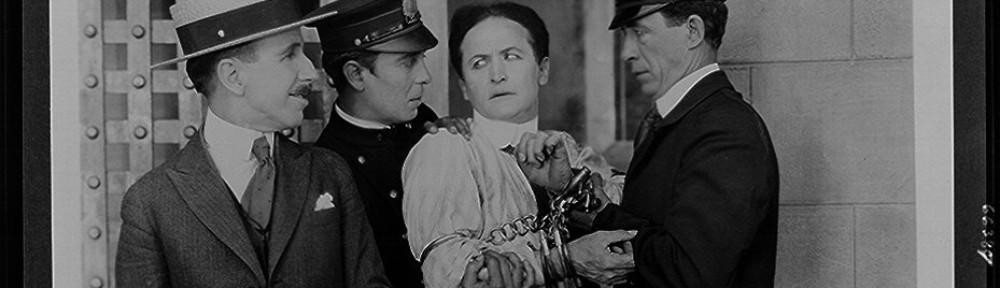
The Amazing Exploits of Houdini – The Jewel Thieves

During my visit to the McCord Museum, I was fortunate enough to have read a compilation (April 24, 1920 v1 n1 to June 5th 1920 v1 n7) of “The Amazing Exploits of Houdini” found in The Kinema Comic.

  1. The Bride & The Orangutan.
  2. The Jewel Thieves.
  3. “Stop Thief!
  4. The Gold Melters.
  5. Adventure of the Midland Express.
  6. In The Dead of Night.
  7. Out of The Sky.

Each issue contains a several page serialized fictional story (by-lined by Houdini). This week I share my paraphrased version of “The Jewel Thieves” found in the May 1 1920 v1 n2 issue:

Houdini is sleeping in a hotel room on the seventh floor. When he stays in a hotel with a telephone in the bedroom, he makes it a point of screwing off the bell before retiring, thinking that the shock of ringing will not be so great. On this night, the sound of the vibrating hammer was more terrifying than any bell would be.

Houdini answered the phone and was told that the hotel was on fire and he needed to leave his room at once and make his way outside by the back staircase, since the main staircase was ablaze and impossible.

Half asleep, Houdini jumped out bed, and dashed out the door toward the back staircase used by the servants. To make his way down the pitch-dark stairs, he had to feel his direction with his hands on the wall. Suddenly, Houdini received a blow on the back of his head from some hard instrument, dropped to the ground, and was hurriedly searched, but nothing was found.

Houdini was awakened by the corner of a door pushing into his ribs. A man with no shoes on dashed across to a window, opened it, and disappeared.

Houdini slowly rose to his feet, crashed through some swinging doors and on to the floor of one of the hotel corridors. He had a splitting headache and didn’t remember that the building was on fire.

Rising to his feet again, Houdini staggered forward perhaps a dozen yards, when a door opened and a man whose face was drenched in blood from a cut on his forehead, yelled that “They’ve bagged the lot. Taken every dashed thing.”

Houdini asked what happened?

Thieves broke into his room, hit him on the head and stole his diamonds.

Houdini told the man he got hit on the head also and that he should telephone the cops.

Houdini staggered towards the man’s room and threw himself on his bed.

The police were sent for. Slowly recuperating and trying to gather his scattered and wounded wits together, Houdini was able to reconstruct the adventures of the night. Houdini remembered the alarm of fire sent over the telephone, his scramble down the back stairs, then being hit on the back of the head by some unknown assailant. Then it dawned on him, that the thieves somehow called him up on the telephone instead of their victim, their purpose evidently being to decoy the man from his room whilst they robbed him of his jewels.

Houdini rose from the bed and pushed his way past the hotel servants who were attending to the victim of the robbery. Houdini made his way through the door of the room which the man had climbed was situated. It was still open.

The window gave on to a lower roof of an adjoining building. The drop from this window to the roof would be about eight feet. Houdini curiosity was aroused, and despite his aching head he decided to investigate.

Just beneath Houdini, on the top floor of the building, he could see a lighted window. There was no reason for a lighted room at that time. Almost before the resolution was made, Houdini’s leg was over the parapet; a drainpipe ran down the front of the building, Houdini tested its strength. It appeared to be safe enough. Houdini risked it, and clinging almost like a fly, slipped down the sill of the window.

Only a corner of the room was visible, but a side of a table was in view. At this table, he could see one hatted man removing precious stones from their settings.

Suddenly, without the slightest warning, the spring of the blind was released. Houdini discovered there were three men in it, the one at the table, another one at the other side of the table, and the one who by letting up the blind had exposed Houdini.

The man nearest the window moved towards Houdini and raised the sash. As Houdini waited his fate, he felt a strong hand grip his ankle and then another took hold of his other ankle.

Houdini was dragged into the room and bound hand and foot. Houdini smiled!

Houdini’s back against the wall, freed his hands; Tied behind him, it was quite a simple matter to hide his actions from view of the men.  Then, working very gingerly, got his feet loose, undetected.

Houdini reached for a revolver from his hip pocket and covered the three men.

Houdini ordered the men into the corner of the room. When they were safely in the corner, Houdini picked up one of the instruments which they had been using and threw it through the window.

Down below in the street, you could hear pattering of feet, and then the shrill blast of a policeman’s whistle.

Within five minutes, three policemen, hammered their way into the room where Houdini held the men prisoners.  All facts were so conclusive. The jewels on the table were sufficient to condemn the men.

Of course, Houdini was thanked by the victim of the robbery. “You must have been called up on the telephone instead of me.” he said. “As a matter of fact, I occupied your room on the previous evening.”

Under Water Escape Photo(s) connected to Terror Island?

The photo below is from my personal copy of the January 5th, 1921 issue of Boys Cinema. It shows Houdini about to be thrown into the water bound hand and foot.

Many of you may recall seeing this “Under Water Escape” image in “Houdini on Magic” by Walter B. Gibson:

It also appears in the Strand Magazine “Houdini the Enigma” by A. Conan Doyle:

But it first appeared in “Magical Rope Ties & Escapes” by Houdini in 1920:

Although, the Boys Cinema photo incorrectly identifies it as an incident in the Paramount Film, “Terror Island”, I believe it, along with Houdini’s dyed black hair for the movies helps support that it was taken during the making of Terror Island in 1919 for inclusion in his 1920 book Magical Rope Ties & Escapes.

Could it have been taken in Elliotta Springs while he was doing his underwater stunts for “Terror Island”?

Or was it taken at Lasky Studio, where we know Houdini did a series of photos with actors Thomas Meighan and Jack Pickford for the 1920 book, Magical Rope Ties & Escapes?

Regardless, comparing photo(s) with all of the stills from Houdini’s two Hollywood movies, “The Grim Game” and “Terror Island”, I believe that is Houdini’s Hollywood hair from “Terror Island”.

Thoughts on when and where under water escape was filmed?

What really happened on October 24th, 1926 between the train arriving and the show in Detroit?

What really happened on October 24th, 1926 between the train arriving and the show in Detroit?

Let’s see what the biographers have to say.

According to Williams & Epstein [1951]:

he took his scheduled train that evening, to Detroit. The doctor’s summoned to meet him at the station in the morning diagnosed appendicitis and ordered an immediate operation, but Houdini insisted that he must appear in the theater that evening. When he walked out on the stage he had a temperature of 104 degrees.

According to Gresham [1959]:

Urged by Bess, Collins sent a wire ahead of them from the train. When they pulled into Detroit, they were met by a doctor. Houdini’s temperature was one hundred and two degrees.

He scorned going to a hospital. But when they got to the hotel he crawled into bed and had Bess pile blankets on him. His chill, which shook the bed, lasted a half hour.

In spite of his loud refusals, Bess sent for a committee of doctors. They were unanimous—Houdini had appendicitis and needed an operation at once. Bess wept and argued all day when Houdini was not dozing uneasily. When curtain time approached he asked for news from the box office. The report came back, “Sold out. Not a vacant seat in the house.” That settled it, “Help me up. They’ve paid their money to see Houdini. “By God, they’re going to get a show.” His temperature was now one hundred and four.

According to Kendall [1960]:

“You can’t take that train to Detroit tonight,” Bess insisted, “show or no show”. He was scheduled to appear in Detroit the next evening.

“A train ride won’t hurt me. I always do my best thinking on trains.”

Stubbornly, he had his way. But as the train clacked onward across the autumn-colored landscape, all thought was driven from him. He was conscious of only one thing, pain driving through him with every turn of the iron wheels on the rails. At last he was forced to give in to the pleas of the nurse and Bess that a wire be sent asking a doctor to meet the train at the station in the morning.

The doctor was there. As soon as Houdini could be gotten to a hotel, the doctor his temperature and examined him. The thermometer measured 102 degrees. Then a severe chill gripped him and he lay shaking for almost a half hour. Other physicians hurried to his bedside.

“Your symptoms indicate acute appendicitis,” one of them told the shivering and sweating magician. You must be operated on at once.”

Houdini clenched his teeth and asked Bess, “How many tickets have been sold for the show tonight?

“All of them, someone else spoke up. “A full house.” “I’ll go through with my act,” Houdini said.

That evening when he walked out onto the stage his temperature was 104 degrees.

According to Christopher [1969]:

A telegram was hurriedly dispatched to George H. Atkinson, the show’s advance man in Detroit, when the train made a brief stop at London, Ontario. He was instructed to have the best doctor in the city ready to give Houdini a thorough examination before the opening, Nurse Rosenblatt took Houdini’s temperature, it was 102 degrees.

The Montreal train arrived late. Collins doubted they could track the equipment to the theater, hang scenery, and get the magical apparatus uncrated and assemble before curtain time. Rather than check in at their hotels, the entire company went directly to the theater. There was no doctor waiting at the Garrick despite the urgent wire. Houdini pitched in and helped stagehands and his assistants set up the heavy gear.

Dr. Leo Dretzka and the show’s advance man paced the lobby at the Statler Hotel. The doctor had to leave for a medical convention that night, but he had promised to examine the ailing escape artist first. After asking a dozen times at the desk if Houdini had checked in, Atkinson finally phoned the theater.

There was no cot in Harry’s dressing room at the Garrick. He stripped off his clothes and stretched out on the floor. Dr. Dretzka knelt and touched the inflamed stomach. Bess didn’t hear the doctor say that an ambulance should be called immediately, that Houdini was suffering from acute appendicitis. Had she known the danger her husband was in, there would have been no performance that night.

Harry dressed for the show. The theater manager had stopped to say the house was sold out and standees were lined outside to get in. “They’re here to see me,” Harry explained as the worried doctor rushed away to make his train. “I won’t disappoint them.”

According to Fitzsimons [1981]:

After the show the company boarded the train for Detroit, where they were booked for a two-week run. When the train started, the pain was so intense that he could hide it no longer. He told Bess about the blows to his stomach. Nurse Rosenblatt took his temperature and it to be 102 degrees.

The train was scheduled to stop at London, Ontario, and from there a telegram was dispatched to the show’s advance man in Detroit, instructing him to have a doctor waiting. When Houdini arrived the doctor examined him. He diagnosed acute appendicitis and ordered an ambulance to be called immediately. But Houdini refused to go into hospital right away. The theatre was sold out and he would not disappoint the audience.

According to Brandon [1993]:

Houdini closed in Montreal that Saturday, 23 October, and was due to open in Detroit the following day for a two-week run. On the train he was no longer able to conceal his suffering. Bess, distraught, and barely recovered from her own illness, telegraphed ahead to the show’s Detroit advance man instructing him to get the best doctor in Detroit ready to examine Houdini before the opening.

The train was late – too late for them to check in at the hotel before leaving for the theatre. The doctor was waiting, meanwhile, in the hotel lobby. Finally the advance man, waiting with the doctor, thought to telephone the theatre. The doctor rushed round and examined Houdini on the dressing room floor, there being nowhere else he could lie down. He diagnosed acute appendicitis and said an ambulance should be called at once to take Houdini to hospital. Bess did not hear this, and Houdini did not tell her. Nor did the theatre manager, who was present during the examination. He had his own worries. The house was sold out and queries were still waiting outside the theatre. He said, “We have a $15,000 advance sale. What are we going to do? to which Houdini replied, “I’ll do this show if its my last”.

He was now running a temperature of 104 degrees.

According to Silverman [1996]:

Scheduled to open in Detroit the next evening, he, Bess, and their entourage got to the train late that night. Once on board he experienced such severe stomach pains that a wire was sent ahead asking for a physician to meet the train at the Detroit station in the morning.

Houdini arrived in Detroit with a temperature of 102. After examining him hurriedly, a physician found signs of appendicitis. Houdini nevertheless checked into the Statler Hotel, where for a half hour he shook with chills. He was determined to give his opening night show, even though at curtain time his temperature had risen to 104.

According to Kalush [2006]:

After Saturday’s evening show, the troupe prepared to take an overnight train to Detroit, where they were scheduled to open their run on Sunday night.

The opening night sold-out crowd at the Garrick Theater in Detroit was getting antsy Houdini’s show was scheduled to start at eight-thirty, but after a short announcement that there was a delay due to the late arrival of personnel and equipment from Toronto, it was almost nine and there was still no sign of the mystifier. Suddenly, the familiar strains of “Pomp and Circumstance” echoed through the theater and Houdini walked onstage.

“We have just made a thousand-mile journey from Montreal, and we are tired,” he exaggerated, as he began to perform magic.

A doctor had examined him before the show and had urged him to the hospital immediately, but Houdini had refused. “They’re here to see Houdini,” he spoke of the sold-out house. “I won’t disappoint them.”

So what is the source for these different versions.  It appears, Williams & Epstein, Gresham, Kendall, and Silverman’s source was Kellock [1928] and the New York Times, 1 Nov 1926.

According to Kellock [1928]:

He had to make a train for Detroit, where the show was due to open the next evening.

Houdini was so ill on the train that his attendants wired for a physician to meet him at the station in the morning. His temperature on arrival was 102. As soon as he reached his hotel in Detroit he had a chill which lasted twenty-five minutes. Several physicians, who had been called insisted that he cancel his performance. They said that his symptoms indicated appendicitis, and an immediate operation was imperative.  Houdini, informed that the house was sold out, doggedly declared that he must go on. Just before the curtain went up his temperature was taken at 104.

According to NYT:

He suffered no distress at the time but after he had boarded a train for Detroit, he complained of pain. At first he attributed it to something he had eaten but as it increased he called in the company’s nurse, who in turn arranged by wire to have a physician meet the magician in Detroit.

Dr. Leo Kretzka, a prominent physician, made a hurried examination and told the patient there were symptoms of appendicitis. He left it to Houdini to decide whether it would be advisable for him to appear that evening at the Garrick Theatre for the opening night of the show. Houdini would not disappoint his admirers.

Fitzsimons, Brandon’s and Kalush source was Christopher, although neither mention a Dr. Dretzka. And Christopher’s source was the Conjurer’s Magazine May 1948 article, The Last Man to see Houdini Alive, by Bruce Reynolds:

George Atkinson, Dean of Theatrical Press Agents, told me the story one evening in the Lambs Club in New York City. “Then the fateful day when I was in Detroit where Houdini was to play next. I received a wire from his manager who was in Montreal, that ‘The Great Man’ had suddenly been stricken ill and that I was to have a doctor meet the train upon his arrival.  He was due in Detroit on Sunday afternoon and was scheduled to give a performance that night. I had a doctor waiting at the hotel but Houdini did not come to the hotel; instead he went directly to the theatre, and there in grave alarm I found him running hither and thither, anxious about his props. I quickly phoned the doctor back at the hotel. The doctor rushed to the theatre and found Houdini sitting on a packing case, with his funny little hat pulled down over his eyes. His temperature was 103. The doctor hurried him into his dressing room, laid him on the floor and made an examination. ‘Appendicitis,’ the doctor said. He ordered Houdini to his hotel and to bed. Cold compresses were to be administered at regular intervals. Houdini scoffed at the doctor’s orders. Defiantly, he went on about arranging his props and he gave a show that night.”

So did a physician see Houdini on the train, the floor of the dressing room at the Garrick Theatre, or at the Statler Hotel? Did Houdini go to the Statler Hotel before going to the Garrick Theatre, or did he go directly to the Theatre?  I tend to believe the following:

According to Sophie Rosenblatt’s (nurse) affidavit [Feb 15th, 1927]:

He had to leave Montreal that night for Detroit and on the way to the railroad station and at the station itself, he was very sick and constantly complained of pains in his stomach. I took him in a restaurant to get a cup of hot boiled water and took a bottle of black coffee for him on the train. He was unable to sleep all that night after leaving Montreal and constantly stated that he had pains in his stomach.

The following morning I took his pulse and told Mrs. Houdini that her husband was a very sick man. I asked Mr. Stuckel, his manager, to have a physician meet the train at Detroit as I realized that Houdini was very ill and was getting worse ever since the blows were struck in his dressing room. Dr. Leo Dretzka of Detroit was the physician who first saw him in Detroit. His temperature was 102, his pulse from 120 to 128 and his respiration 46. At the hotel in Detroit where he went upon leaving the train, he had severe a severe chill which lasted for about twenty-five minutes. At that time his temperature was 103.6, his pulse was 130 and his respiration 48. We then called Dr. Richards, the hotel doctor, who saw Houdini at about 6:30 in the afternoon and prescribed pills for Houdini to take every half hour for his pulse and respiration. He went to the theatre to give his evening performance. He was practically helpless and was unable to dress himself for the performance. We took him to the theatre and he was in bad shape throughout the performance. It seemed that he was unable to open his eyes while he was putting on his make-up for the performance. After each act he literally fell down almost helpless and dragged himself on the stage again. After the performance he was carried to the hotel and his condition was reported to Dr. Richards who was then out of town. Dr. Richards recommended Dr. Cohn and Dr. Cohn called on Dr. Owen who took a blood count. It was then decided to call in Dr. Watkins and Dr. Kennedy, distinguished surgeons of Detroit, to examine Houdini. He was taken from the hotel to the Grace Hospital in an ambulance and an operation was decided upon.

I suppose its also possibly that Houdini went to the theatre first, saw Dr. Dretzka, who ordered him to his hotel where he saw Dr. Richards and then returned to the theatre to perform.

What do you believe?

Related:

100 Year Anniversary – Private Showing of The Grim Game In New York

MUM-New-York-August-1919-page-17

One Hundred Years ago, Houdini gave a private showing in NYC.

The following passage is excerpted verbatim, even to the punctuation from a private letter WRT to a private showing of The Grim Game on August 18th, 1919:

Monday night 8 o’clock shapr [sic] there will be a private show of my latest picture The Grim Game which will be shown only to a few chosen magic friends before the regular trade showing and if you have desire to see same would like to have pleasure of having you attend.  Takes place at the production room of Lasky Famous Players offices, 400 [485] Fifth Ave near 42nd St. Monday August 17th [Note: Monday was really August 18th] Tried to get you twice on phone and no answer. Regards sincerely yours Houdini. [The Houdini Code Mystery by William V. Rauscher, page 106]

Note:  Koval places the private showing at 485 Fifth Avenue, which was the address of the corporate main office right across from the New York Public Library.

Aug 18 – A private showing of “The Grim Game” is given to Houdini’s chosen friends at the Lasky Famous Players Offices at 485 Fifth Avenue, New York City.

The Society of American Magicians officially endorsed The Grim Game at this private showing:

The endorsement was given at a private showing of the picture for the members of the society in New York, which was attended by Messrs. Houdini, Howard Thurston, Francis E. Werner, G.G. Laurenz, Hardeen, William J. Hilliar and about forty others.

After the showing,  Mr. Howard Thurston said: “I have always thought Houdini was a great showman, but I expected nothing like this.  It leaves nothing undone.  Houdini may now retire, confident that he has done his greatest work.  It is one of the most wonderful things I have ever seen”.  At the conclusion of Mr. Thurston’s speech, Oscar S. Teale, Secretary of the S.A.M. said:

“Gentlemen, I move that the Society of American Magicians pronounce the picture a glowing success, worthy of highest commendation, and that it go forth as officially endorsed by this society.”

[The Sphinx, September 1919]

Bonus:

According to a 17 September 1919 New York Clipper article, the Famous Players also had New York City offices at 428 Fifth avenue, 729 Seventh avenue and at 469 Fifth avenue, but at the termination of the leases, the company will use the entire front of the Putman Building [at Forty-Third street and Broadway] for its offices:

NY Clipper 17 Sep 1919 Putnam Bldg To Become Theatre

Next week:

  • 100 Year Anniversary – B.S. Moss Broadway Theatre Screening


100 Year Anniversary – M U M SAM Monthly

This month marks the 100 Year Anniversary of the Society of American Magicians endorsing The Grim Game. To celebrate, thought I would share some interesting things from my personal copy of the Magic—Unity—Might M U M The Society of Americans Magicians Monthly Vol 9 No. 3 New York August 1919.

The first is a photo of Dean Kellar, Wizard of Wizards, Irvin W. Willat, Wizard of the Camera, who directed “The Grim Game”, and Houdini, Wizard of Escape. This picture was taken while Dean Kellar was visiting the studio during the picturization of the great story.

Second, Houdini shares new light on the bullet catching trick:

Third, is a highly sought after four-page color insert:

And last, is an exchange between a Mr. Levett and Houdini regarding Robert Heller and Laura Keene:


Escape From a Nailed Packing Box – Advertising Calendar

Back in 2017, five of the six 1977 Stuart Pharmaceutical calendars from the series numbered DM-73301 to DM-73306 were shared:

  1. June: Escape from Prison when Manacled in Handcuff and Irons (HHCE Collection)
  2. July: The Celebrated Straitjacket Release (HHCE Collection)
  3. August: The Challenging Release From Wet Sheets (John Cox Collection)
  4. September: The Perilous Escape From the Spanish Maiden (HHCE Collection)
  5. October: The Spectacular Release From the Cannon (HHCE Collection)

Each featured Spectacular Houdini Feats and original artwork by James Barkly. At the time, we didn’t know what the number 6 (DM-73306) calendar was, but we do now.

It is for the The Daring Underwater Escape from a Nailed Packing Box and covers the month of November and December.
Stuart Pharmaceutical’s also created six 1978 Houdini calendars, of which five ot them I will be sharing at later dates; the September/October 1978 calendar still alludes me.

White Studio Houdini Movie Photos

The following two White Studio, NY “Houdini Movie Photos” advertised as “originals”  from an estate of magic and circus collection sold yesterday on eBay.

  • Original Houdini Magic Studio Photo #1 ($371.00 + $8.95 shipping):

Note: This is from Terror Island

  • Original Houdini Magic Studio Photo #2 ($515.09 + $8.95 shipping):

Note: This is from The Grim Game

The following White Studio photo below shows the above two White Studio photos (2 Terror Island, 8 Grim Game) plus other White Studio photographs from his movies (1 The Grim Game, 5 Haldane, 6 The Man From Beyond, 9-11 Master Mystery)

Note: This photo is courtesy of The New York Public Library for the Performing Arts, Billy Rose Theatre collection. It was also part of the Houdini Art and Magic exhibition/book.

Houdini items of Interest at Haversat & Ewing Auction

There were two Houdini items (Lot #260 and Lot#267) that I had my eye in in the July 12-13 Haversat & Ewing Howie Schwarzman Auction Part II.

Lot# 260 [Price Realized $1,925,00] :

Laurel Canyon, California. Bess Houdini writes in her hand: My home on Lookout Mountain, Laurel Canyon, Hollywood, Calif. Very rare! [Estimate $125-150]

Note: This is also the home that Houdini may have stayed in when he came to California in 1919 to film, The Grim Game.

Lot #267 [Price Realized $460.00]:

Small scrapbook with clipping mostly pertaining to Houdini. Other articles on Blackstone and Kellar. two dozen pages along with many additional blank pages.

[Estimate $80-100]

Note: The scrapbook contains an original 1925 Parson’s Theatre Program

I am not surprised that both items went for way more than their estimate.

Congratulations to winner(s).

Related: